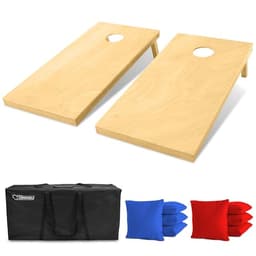
The published specs
Side by side
| Cornhole | Ladder toss | |
|---|---|---|
| Throw distance | 27 ft between board fronts | 15 ft toss line |
| Total footprint | About 33 x 10 ft (330 sq ft) | About 20 x 8 ft (160 sq ft) |
| Players | 2 or 4 | 2 or 4 |
| Scoring | 3 in the hole, 1 on the board, cancellation | 3 top rung, 2 middle, 1 bottom |
| Winning score | At least 21 at the end of a round | Exactly 21 |
| Published set weight | 38 to 46 lb | Not published |
| Packs to | Two 4-ft boards plus a case | A frame plus a nylon case |
| Wind | Unaffected | Frames blow over |
| Governing body | American Cornhole League | No single governing body |
| Equipment standardization | High — bags and boards interchange | Low — bola mass varies by maker |
The case for
Why cornhole is the better game, when it fits
Two things put cornhole ahead, and neither is tradition.
The specification. The American Cornhole League publishes board size, hole size and position, both board heights, board weight, court distance, pitcher's box, bag size, bag weight and bag thickness. Nothing else on this site is documented that precisely except horseshoes. It means a set that says regulation is making a checkable claim.
The strategic layer. Cornhole at a decent level is not about getting bags in the hole; it is about putting a blocker in front of the hole and then pushing it in. That is why dual-speed bags exist. Ladder toss has no equivalent — a bola either wraps or it does not.
The case for
Why ladder toss is not a consolation prize
The footprint. 160 square feet against 330. That is the difference between a game you can set up and one you cannot, and it is the whole reason this page exists.
The finish. Ladder toss requires exactly 21. Cornhole requires at least 21 at the end of a round with no mandatory margin. The exact-21 rule produces a much better endgame: a player on 20 needing a single bottom-rung wrap while their opponent needs three is genuinely tense, and it happens constantly.
The carry. A frame and six bolas in a nylon case, against 38 to 46 published pounds of plywood.
Its one real weakness is wind: a wooden ladder frame is a sail with a small base and nothing to anchor it. See ladder toss.
Practical
If you are buying your first yard game
Pace out your longest clear line heel to toe. An adult pace is roughly two and a half feet, so fourteen paces is about 35 feet — enough for cornhole with a little to spare. Under twelve paces and cornhole will not fit properly.
Full footprint table for everything else: how much space do yard games need. If your run is short, the wider shortlist is in games for small yards.
The other side
Where to buy the other one
The card at the top of this page covers one side of the comparison. This is our current pick for the other, ranked on published specifications rather than on play we have not done.

Best overall
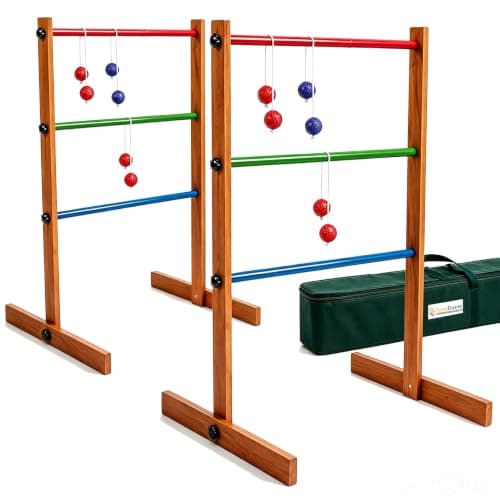
Yard Games Ladder Toss (Double Wooden Ladder Ball)
Yard Games
A finished wood frame with real golf-ball bolas and a nylon case — the version that does not rattle apart the way tube-and-plastic ladder sets do.
Skip this if
Skip this if you need the set to stand up in wind. A wooden ladder frame has a big sail area and no ground stakes.
Price as of October 19, 2026. #ad How we make money
FAQ
Questions people actually ask
Is cornhole or ladder toss better?
How much space does each need?
Which is easier to carry?
Why you can check our work
We have not played these. Every figure above is copied from a manufacturer's published listing or a governing body's published rules, and named so you can verify it. Where a maker publishes nothing, the field is blank rather than filled in. How we pick explains the whole method, including what would change a recommendation.
Read next
Related pages

Picks
Compare yard games
Twenty-one head-to-heads with the verdict first and the published specs behind it.
Picks
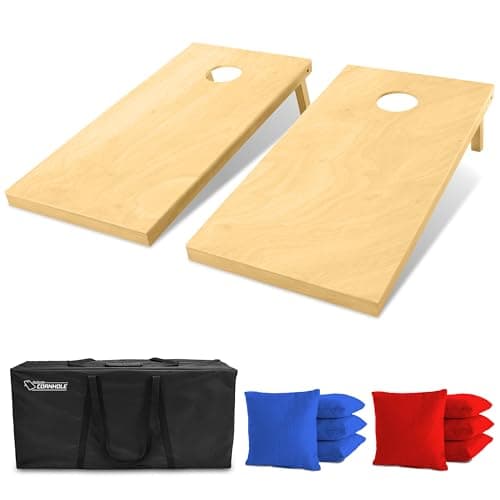
Best cornhole boards
Five regulation sets ranked on published surface thickness, frame construction, weight and bags.
Picks
Ladder toss
Roughly 20 by 8 feet, a 15-foot toss line and exactly 21 to win — the game for yards cornhole cannot fit.
Picks
Best yard games for small yards
Five games that fit under 30 feet of clear run, with published footprints for each.
Picks
Best yard games for a backyard cookout
Five games that survive a cookout — fast setup, one-handed play, easy to abandon and rejoin.

Guide
How much space do yard games need?
Every game's published footprint, longest run and player count in one sourced table.
Sources
- American Cornhole League — rules and regulations
- Ladder golf official rules (FCRV)
- GoSports — solid wood premium cornhole set
Every figure on this page is copied from one of these sources. If you find one that is wrong or out of date, tell us and we will fix it.