This is the question every yard-game purchase actually turns on, and we could not find anybody publishing the answer across games. So we compiled it: every game we cover, its footprint, and where the number came from.
Where a sport has a governing body, the figure is that body's published court dimension plus the standing room the format requires. Where it does not, it is derived from the manufacturer's published equipment dimensions and stated explicitly as derived. Nothing here is a guess.
The table
Every game, smallest first
| Game | Footprint | Area | Longest run | Players | Source of the figure |
|---|---|---|---|---|---|
| Giant 4 in a row | About 6 x 6 ft | 36 sq ft | 6 ft | 2 | Derived from published 33 x 22 in overall size |
| Giant yard dice | About 8 x 8 ft | 64 sq ft | 8 ft | 2+ | Derived from published 3.5 in die size |
| Giant stacking tower | About 10 x 10 ft | 100 sq ft | 10 ft | 2+ | Derived from published 5 ft max height |
| Ladder toss | About 20 x 8 ft | 160 sq ft | 20 ft | 2 or 4 | Commonly published 15 ft toss line |
| Molkky | About 20 x 13 ft | 260 sq ft | 20 ft | 2+ | IMO 3.5 m throwing distance |
| Cornhole | 33 x 10 ft | 330 sq ft | 33 ft | 2 or 4 | ACL 27 ft plus pitcher's boxes |
| Kubb | 26 x 16 ft | 430 sq ft | 26 ft | 2 to 12 | Kubb World Championship 5 x 8 m pitch |
| Badminton (casual) | About 30 x 15 ft | 450 sq ft | 30 ft | 2 or 4 | Derived from BWF court length |
| Horseshoes | About 48 x 10 ft | 480 sq ft | 48 ft | 2 or 4 | NHPA 40 ft plus pitching platforms |
| Bocce (backyard) | About 60 x 12 ft | 720 sq ft | 60 ft | 2 to 4 | Commonly published recreational court |
| Badminton (full doubles) | 44 x 20 ft | 880 sq ft | 44 ft | 2 or 4 | BWF published court |
| Spikeball | About 30 x 30 ft | 900 sq ft | 30 ft | 4 | Derived — 15 ft service circle, no boundary in the rules |
| Bocce (USBF regulation) | 86.92 x 13.12 ft | 1,140 sq ft | 87 ft | 2 to 4 | USBF published court |
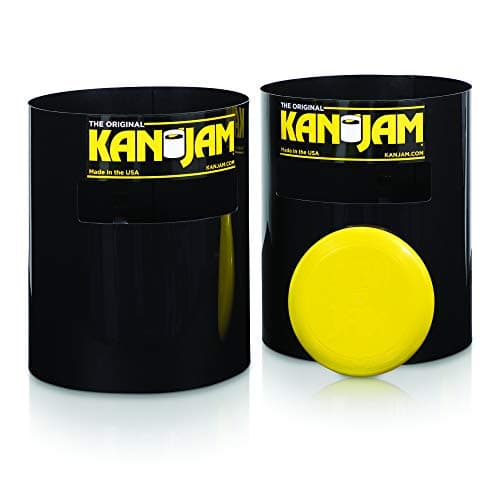
| Kan Jam | About 60 x 20 ft | 1,200 sq ft | 60 ft | 4 | Manufacturer 50 ft plus deflection room |
| Croquet (nine-wicket) | 100 x 50 ft | 5,000 sq ft | 100 ft | Up to 6 | USCA published full court |
Reading the table
What each threshold unlocks
Under 20 feet of clear run
You are in giant-game territory only: 4 in a row, yard dice and a small stacking tower. All three need hard, level ground rather than lawn, which suits a patio. See patios and balconies.
20 to 30 feet
Ladder toss and Molkky open up, and both have the exact-score endgames that make them punch above their footprint. This is the sweet spot most small yards land in — see games for small yards.
33 feet
Cornhole. This is the single most important line on the table, because cornhole is what most people buy first and 33 feet is what it needs. Below it, buy something else rather than shortening it — the argument is in regulation vs tailgate size.
30 feet in every direction
Note that this is a different requirement from 30 feet of length. Spikeball plays outward from the net with no boundary in the rules, so it needs an open area rather than a corridor.
60 feet and up
Kan Jam, full-size bocce, horseshoes and — at 100 feet — croquet. See games for big lawns.
Shrinking a court
Which games resize honestly
| Game | Resizes? | Why |
|---|---|---|
| Croquet | Yes — explicitly | The USCA says to adjust size and shape to the space available |
| Bocce | Yes | Backyard courts are a published convention; indoor courts go to 22 x 6 ft |
| Badminton | Yes | A shortened court keeps the width and loses run-back |
| Ladder toss | Somewhat | Shortening the toss line makes it easier but does not break it |
| Cornhole | Poorly | 27 ft is the skill being tested; a short court has a proportionally larger hole |
| Kubb | Poorly | Baton throwing distance is the core skill |
| Horseshoes | No | 40 ft is fixed; the rules handicap by moving the foul line instead |
| Kan Jam | No | The deflection game depends on the disc arriving at speed |
Horseshoes is the interesting case. The NHPA does not shrink the court — it keeps the 40-foot stake distance and moves the foul line instead, to 27 feet for women, youth through 18, and men 70 and over. That is a better model than shrinking a court, and it transfers to any game here where players have different strengths.
Method
How we calculated the derived figures
Four of the footprints above are marked derived rather than published, and here is exactly how each was reached:
- Giant games — the constraint is the fall or roll radius, not the base. A published 5-foot tower height gives roughly 10 by 10 feet of clear space, because a tower that tall throws blocks well beyond its footprint.
- Spikeball — the published geometry is a 3-foot net and a 15-foot service circle, and the rules contain no boundary at all. Thirty feet square is the honest working figure for a game that will not constantly stop.
- Cornhole and horseshoes — governing-body court distance plus the published throwing area at each end.
- Kan Jam — the published 50 feet between goals plus room behind each goal for the deflecting player.
If you think any of these is wrong, we would genuinely like to know — tell us and we will re-check it against the source. Our method is public for exactly this reason.
What we would buy
The gear behind this guide
The sets whose published specifications this page is built on. Ranked on spec completeness and footprint clarity, not on testing we have not done.

Best overall
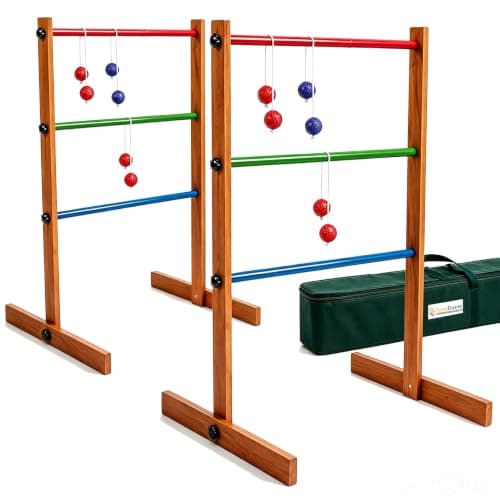
Yard Games Ladder Toss (Double Wooden Ladder Ball)
Yard Games
A finished wood frame with real golf-ball bolas and a nylon case — the version that does not rattle apart the way tube-and-plastic ladder sets do.
Skip this if
Skip this if you need the set to stand up in wind. A wooden ladder frame has a big sail area and no ground stakes.
Price as of October 19, 2026. #ad How we make money

Best overall
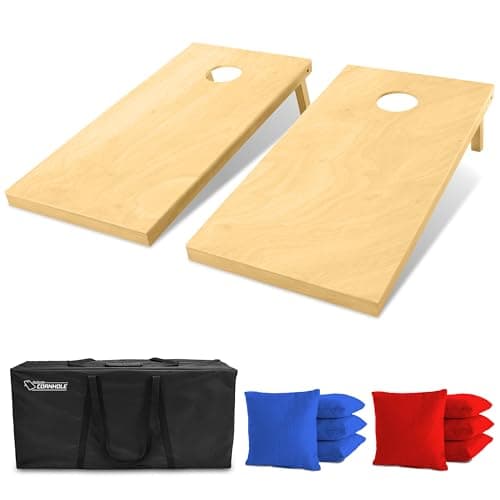
GoSports 4 ft x 2 ft Solid Wood Premium Cornhole Set
GoSports
Regulation 4 x 2 ft boards on solid pine frames with a 1/2 in cabinet-grade plywood top, eight 16 oz all-weather bags and a case — the complete tournament-legal setup in one box.
Skip this if
Skip this if your yard is under 30 ft long. A regulation court is 27 ft board-front to board-front plus throwing room behind each board, and there is no shortening it without changing the game.
Price as of October 19, 2026. #ad How we make money
Best overall
Yard Games Kubb Premium Size Set
Yard Games
Hardwood kubb with a case, printed instructions and — the part that matters — boundary markers, so the 5 x 8 m pitch is set correctly the first time.
Skip this if
Skip this if your only space is 20 ft long. The pitch is 8 m end to end and shortening it breaks the throwing distances the game is built on.
FAQ
Questions people actually ask
How much space does a cornhole set need?
What is the smallest yard game?
What is the biggest yard game?
Should I measure area or length?
Can you shrink a yard game court?
Why you can check our work
We have not played these. Every figure above is copied from a manufacturer's published listing or a governing body's published rules, and named so you can verify it. Where a maker publishes nothing, the field is blank rather than filled in. How we pick explains the whole method, including what would change a recommendation.
Read next
Related pages
Picks
Yard game guides
Rules, regulation dimensions, materials and storage — sourced from governing bodies and makers.
Picks
Yard games by space
The footprint table, and ten collections filed by the space you actually have.
Picks
Best yard games for small yards
Five games that fit under 30 feet of clear run, with published footprints for each.
Picks
Best yard games for big lawns
The games that need 60 feet or more — and finally work when you have it.
Guide
Regulation cornhole dimensions
The complete ACL dimension table with tolerances, and the two measurements people misread.
Guide
Bocce court dimensions
USBF regulation, backyard and indoor court sizes — and how small a court can honestly get.
Sources
- American Cornhole League — rules and regulations
- United States Bocce Federation — open rules
- Kubb World Championship — rules (English)
- International Molkky Organisation — game rules
- NHPA — backyard horseshoe court
- United States Croquet Association — nine-wicket croquet
- Kan Jam — how to play
- Spikeball / roundnet published specifications
Every figure on this page is copied from one of these sources. If you find one that is wrong or out of date, tell us and we will fix it.