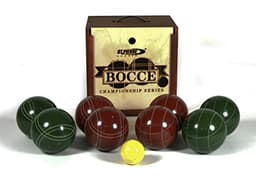
Every game in this family rewards placement rather than power. That sounds like a stylistic distinction and it is actually the most practical fact on this page: a game where the strongest arm wins is a game where half your guests stop trying after two rounds. Precision games stay competitive across a much wider range of players.
The four games here differ enormously in footprint, though. That is where the choice really gets made.
Choose on space first
The four games by footprint and crowd
| Game | Pitch | Footprint | Players | Wins at |
|---|---|---|---|---|
| Molkky | 3.5 m throwing distance | About 20 x 13 ft | 2+ | Exactly 50 |
| Kubb | 5 m x 8 m | About 26 x 16 ft | 2 to 12 | Felling the king last |
| Bocce (backyard) | About 60 x 12 ft | About 720 sq ft | 2 to 4 | Typically 7 to 13 points |
| Bocce (USBF regulation) | 86.92 x 13.12 ft | About 1,140 sq ft | 2 to 4 | Typically 12 or 16 |
| Croquet (USCA nine-wicket) | 100 x 50 ft | 5,000 sq ft | Up to 6 | All wickets and both stakes |
Note the range: Molkky to full croquet is a nineteen-fold difference in area. These are not interchangeable purchases, and “lawn game” as a category tells you almost nothing about whether a set will fit.
Bocce and croquet both resize honestly, which is worth knowing. The USCA explicitly allows adjusting the nine-wicket court to the space available, and backyard bocce is routinely played on a strip about 60 by 12 feet rather than the federation's 86.92 by 13.12. Kubb does not resize as gracefully: the throwing distances are the game, and shortening the pitch changes what a baton throw is worth.
Character
What each one is actually like
Bocce — the one everyone can play in ten seconds
Roll a small target ball, then roll your balls closer to it than the other team. That's the whole explanation. It works on grass, sand, gravel and dirt, it scales from two to four players, and the only real decision is ball size: 107 mm is the tournament diameter, 90 mm is the one a child can actually roll accurately. See best bocce ball sets.
Kubb — the crowd game
Throw batons underhand to knock over your opponent's blocks, then fell the king. The Kubb World Championship publishes every piece dimension, and the published player range of 2 to 12 makes it the only game we cover that genuinely absorbs a party. It needs 430 square feet, which is the price of that. See kubb sets.
Croquet — the one that needs a lawn, not a yard
Nine wickets, two stakes, up to six players, and the largest published footprint on this site. The USCA does allow you to shrink the court, and a shrunk court is a real game — but below about 40 feet the wickets stop being a challenge. See croquet sets.
Molkky — the one with the best scoring rule
Knock over numbered pins to reach exactly 50. Go over and you drop back to 25. That rule turns a comfortable lead into a genuinely awkward position, and it is the reason Molkky stays tense to the end more reliably than anything else here. See Molkky sets.
Cross-check
Fits your crowd
- Mixed ages — this family is the backbone of that list, and 90 mm bocce is its single best pick.
- Large groups — kubb, and after that croquet.
- Big lawns — croquet finally makes sense here.
- Beach and sand — bocce and kubb both play on sand; croquet does not.
Newly added
Lawn bowling joins this family
Ten wooden pins and a ball on short grass. Lawn bowling — sold as skittles or skittle ball — is the fourth rolling game here, and it is the most inclusive game on the whole site: its maker publishes an age floor of three years and up, which nothing else we cover does. Full page: best outdoor bowling set.
Bocce and croquet each gained a buying page too: lighted bocce ball sets, for the one real problem with bocce after sunset, and croquet set sizes, which explains why the player count on the box does not change the size of the court.
Newly added
Three pages for smaller players
The rolling games suit children better than any other family here, and three new pages cover that properly: croquet sets for kids, where mallet length is the whole decision; bocce sets for kids, which covers the soft-surfaced set you can play indoors and on a beach; and Molkky alternatives, for when the Finnish original is not the set in front of you.
Newly added
Petanque joins this family
Petanque is the boules game for yards bocce cannot use. Steel boules thrown from a fixed 50 cm circle onto gravel or hardpack, under FIPJP rules that fix the ball at 70.5 to 80 mm and 650 to 800 g: best petanque sets. Which of the two your ground suits is settled in bocce vs petanque, and petanque vs lawn bowling covers the choice for a mixed-age crowd. For the youngest players, the ten-pin sets are compared in lawn bowling sets for kids.
Newly added
Shuffleboard joins this family
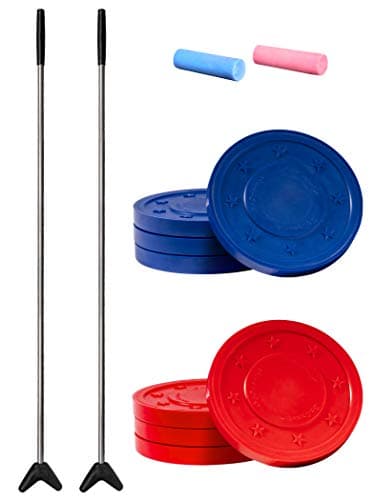
The one precision game here that cannot use a lawn at all. A shuffleboard disc slides rather than rolls, so grass stops it within a few feet — which makes a concrete driveway the correct home surface and the court, not the equipment, the real purchase. Published court sizes from a chalked driveway to a 28 foot roll-out court, against the International Shuffleboard Association's 6 by 39 foot playing surface: best outdoor shuffleboard set. It is also the most genuinely inclusive game on this site — a standing push with the cue taking the weight, no throwing and nothing overhead.
FAQ
Questions people actually ask
Which precision game is best for a large group?
Which one needs the least lawn?
Do precision games work on uneven grass?
Why you can check our work
We have not played these. Every figure above is copied from a manufacturer's published listing or a governing body's published rules, and named so you can verify it. Where a maker publishes nothing, the field is blank rather than filled in. How we pick explains the whole method, including what would change a recommendation.
Read next
Related pages
Picks
Best outdoor shuffleboard set
Driveway chalk sets, rollable courts and tournament discs — published court sizes against the ISA regulation surface.
Comparison
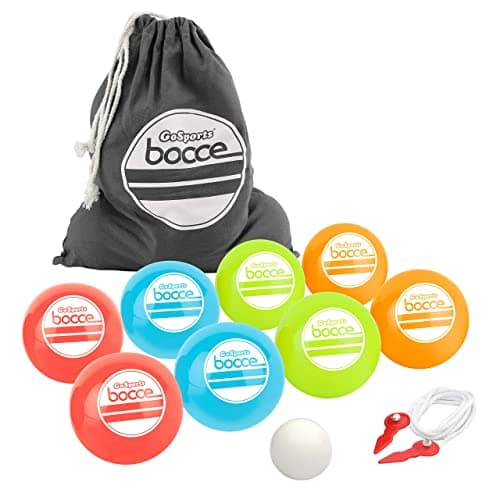
Best bocce ball set for kids
Soft or resin, both 90 mm — the published weights and the surfaces each one plays on.
Picks
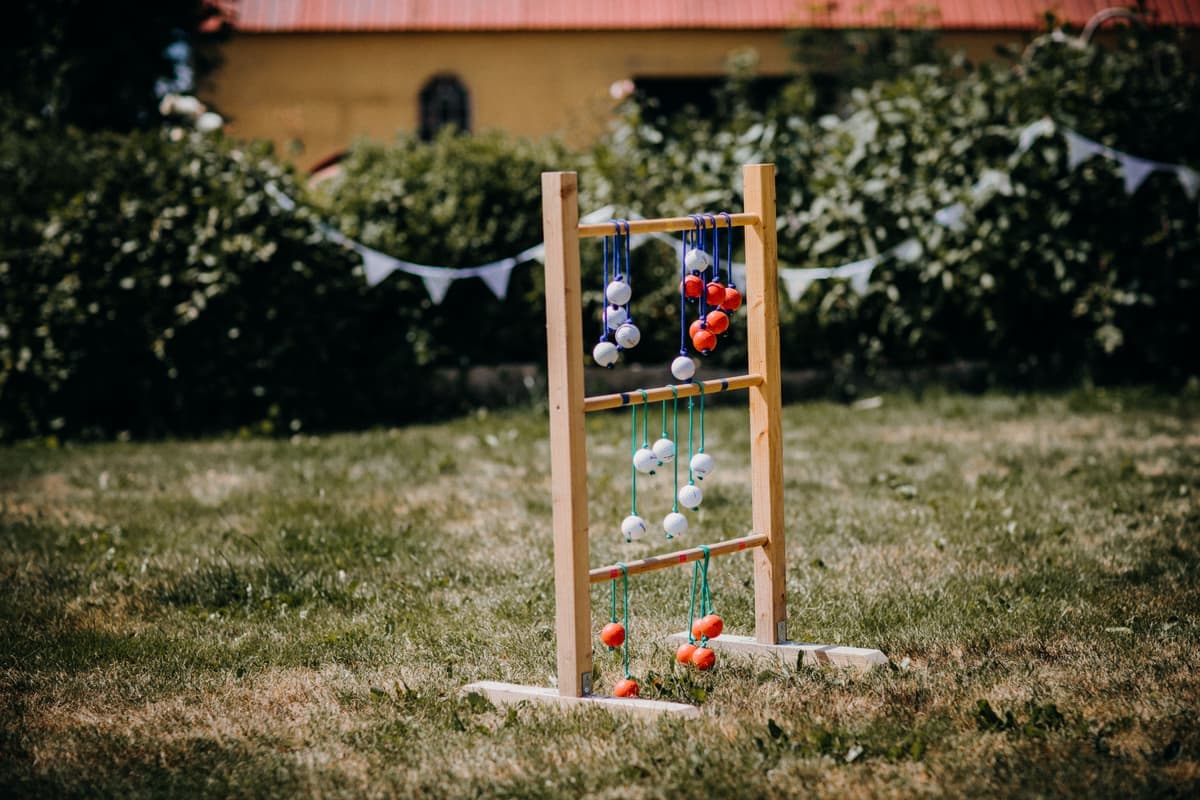
Best outdoor bowling set
Ten wooden pins, two balls, a published 7.75 lb and an age floor of three — the most inclusive game here.
Picks
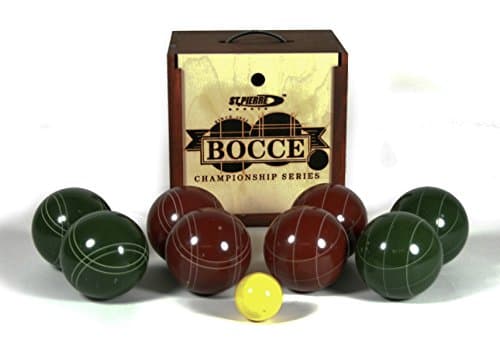
Best bocce ball sets
Six sets compared on published ball diameter, material and weight — including the size question nobody explains.
Picks
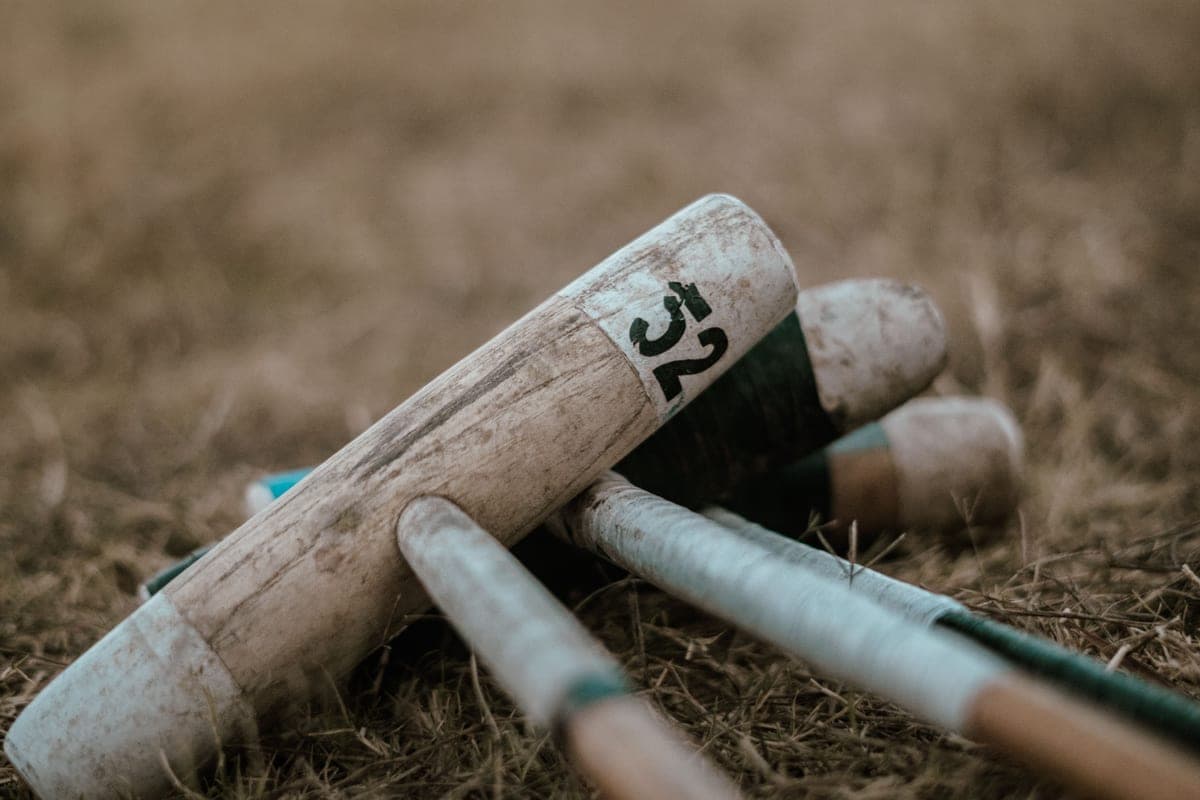
Best kubb sets
2 to 12 players on a 5 by 8 meter pitch — three hardwood sets compared on published piece dimensions.
Picks
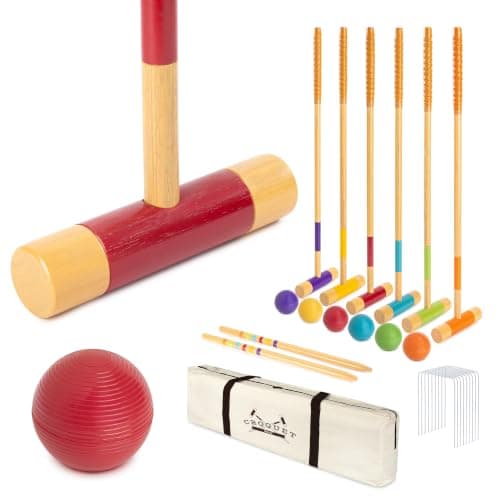
Croquet sets
Nine wickets, two stakes, up to six players — and the honest answer on how small a court can get.
Sources
- United States Bocce Federation — open rules
- Kubb World Championship — rules (English)
- United States Croquet Association — nine-wicket croquet
- International Molkky Organisation — game rules
Every figure on this page is copied from one of these sources. If you find one that is wrong or out of date, tell us and we will fix it.