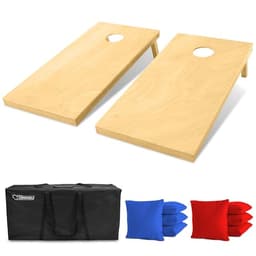
Toss games are the most yard-efficient family on this site, and the reason is geometry. A regulation cornhole court is 33 feet long and 10 feet wide. A Kan Jam court is about 60 by 20. Both are corridors. If your usable space is a strip down one side of the house or a driveway, a corridor game fits where an open-lawn game like croquet or Spikeball simply does not.
The other thing this family shares is that the throwing is underhand and the targets do not move. That makes these the easiest games to teach at a party — a first-time player gets a bag on the board within a couple of throws, which is a much lower barrier than any net game.
Pick by your longest run
The five games, side by side
| Game | Court | Players | Surface | Wins at |
|---|---|---|---|---|
| Cornhole | 27 ft between board fronts; about 33 x 10 ft total | 2 or 4 | Grass, hard, sand | 21 (cancellation) |
| Kan Jam | 50 ft between goals; about 60 x 20 ft total | 4 | Grass, hard, sand | Exactly 21 |
| Ladder toss | 15 ft toss line; about 20 x 8 ft total | 2 or 4 | Grass, hard | Exactly 21 |
| Washer toss | About 20 ft between boxes; about 26 x 6 ft total | 2 or 4 | Grass | 21 (no governing body) |
| Horseshoes | 40 ft between stakes; about 48 x 10 ft total | 2 or 4 | Clay or sand pit | Varies by format |
Washer toss is the newest page in this family and the odd one out. Every other game here has a governing body publishing dimensions — the ACL for cornhole, the NHPA for horseshoes. Washer pitching has none, so its figures are conventions that vary regionally rather than rules. It is also the shortest court in this family after ladder toss, which is the reason to care: washer toss.
Three of the four win at 21, which is not a coincidence — it is the shared inheritance of American backyard scoring. The differences are in how you get there. Cornhole uses cancellation scoring, where only the net difference in a round counts, so a round where both teams score well can move the total by one point. Kan Jam and ladder toss both require exactly 21, so overshooting is penalized. That single rule makes both games much longer and much more tense at the end than cornhole.
Honest steer
Cornhole is the default, and here is when it is the wrong default
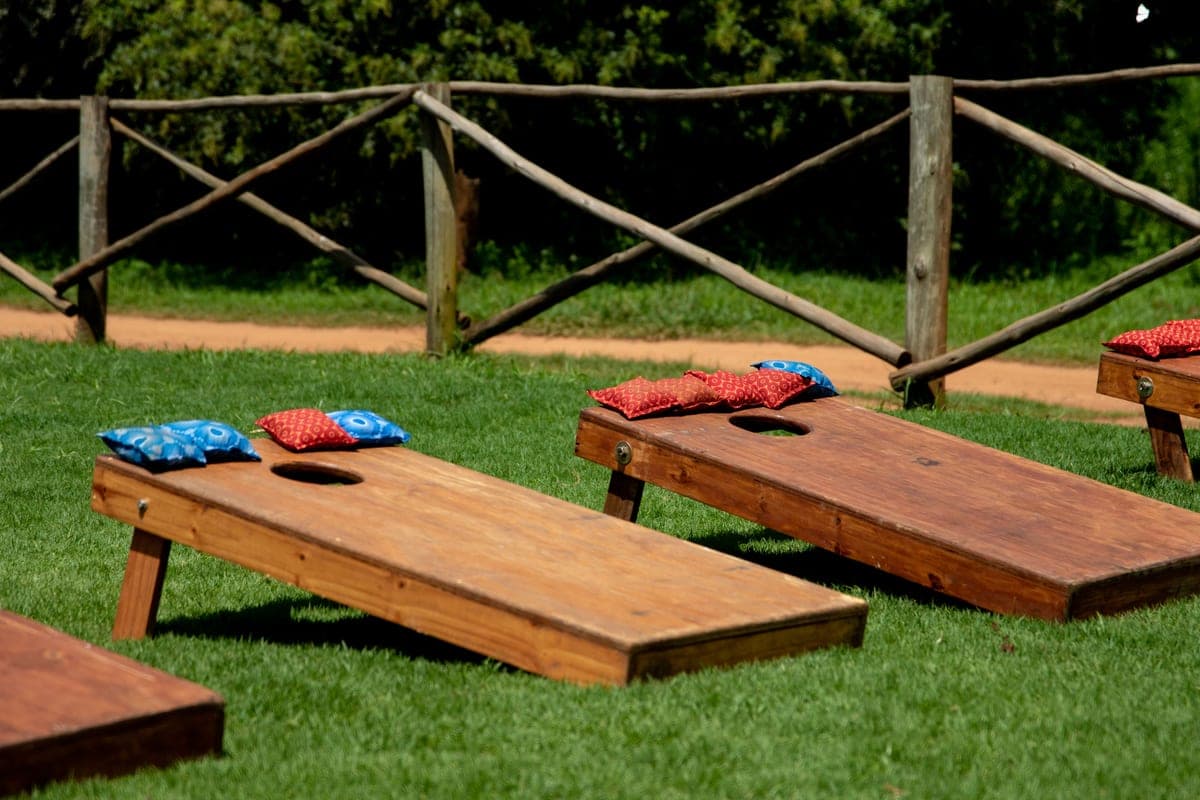
Cornhole earns its position: the American Cornhole League publishes every dimension, so a home setup can be genuinely correct rather than approximately correct; it plays two or four; and the equipment is the most standardized in yard games, which means bags from one maker fit boards from another.
Three situations where it is the wrong buy:
- Your longest run is under 30 feet. The court is 27 feet board-front to board-front plus a 3-by-4-foot pitcher's box behind each board. Under 30 feet you are throwing from the flowerbed. Buy ladder toss instead.
- You need to carry it any distance. The lightest full set here publishes 38 pounds; the heaviest publishes 46. Kan Jam goals nest into one another.
- You have ten or more people. Four players, then a queue. For a crowd, kubb takes 2 to 12.
If you are starting from nothing
What to buy first
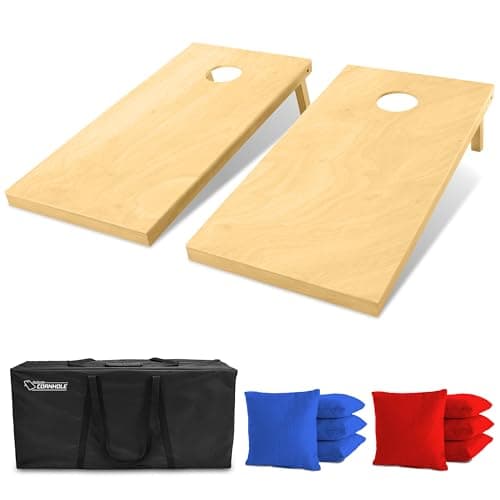
Buy one regulation cornhole set with plywood tops and resin-filled bags, and buy the bags separately if the set includes six rather than eight. That is the whole first purchase. Everything else in this family is an addition to a party, not the party.
Our full ranking with published specs for each set is on the cornhole page. If you already own boards and the bags are the disappointing part — which they usually are — go straight to cornhole bags.
Newly added
The smallest game in this family
Ring toss is the sixth game here and the only one with no minimum footprint at all. Five scoring towers, four rope rings, and a throwing line you set yourself — which makes it the only throwing game we would happily put on a balcony, indoors, or six feet from a three-year-old: best ring toss game.
Each of the bigger games now also has a page for the decision it actually turns on: cornhole accessories, cast iron vs drop-forged horseshoes, wood vs PVC ladder toss, and which Kan Jam set to buy.
Newly added
Two more ways to throw at a target
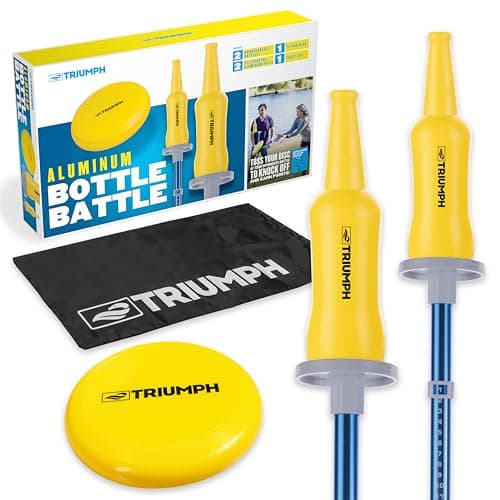
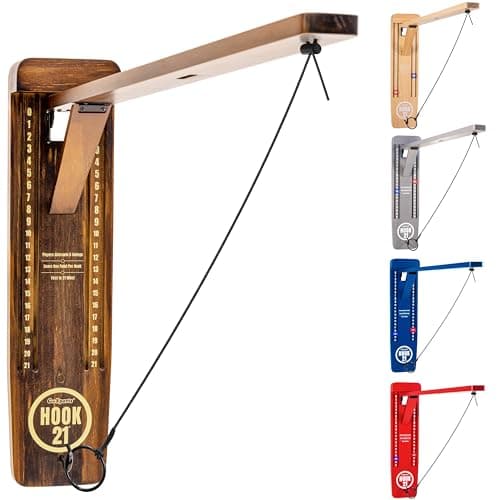
Polish horseshoes and hook and ring join this family. The first is a disc thrown to knock a bottle off a pole, with the defender diving to catch it — the adult party game of the two, and the one Triumph publishes 20, 30 and 40 foot courts for: best Polish horseshoes set. The second is the old bar game of a ring swung on a rope at a hook, now sold for walls, lawns and playrooms: best hook and ring game.
Newly added
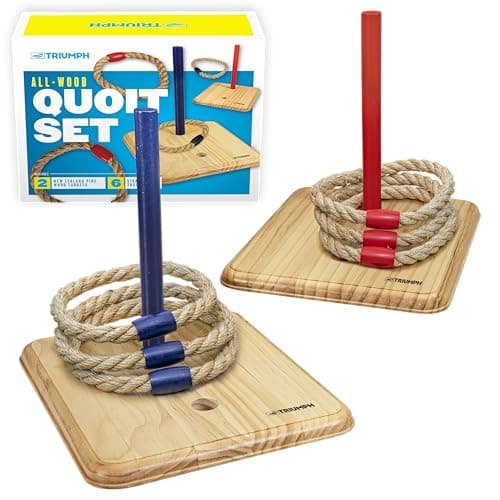
Quoits, the adult ring game
Quoits is the ring toss game adults actually played. Rope rings pitched at a pin with a published tournament distance of 21 feet, scored 3 for a ringer and 1 for a ring on the platform — horseshoes without the steel, the pit or the risk: best quoits set. For the smallest throwers, smaller boards and real-weight bags are in cornhole sets for kids.
Newly added
Lawn darts, and the ban behind it
The pointed lawn darts of the 1970s are illegal to sell in the United States. The CPSC banned them in 1988 after three children died, and every set on sale today is legal because it has a soft tip and is not designed to stick in the ground: best lawn darts. The scoring, the safety brief and what to do with a vintage set are in lawn dart rules and safety, and the throwing game it most resembles is covered in lawn darts vs horseshoes.
Newly added
Yard pong joins this family
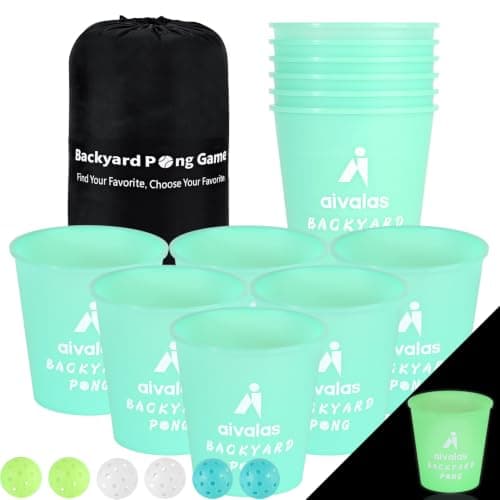
Every set on sale ships twelve buckets — six a side — against the ten a side of the table game it comes from. That makes a smaller triangle and a much shorter game, and nobody mentions it. It is also the loosest game in this section: no governing body, no published court, and across five sets exactly one published measurement. The sets, and how to set a throw distance no maker states, are in best yard pong set — the one throwing game here that works better on sand than on a mown lawn.
FAQ
Questions people actually ask
Which toss game needs the least space?
Are lawn darts legal to buy?
Can toss games be played on concrete or gravel?
Why you can check our work
We have not played these. Every figure above is copied from a manufacturer's published listing or a governing body's published rules, and named so you can verify it. Where a maker publishes nothing, the field is blank rather than filled in. How we pick explains the whole method, including what would change a recommendation.
Read next
Related pages
Picks
Best yard pong set
12-bucket giant pong sets compared on what they publish, plus how to set the throw distance nobody states.
Picks
Best Polish horseshoes set
Disc knocks bottle off pole, defender tries to catch it — two ready-made sets and their published courts.
Picks
Best hook and ring game
Wall-mounted, freestanding or a throwing board — three hook-and-ring formats and where each belongs.
Picks
Best ring toss game
Five scoring towers, four rope rings, and the only game here with no minimum footprint.
Picks
Best cornhole boards
Five regulation sets ranked on published surface thickness, frame construction, weight and bags.
Sources
- American Cornhole League — rules and regulations
- Kan Jam — how to play
- NHPA — backyard horseshoe court
- CPSC — 16 CFR Part 1306, ban of hazardous lawn darts
Every figure on this page is copied from one of these sources. If you find one that is wrong or out of date, tell us and we will fix it.