Bocce is the only game we cover with a genuine three-tier size structure: a federation court, a well-established backyard convention, and a published indoor minimum. That is useful, because it tells you how much you can shrink before the game changes.
Reference
The three published sizes
| Court | Length | Width | Area | Length-to-width |
|---|---|---|---|---|
| USBF regulation | 86.92 ft | 13.12 ft | About 1,140 sq ft | 6.6 : 1 |
| Typical backyard | About 60 ft | About 12 ft | About 720 sq ft | 5 : 1 |
| Small indoor | 22 ft | 6 ft | 132 sq ft | 3.7 : 1 |
The right-hand column is the one worth reading. A regulation court is nearly seven times longer than it is wide — bocce is a corridor game, and the width exists mostly so balls have somewhere to end up rather than to be played across.
When you shrink a court, keep it narrow. A 40-by-20-foot patch is 800 square feet and a worse bocce court than a 55-by-10-foot strip at 550, because the short-and-wide version turns every throw into a straight line with no consequence for missing.
No construction required
Marking one out on a lawn
You do not need to build anything. What a marked court gives you over open lawn is an agreed boundary, which removes the most common bocce argument.
- Pick the longest straight strip you have, ideally 50 feet or more, and mark the four corners with anything visible — tent pegs, garden canes, upturned flowerpots.
- Keep it narrow: about a fifth of the length is the right proportion.
- Mark a throwing line at each end. Everything is thrown from behind it.
- Agree a minimum pallino distance — a line the pallino must cross, or a landmark it must pass.
That is a court. It takes five minutes and no digging, and it makes a lawn game feel like an actual game.
Space in context
How it compares to everything else
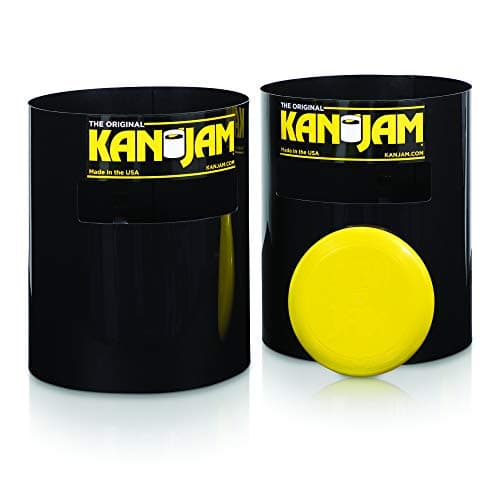
At about 720 square feet for a backyard court, bocce sits near the top of our footprint table — bigger than cornhole (330), bigger than kubb (430), and beaten only by Spikeball's open square, Kan Jam's corridor and full croquet.
The full comparison is in how much space do yard games need. If 60 feet is not available, the rules still work on a shorter strip — see the no-court section of bocce ball rules.
What we would buy
The gear behind this guide
The sets whose published specifications this page is built on. Ranked on spec completeness and footprint clarity, not on testing we have not done.

Best overall
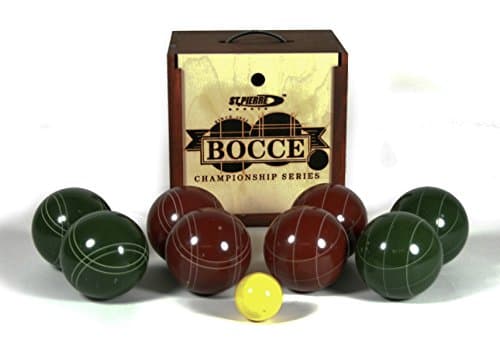
St. Pierre Sports Professional Bocce Set, 107 mm
St. Pierre
107 mm thermo-set composition resin balls built to international bocce specifications and named an official ball of the United States Bocce Federation.
Skip this if
Skip this if the set is mainly for kids or a beach bag. Full-size 107 mm balls are heavy enough that a small player cannot roll one accurately.
Price as of October 19, 2026. #ad How we make money

Best set with a measuring rope
GoSports 100 mm Regulation Bocce Set
GoSports
100 mm high-gloss polyresin with square- and circle-cut scoring marks, a 45 mm pallino, a case and — the useful part — a measuring rope in the box.
Skip this if
Skip this if you want the 107 mm tournament diameter. 100 mm is a deliberate middle size and does not match league equipment.
Price as of October 19, 2026. #ad How we make money
FAQ
Questions people actually ask
What are official bocce court dimensions?
How big should a backyard bocce court be?
What is the smallest bocce court you can play on?
Does a bocce court need a surface?
Why you can check our work
We have not played these. Every figure above is copied from a manufacturer's published listing or a governing body's published rules, and named so you can verify it. Where a maker publishes nothing, the field is blank rather than filled in. How we pick explains the whole method, including what would change a recommendation.
Read next
Related pages
Picks
Yard game guides
Rules, regulation dimensions, materials and storage — sourced from governing bodies and makers.
Picks
Best bocce ball sets
Six sets compared on published ball diameter, material and weight — including the size question nobody explains.
Guide
Bocce ball rules
Scoring, player-count variations and the no-court version — with the USBF as the source.
Guide
How much space do yard games need?
Every game's published footprint, longest run and player count in one sourced table.
Picks
Best yard games for big lawns
The games that need 60 feet or more — and finally work when you have it.
Sources
Every figure on this page is copied from one of these sources. If you find one that is wrong or out of date, tell us and we will fix it.