Cornhole is the most precisely specified game we cover after horseshoes, and every figure below is checkable with a tape measure. That matters when you are buying: a set advertised as regulation is making a claim you can verify in ninety seconds.
American Cornhole League
The complete specification
| Dimension | Specification | Tolerance |
|---|---|---|
| Board width | 2 ft | ±1/4 in |
| Board length | 4 ft | ±1/4 in |
| Hole diameter | 6 in | ±1/8 in |
| Hole position | Center 9 in from the back edge, centered across the width | ±1/8 in |
| Board top height | 12 in above the ground | ±1/2 in |
| Front edge height | 2.5 to 3.5 in above the ground | — |
| Board material | Wood (birch or oak), smooth finished coat | — |
| Board weight | At least 15 lb | — |
| Court distance | 27 ft, board front to board front | ±1/2 in |
| Pitcher's box | 3 ft wide x 4 ft long | — |
| Foul line | The front edge of the pitcher's box | — |
| Bag size | 6 in x 6 in | ±1/4 in |
| Bag weight | 15.5 to 16.5 oz | — |
| Bag thickness | 1.1 to 1.5 in | — |
| Bag construction | Double-seamed fabric | — |
In practice
Laying out a court
- Set the first board down and mark the position of its front edge.
- Measure 27 feet from that mark in a straight line.
- Place the second board with its front edge on the 27-foot mark, facing back toward the first.
- Mark a pitcher's box beside each board: 3 feet wide, 4 feet long, running along the board's length. The end nearest the opposing board is the foul line.
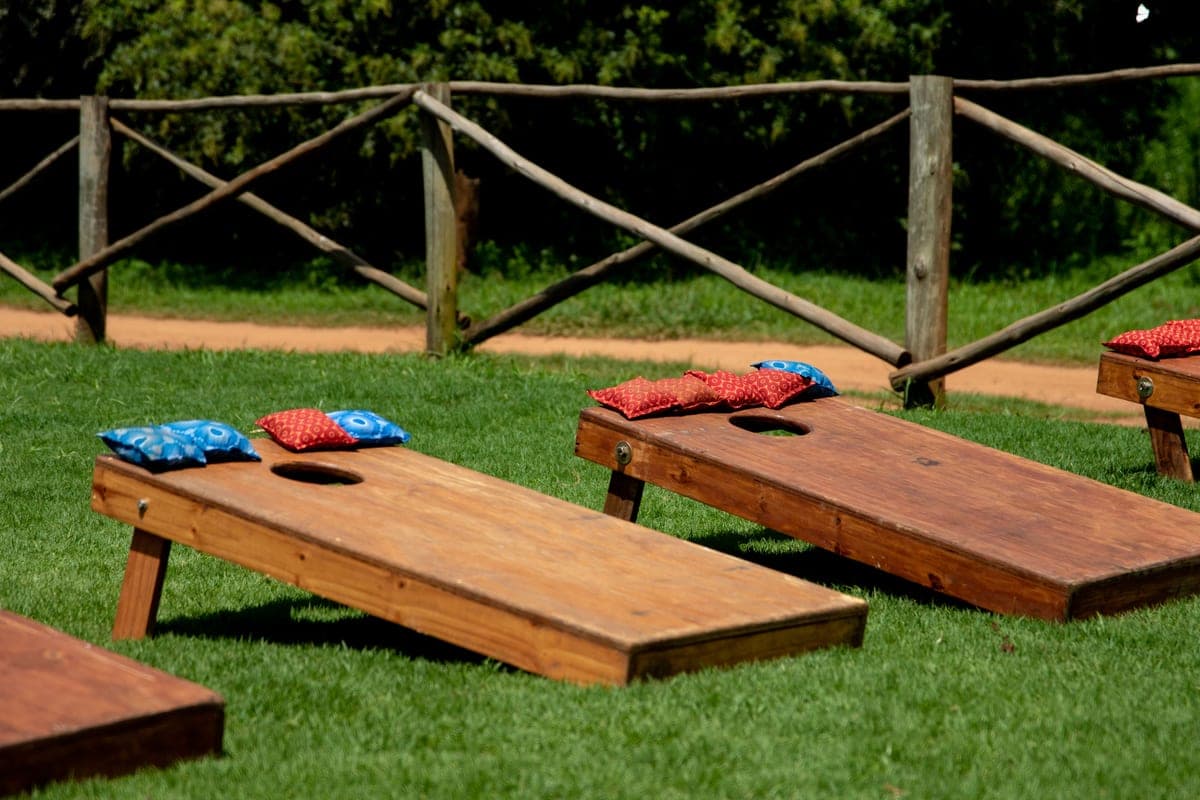
Total footprint: about 33 by 10 feet. That is 27 feet between boards, 4 feet of board at each end (overlapping the pitcher's boxes), and enough width for players to stand beside the box.
How that compares to everything else: how much space do yard games need.
Five minutes with a tape
Checking a set you already own
Four checks, in the order that matters:
- Hole diameter. 6 inches, ±1/8. Undersized holes are the most common deviation in cheap sets and they make the game meaningfully harder.
- Hole position. Center 9 inches from the back edge.
- Top height. 12 inches, ±1/2. Legs that have racked over a season are the usual culprit, and a board that is an inch low changes every slide.
- Bag weight. 15.5 to 16.5 oz on a kitchen scale. Old corn-filled bags that have taken on moisture will read heavy; ones that have dried out read light.
If the bags fail, that is the cheap fix — see best cornhole bags. If the boards fail, see best cornhole boards.
What we would buy
The gear behind this guide
The sets whose published specifications this page is built on. Ranked on spec completeness and footprint clarity, not on testing we have not done.

Best overall
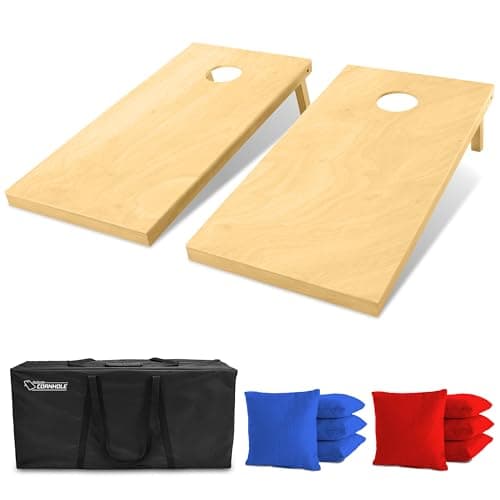
GoSports 4 ft x 2 ft Solid Wood Premium Cornhole Set
GoSports
Regulation 4 x 2 ft boards on solid pine frames with a 1/2 in cabinet-grade plywood top, eight 16 oz all-weather bags and a case — the complete tournament-legal setup in one box.
Skip this if
Skip this if your yard is under 30 ft long. A regulation court is 27 ft board-front to board-front plus throwing room behind each board, and there is no shortening it without changing the game.
Price as of October 19, 2026. #ad How we make money

Best build for weekly play
Victory Tailgate 2x4 Tournament Cornhole Set
Victory Tailgate
The heaviest set here at 46 lb, with dual cross-beam framing and a 15 mm furniture-grade plywood top that does not drum or bounce when a bag lands short.
Skip this if
Skip this if you are carrying boards to a tailgate on foot. 46 lb across two boards is a real load, and the extra mass buys you nothing if the set lives in a trunk.
Price as of October 19, 2026. #ad How we make money
FAQ
Questions people actually ask
What are the dimensions of a regulation cornhole board?
How far apart should cornhole boards be?
How much does a regulation cornhole board weigh?
What is the pitcher's box in cornhole?
What are regulation cornhole bags?
Why you can check our work
We have not played these. Every figure above is copied from a manufacturer's published listing or a governing body's published rules, and named so you can verify it. Where a maker publishes nothing, the field is blank rather than filled in. How we pick explains the whole method, including what would change a recommendation.
Read next
Related pages
Picks
Yard game guides
Rules, regulation dimensions, materials and storage — sourced from governing bodies and makers.
Picks
Best cornhole boards
Five regulation sets ranked on published surface thickness, frame construction, weight and bags.
Guide
Cornhole rules
ACL scoring, cancellation explained, and what happens past 21 — with the published source.
Comparison
Regulation vs tailgate-size cornhole
The full-size court is 33 by 10 feet. Here is what a smaller board changes, in feet and in play.
Guide
How much space do yard games need?
Every game's published footprint, longest run and player count in one sourced table.
Sources
Every figure on this page is copied from one of these sources. If you find one that is wrong or out of date, tell us and we will fix it.