Space
The numbers
| Setup | Board | Throw distance | Total footprint |
|---|---|---|---|
| Regulation | 4 ft x 2 ft | 27 ft front to front | About 33 x 10 ft |
| Shortened regulation court | 4 ft x 2 ft | About 21 ft | About 27 x 10 ft |
| Tailgate / smaller board | Typically 3 x 2 or 2 x 2 ft | About 15 to 21 ft | About 20 to 26 x 8 ft |
Note what changes and what does not. Shrinking the board saves you a foot or two of length. Shrinking the throw saves you six or more. If space is the problem, shortening the throw on full-size boards is the bigger win — and it costs nothing.
Play
What you actually give up with a smaller board
The hole gets proportionally bigger. The ACL hole is 6 inches on a 24-inch-wide board — a quarter of the width. On a narrower board a 6-inch hole is a larger share of the target, so scoring goes up and the game gets shorter. Some small-board sets shrink the hole to compensate; most do not.
Blocking stops working. A bag sitting in front of the hole on a regulation board covers a meaningful fraction of the approach. On a short court with a proportionally larger hole, there is more room to slide past it, so the block-and-push game that makes cornhole interesting at a decent level mostly disappears.
Bags behave differently. Competitive bags are tuned for a 27-foot throw onto a 12-inch-high board. At 15 feet the same bag arrives flatter and faster. This is not a defect; it is just a different game, and your dual-speed bags will feel wrong until you adjust.
Decision
Pick regulation if…
- You have 33 feet of clear run — measure it, do not estimate it.
- Anyone might play a league or a stamped event.
- The boards mostly live where they are played.
- You want the block-and-push game rather than a pure accuracy contest.
Pick a smaller board if…
- Your run is under 30 feet. See games for small yards for the games that fit properly rather than approximately.
- The set travels weekly and 38 to 46 pounds is genuinely a problem.
- The players are mostly children, where a shorter throw is the whole point.
The full ranked list of regulation sets, with published surface thickness and set weight for each, is on the best cornhole boards page. Every court dimension used above is broken down in regulation cornhole dimensions.
The other side
Where to buy the other one
The card at the top of this page covers one side of the comparison. This is our current pick for the other, ranked on published specifications rather than on play we have not done.

Best cheap regulation set
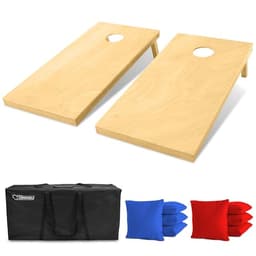
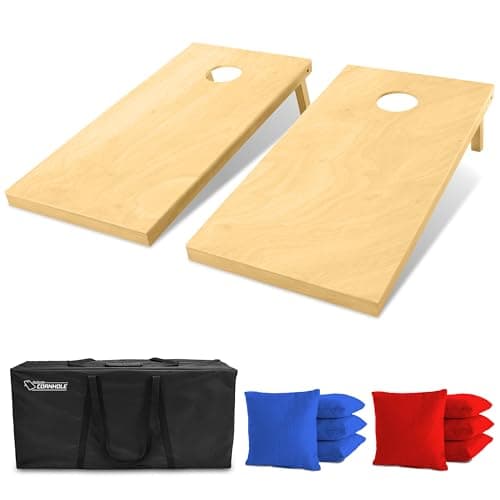
GoSports Classic 4 ft x 2 ft Cornhole Set (MDF)
GoSports
Full regulation footprint on an MDF top instead of plywood — the cheapest honest way to get 4 x 2 ft boards, eight bags and a case.
Skip this if
Skip this if the set will be stored in a shed or left under a tarp. MDF and moisture are a one-way relationship; plywood is the upgrade that matters.
Price as of October 19, 2026. #ad How we make money
FAQ
Questions people actually ask
How much space do you need for regulation cornhole?
Can you play cornhole at less than 27 feet?
Are tailgate-size cornhole boards worth it?
Why you can check our work
We have not played these. Every figure above is copied from a manufacturer's published listing or a governing body's published rules, and named so you can verify it. Where a maker publishes nothing, the field is blank rather than filled in. How we pick explains the whole method, including what would change a recommendation.
Read next
Related pages
Picks
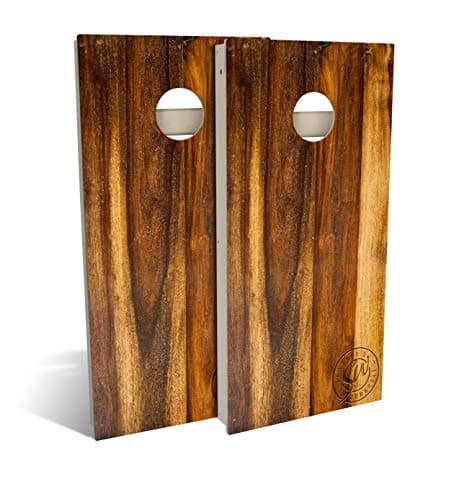
Best cornhole boards
Five regulation sets ranked on published surface thickness, frame construction, weight and bags.
Comparison
All-weather vs wood cornhole boards
What weather-resistant construction actually buys, and when a $30 cover beats the upgrade.
Guide
Regulation cornhole dimensions
The complete ACL dimension table with tolerances, and the two measurements people misread.
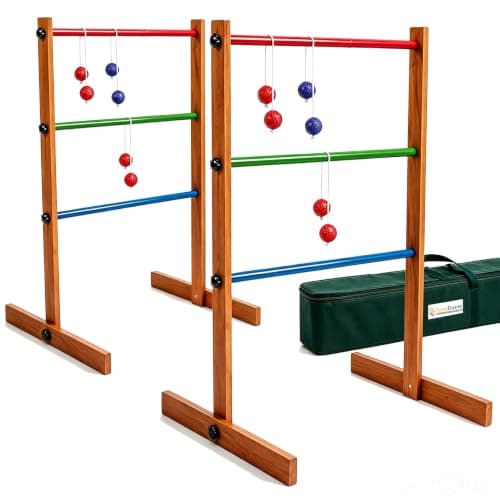
Picks
Best yard games for small yards
Five games that fit under 30 feet of clear run, with published footprints for each.
Sources
Every figure on this page is copied from one of these sources. If you find one that is wrong or out of date, tell us and we will fix it.