Definitions
What each one actually is
Wood means a solid frame — usually pine — with a half-inch cabinet-grade plywood top, varnished or painted and clear-coated. This is the ACA-regulation build and what almost every competitive board is.
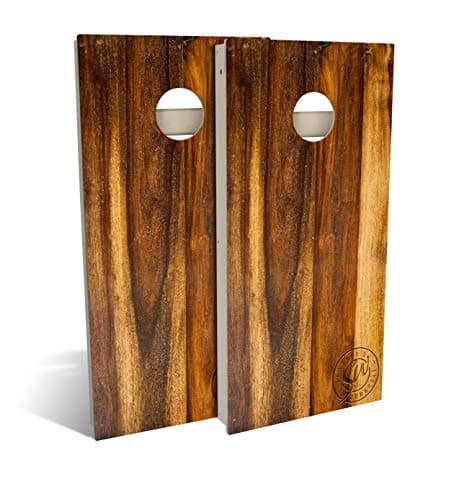
All-weather is a marketing category rather than a single construction. In practice it means water-resistant materials in the top, the frame or both, plus reinforced leg and back-brace supports. Slick Woody's publishes exactly that: water-resistant materials with leg and back-brace supports, at regulation 4 by 2 feet.
Note the phrase every maker uses: water-resistant. Not waterproof. There is no cornhole board on the market that a manufacturer describes as waterproof.
The comparison
Side by side
| Wood (plywood top, pine frame) | All-weather | |
|---|---|---|
| Regulation dimensions | Yes — 4 x 2 ft, 6 in hole, 12 in top height | Yes on dimensions; check the material clause |
| Published surface | 1/2 in varnished cabinet-grade plywood | Water-resistant materials, varies by maker |
| Slide | The reference surface bags are made for | Different — usually faster dry, less predictable damp |
| Left out in rain | Delaminates and swells | Designed for it, cover still recommended |
| Published set weight | 38 to 46 lb typical | Often not published |
| Repaintable | Yes — sand and recoat | Usually not; the graphic is the product |
| Cost of the alternative | Add a cover, roughly $30 | Built in |
Decision
Pick wood if…
- The boards can live in a garage, shed or basement between games.
- Anyone in the household might play in a league, now or later.
- You want to paint or customize the surface.
- You care about slide consistency — this is the surface competitive bags are designed against.
Pick all-weather if…
- There is nowhere indoors for a pair of 4-foot boards, and there never will be.
- The set lives at a lake house, a rental or a bar and nobody is going to cover it.
- You value the boards looking good on day 400 more than the last 5% of slide fidelity.
Cheaper than either
The third option nobody mentions
A weather-resistant cover over a wooden set costs a fraction of the all-weather premium and solves the same problem better, because it also keeps UV off the surface. Sun fade is the failure mode people forget: a board that never gets rained on but bakes all summer will still lose its finish.
The one thing a cover does not fix is ground moisture wicking up through the frame feet on a lawn. If the boards live on grass rather than a deck, stand them on edge against a wall rather than flat on the ground.
Broader version of this argument, across every game on the site: weatherproof yard games. And for the material detail specifically, cornhole board materials.
The other side
Where to buy the other one
The card at the top of this page covers one side of the comparison. This is our current pick for the other, ranked on published specifications rather than on play we have not done.

Best overall
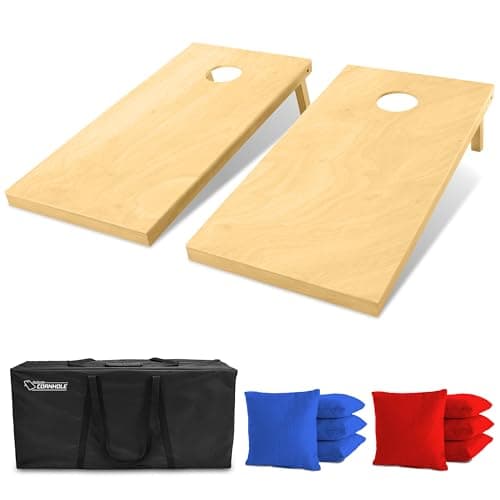
GoSports 4 ft x 2 ft Solid Wood Premium Cornhole Set
GoSports
Regulation 4 x 2 ft boards on solid pine frames with a 1/2 in cabinet-grade plywood top, eight 16 oz all-weather bags and a case — the complete tournament-legal setup in one box.
Skip this if
Skip this if your yard is under 30 ft long. A regulation court is 27 ft board-front to board-front plus throwing room behind each board, and there is no shortening it without changing the game.
Price as of October 19, 2026. #ad How we make money
FAQ
Questions people actually ask
Can you leave cornhole boards outside?
Do all-weather cornhole boards slide the same as wood?
Is an all-weather board still regulation?
Why you can check our work
We have not played these. Every figure above is copied from a manufacturer's published listing or a governing body's published rules, and named so you can verify it. Where a maker publishes nothing, the field is blank rather than filled in. How we pick explains the whole method, including what would change a recommendation.
Read next
Related pages
Picks
Best cornhole boards
Five regulation sets ranked on published surface thickness, frame construction, weight and bags.
Comparison
Cornhole board finishes compared
Substrate is durability; finish is slide. What each set publishes about its surface, and what it does not.
Comparison
Regulation vs tailgate-size cornhole
The full-size court is 33 by 10 feet. Here is what a smaller board changes, in feet and in play.
Guide
Weatherproof yard games
Every game ranked on what actually happens when it is left outside, by published material.
Guide
Cornhole board materials
Plywood against MDF, frame construction and bag fill — what each buys over five seasons.
Sources
- American Cornhole League — rules and regulations
- Slick Woody's — all-weather cornhole boards
- GoSports — solid wood premium cornhole set
Every figure on this page is copied from one of these sources. If you find one that is wrong or out of date, tell us and we will fix it.