A cornhole set is two heavy boards that last for years and eight bags that do not. Almost all of the change people notice in how a set plays over a season is the bags, and almost nobody thinks about them until one splits.
The good news is that bags are the cheapest component to replace and the easiest to look after. The bad news is that most of what is done to look after them — washing, mainly — makes them worse.
Why care is not obvious
What a bag actually is
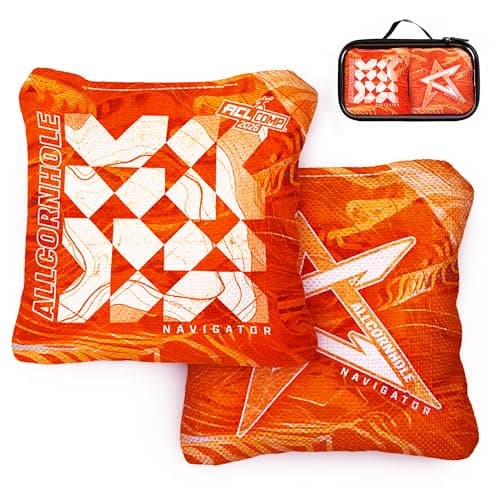
Competition bags are published at 6 by 6 inches and 16 ounces, and modern ones are dual fabric: one face designed to slide and one designed to stick. ACL COMP bags publish exactly this — dual fabric, dual speed, with a DFR pellet filler. Slide-Rite publishes a slick face and a suede stick face. GameChanger publishes speed ratings of 95 fast and 64 slow; All-Slides publishes 94 and 74.
Those numbers are the product. A bag is not a beanbag with a logo — it is two engineered surfaces on one object, and everything you do to it either preserves that difference or erodes it.
Which is why the standard laundry instinct is wrong. Washing does not clean a bag back to new; it changes the nap of both faces, unevenly, and there is no way to change them back. Comparison of the sets themselves: cornhole bags compared.
| Set | Published fill | Published faces | Certification |
|---|---|---|---|
| ACL COMP | DFR pellet filler | Dual fabric, dual speed | ACL COMP certified |
| Slide-Rite Geo | Not published | Slick face, suede stick face | ACL PRO stamped |
| GameChanger OG | Not published | Patented suede patch technology | ACL PRO certified |
| All-Slides 2.0 | Not published | Not published | ACL PRO certified |
| ACL REC Stick-N-Slick | Not published | Stick-N-Slick dual face | ACL REC |
| Bags supplied with board sets | Resin or recycled plastic pellet | Varies | Usually none |
What to actually do
The four rules
1. Dry them before they go away
This is the whole of bag care in one sentence. Pellet fill does not rot — that is the published reason it replaced corn — but the fabric holds water, and a damp bag zipped into a case will mildew. Lay them out flat, faces up, indoors, until they are properly dry. Not in direct sun, which fades and stiffens fabric.
2. Brush, do not wash
Dried mud comes off with a stiff brush and nothing else is usually needed. If something genuinely has to be cleaned, spot-clean that area with as little water as possible and let it dry flat. Never a washing machine, never a dryer, never a hose.
3. Store them flat and loose
Bags stored compressed under something heavy develop a set shape and the fill compacts unevenly. Most sets ship a carry case — ACL COMP publishes one, and Slide-Rite, GameChanger and All-Slides all ship as four-bag sets — and flat in that case, indoors, is the right answer.
4. Keep two sets if you play on hard ground
If your court is a driveway, the slick face abrades measurably faster than it does on grass. A cheap REC-grade set for concrete play and a certified set kept for grass is a genuinely sensible split, and it is why games on driveways and hard surfaces is worth reading if that is your situation.
Worth knowing
Bags are also the cheapest upgrade you can make
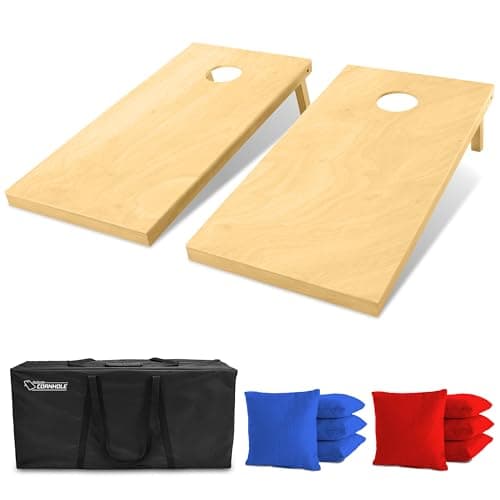
Most board sets ship with bags that exist to make the box complete. The GoSports solid wood set publishes eight 16-ounce recycled-plastic-pellet bags, which is a genuinely reasonable inclusion; plenty of cheaper sets simply publish “8 included” with no specification at all.
Swapping to an ACL-certified set changes how a board plays far more than a more expensive board would. If you already own boards, this is the purchase that improves your game — see the ranked bag comparison, and cornhole rules for where bag weight and size sit in the ACL regulations.
For the boards themselves — which are a different maintenance problem entirely, since plywood delaminates and MDF swells — see cornhole board materials and weatherproof yard games.
What we would buy
The gear behind this guide
The sets whose published specifications this page is built on. Ranked on spec completeness and footprint clarity, not on testing we have not done.

Best league-legal starting point
ACL COMP Officially Licensed Cornhole Bags
American Cornhole League
Dual-fabric, dual-speed bags at the ACL's own 6 x 6 in and 16 oz spec, licensed and stamped by the league that wrote the number.
Skip this if
Skip this if nobody in your group can slide a bag yet. Dual-speed fabric rewards a technique you have to build first; a rec bag is more fun for a year.
Price as of October 19, 2026. #ad How we make money

Best in wet grass
Slide-Rite Geo ACL Pro Stamped Cornhole Bags
Slide-Rite
ACL PRO stamped, 16 oz, with a proprietary slick face the maker specifically claims holds its slide in any condition and a suede stick side for control.
Skip this if
Skip this if you only ever play on a dry patio. The wet-weather face is the whole reason for the price step.
Price as of October 19, 2026. #ad How we make money

Best speed spread
GameChanger OG ACL Pro Stamped Cornhole Bags
GameChanger
Rated 95 fast and 64 slow with a patented suede patch — the widest published speed gap on this page, which is what a blocker-and-push game actually needs.
Skip this if
Skip this if your group plays one shot: straight at the hole. A 31-point speed spread only pays off when you are choosing sides deliberately.
Price as of October 19, 2026. #ad How we make money
Best for a backyard set
ACL REC Stick-N-Slick Cornhole Bags
Escalade Sports
The league's recreational certification rather than its competitive one — same 6 x 6 in geometry, simpler fabric, and the sensible bag for a set that guests will use.
Skip this if
Skip this if you intend to enter a stamped ACL event. REC and PRO are different certifications.
FAQ
Questions people actually ask
Can you wash cornhole bags?
Do cornhole bags get ruined by rain?
How long do cornhole bags last?
Does playing on concrete wear bags out faster?
Why you can check our work
We have not played these. Every figure above is copied from a manufacturer's published listing or a governing body's published rules, and named so you can verify it. Where a maker publishes nothing, the field is blank rather than filled in. How we pick explains the whole method, including what would change a recommendation.
Read next
Related pages
Picks
Yard game guides
Rules, regulation dimensions, materials and storage — sourced from governing bodies and makers.
Picks
Best cornhole bags
Five ACL-certified bag sets compared on published speed ratings, fabric and certification tier.
Picks
Best cornhole boards
Five regulation sets ranked on published surface thickness, frame construction, weight and bags.
Guide
Cornhole rules
ACL scoring, cancellation explained, and what happens past 21 — with the published source.

Guide
Weatherproof yard games
Every game ranked on what actually happens when it is left outside, by published material.
Guide
Cornhole board materials
Plywood against MDF, frame construction and bag fill — what each buys over five seasons.
Sources
- American Cornhole League — rules and regulations
- ACL PRO stamped bags — retailer listing
- Escalade Sports — ACL REC Stick-N-Slick bags
Every figure on this page is copied from one of these sources. If you find one that is wrong or out of date, tell us and we will fix it.