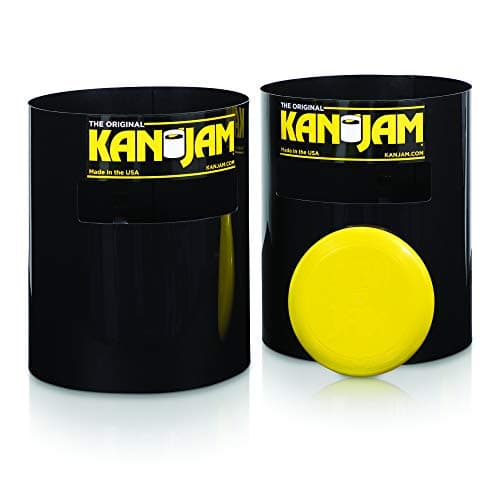
Kan Jam is the only game we cover where your partner is not optional. Almost every point on the board involves two people: one throws, the other redirects. That is what makes it the best party game in the toss family — a weak thrower still decides points.
Before the first throw
Setup
- Place the two goals 50 feet apart, facing each other, per the manufacturer's published rules.
- Four players, in two teams of two. Partners stand at opposite goals.
- You throw from beside your own goal toward your partner, who is standing at the far goal.
- The practical footprint is about 60 by 20 feet — the 50 feet plus room behind each goal for the deflector.
The published values
Scoring
| Play | What happens | Points |
|---|---|---|
| Dinger | Your partner deflects your throw so it hits the goal | 1 |
| Deuce | Your throw hits the goal unassisted | 2 |
| Dunk | Your partner deflects your throw into the goal | 3 |
| Done Deal | The disc goes through the front slot — assisted or not | Instant win |
| Interference | The defending team interferes with a throw | 3 to the throwing team |
Note what is not on that list: a throw that goes straight into the goal untouched. The scoring is deliberately built so that the assisted plays are worth more than the unassisted ones. Kan Jam is a cooperative game wearing a competitive game's clothes.
Exactly 21
Winning
First team to exactly 21 wins. Some published versions of the rules add that a team going over 21 resets to 15 and play continues until somebody hits 21 exactly or scores an instant win.
The instant win is the rule that makes the endgame tense. A team on 19 or 20 that cannot find the exact number it needs can still end the game outright by putting the disc through the slot — a low-probability shot that becomes rational precisely when the arithmetic has stopped working.
If scores are level at the end, the published tiebreak is an overtime round: each team plays one round and the higher score wins.
Honest gap
What the rules do not publish
The manufacturer publishes the rules thoroughly and the equipment barely at all. There are no published goal dimensions and no published set weight, so those fields are blank on our Kan Jam page rather than estimated.
If you are deciding between this and the other four-player fast game, Spikeball vs Kan Jam settles it on the shape of your space rather than on preference.
What we would buy
The gear behind this guide
The sets whose published specifications this page is built on. Ranked on spec completeness and footprint clarity, not on testing we have not done.

Best overall
Kan Jam Original Disc Game Set
Kan Jam
Two goals and a disc, played at a published 50 ft, with a scoring system that only works because one player deflects for the other — the most genuinely cooperative game on this site.
Skip this if
Skip this if you have an odd number of players who all want to throw. Kan Jam is built around pairs and does not adapt to three.
Price as of October 19, 2026. #ad How we make money
FAQ
Questions people actually ask
How far apart are Kan Jam goals?
How do you score in Kan Jam?
Do you have to hit exactly 21 in Kan Jam?
How many people play Kan Jam?
Why you can check our work
We have not played these. Every figure above is copied from a manufacturer's published listing or a governing body's published rules, and named so you can verify it. Where a maker publishes nothing, the field is blank rather than filled in. How we pick explains the whole method, including what would change a recommendation.
Read next
Related pages
Comparison
Which Kan Jam set to buy
Same game to exactly 21 on the same 50 ft court — what actually changes between the versions.
Picks
Yard game guides
Rules, regulation dimensions, materials and storage — sourced from governing bodies and makers.
Picks
Kan Jam
Goals 50 feet apart, exactly four players, exactly 21 to win — and the deflection rule that makes it work.

Comparison
Spikeball vs Kan Jam
Two four-player games with opposite space requirements — a square versus a corridor.
Picks
Best tailgate games
Games that survive asphalt, wind and a trunk — with the published set weights that decide it.
Picks
Best yard games for big lawns
The games that need 60 feet or more — and finally work when you have it.
Sources
Every figure on this page is copied from one of these sources. If you find one that is wrong or out of date, tell us and we will fix it.