The published specs
Side by side
| Horseshoes | Ladder toss | |
|---|---|---|
| Footprint | About 48 x 10 ft (about 480 sq ft) | About 20 x 8 ft (about 160 sq ft) |
| Core geometry | Stakes 40 ft apart, front to front | Toss distance 15 ft |
| Throwing line | 27 ft or 37 ft depending on class | One line, 15 ft |
| Surface required | Clay or sand pit | Anything — grass, hard, sand |
| Ground preparation | Two dug pits, 43 to 72 in x 31 to 36 in | None |
| Stake | 1 in diameter, 15 in above ground, leaning about 12 degrees | No stake — a freestanding frame |
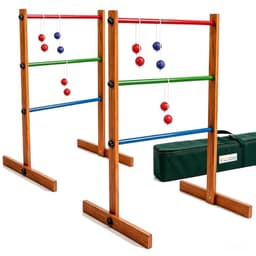
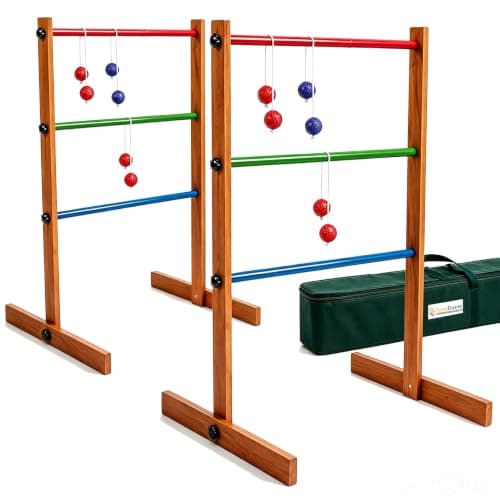
| Projectile | Steel shoe, no more than 2 lb 10 oz | Bola — two golf balls on a cord |
| Scoring | Ringers and closest shoe | 3 top rung, 2 middle, 1 bottom; first to exactly 21 |
| Players | 2 or 4 | 2 or 4 |
| Packs down | No — the court is permanent | Yes — nylon carrying case |
| Governing body | National Horseshoe Pitchers Association | None |
The honest framing
One of these is a construction project
Almost every disappointed horseshoe purchase comes from the same misunderstanding: people buy the shoes and stakes and expect a game. What they have bought is the equipment for a court they have not built.
The NHPA publishes the whole thing — stakes 40 feet apart front to front, one inch in diameter, standing 15 inches above ground and leaning about three inches, roughly 12 degrees, toward the opposite stake. Around each stake sits a pit box between 43 and 72 inches long and 31 to 36 inches wide, filled with clay or sand. Foul lines are at 27 or 37 feet depending on class.
That pit is the part people skip and the part that matters. A drop-forged steel shoe at the 2 pound 10 ounce limit landing on turf does two things: it bounces unpredictably, which removes the skill, and it takes a divot, which removes the lawn. Clay or sand stops the bounce and holds the shoe where it lands. Without it you are not playing horseshoes with a handicap — you are playing a different, worse game.
Ladder toss asks nothing. The frame stands on whatever is there, the toss distance is 15 feet, and the bolas do no damage. If you want the game standing in ten minutes on ground you have not prepared, that is the entire comparison.
Beyond the specs
What each one is actually good at
Horseshoes is the better game
It has the deepest skill curve of any pitching game we cover, a century of published standards behind it, and a scoring system that rewards precision without being fussy. A well-built pit is a permanent piece of a yard that people gravitate to, in the same way a fire pit is. If a household has the space and wants one thing that will still be there in ten years, this is it.
Ladder toss is the better purchase
It fits in a small yard — see yard games for small yards — it travels, it takes 2 or 4 players, and the 3 / 2 / 1 scoring from the top rung down means a wild throw still sometimes scores. That last property is why beginners stay at it. Full rules: ladder toss rules.
It is also the more forgiving game on uneven ground. If your lawn is not flat, read levelling ground for yard games before you buy anything that needs a true surface.
Decision
Pick horseshoes if…
- You have 48 feet of yard you are willing to commit permanently.
- You will actually dig and fill two pits.
- The players are adults and there is no small-child traffic across the run.
- You want the game with a governing body and published specifications for every part.
Full page: horseshoes. If the appeal is precision rather than the pit, the other adult precision game to consider is bocce.
Pick ladder toss if…
- Your clear run is under 30 feet.
- Nothing is getting dug.
- Children will be nearby, or playing.
- The game needs to pack into a bag and go to a park or a campsite.
Full page: ladder toss. Against the other obvious first purchase, see cornhole vs ladder toss.
The other side
Where to buy the other one
The card at the top of this page covers one side of the comparison. This is our current pick for the other, ranked on published specifications rather than on play we have not done.

Best overall
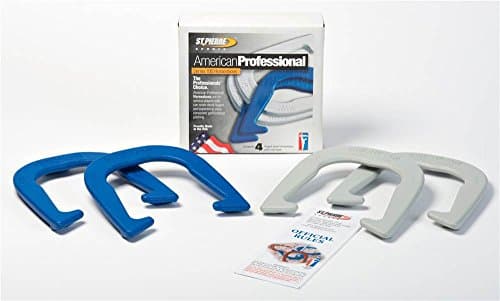
St. Pierre Professional Horseshoe Set
St. Pierre
Drop-forged steel shoes built to the NHPA's published weight limit, which is the one spec that decides whether a shoe behaves like a competition shoe.
Skip this if
Skip this if children will be anywhere near the pits. A 2 lb 10 oz steel shoe thrown 40 ft is the most dangerous object on this website.
FAQ
Questions people actually ask
How much space do horseshoes need?
Do you have to build a pit for horseshoes?
Which is safer around children?
Is ladder toss the same as ladder ball?
Why you can check our work
We have not played these. Every figure above is copied from a manufacturer's published listing or a governing body's published rules, and named so you can verify it. Where a maker publishes nothing, the field is blank rather than filled in. How we pick explains the whole method, including what would change a recommendation.
Read next
Related pages

Picks
Compare yard games
Twenty-one head-to-heads with the verdict first and the published specs behind it.
Picks
Horseshoes
40 feet between stakes, a built clay or sand pit, and a 2 lb 10 oz weight limit straight from the NHPA.
Picks
Ladder toss
Roughly 20 by 8 feet, a 15-foot toss line and exactly 21 to win — the game for yards cornhole cannot fit.
Guide
Ladder toss rules
Rung values, the 15-foot line and the exactly-21 finish — with the common house variants.
Picks
Best yard games for small yards
Five games that fit under 30 feet of clear run, with published footprints for each.
Guide
Levelling ground for yard games
Which games need level ground, which do not, and the fixes that avoid digging entirely.
Sources
Every figure on this page is copied from one of these sources. If you find one that is wrong or out of date, tell us and we will fix it.