Most people have played croquet and almost nobody has played it by the rules. The version that gets played at parties — hit your ball, hope it goes through a hoop, pass the mallet — is missing the two mechanics that make croquet a game rather than a walk: bonus strokes and deadness.
This is the USCA nine-wicket game, which is the backyard standard in the United States. The association game played on a club lawn uses six wickets and is a different, stricter sport.
Layout
The court
| Element | Specification |
|---|---|
| Full court | 100 ft long x 50 ft wide |
| Smaller courts | Allowed — scaled proportionally |
| Wickets | 9 |
| Stakes | 2 |
| Layout | Double diamond |
| Balls | 6 (or 4), 3 in diameter, 10 oz each |
| Mallets | 6 — 35 in deluxe or 28 in standard on the set we cover |
| Colour order, six balls | Blue, red, black, yellow, green, orange |
| Colour order, four balls | Blue, red, black, yellow |
| Surface | Short grass |
The double diamond is the shape that confuses newcomers. The nine wickets are not in a line: two diamonds share a central wicket, with a stake at each end. A ball travels up one diamond, hits the turning stake, and comes back down the other — so the course is a circuit, not a slalom.
Court dimensions and how small you can honestly go are covered on the set page: croquet sets.
The rules that matter
A turn, and the bonus strokes that define it
On your turn you get one stroke. Everything beyond that is earned:
- Run a wicket: one bonus stroke.
- Hit the turning stake at the right point in your course: one bonus stroke.
- Roquet another ball — hit it with your ball: two bonus strokes.
The published maximum earned from a single stroke is two. You cannot stack a wicket bonus and a roquet bonus from the same shot into three.
Those two roquet strokes are what turns croquet from a race into a game. The first is usually played as a croquet stroke: your ball is placed against the ball you hit, and striking your ball sends both. That is how you move an opponent away from their wicket, or move your partner ball into position ahead of you — and it is where the game's name comes from.
A player who understands this can chain wickets and roquets into a long single turn, which is called a break. A player who does not gets one tap and hands the mallet on.
The rest of the rulebook
Boundaries, and finishing
Out of bounds is defined generously: a ball is out when more than half of it crosses the inside edge of the boundary. A ball that goes out is brought back in by one mallet length — 36 inches — from where it left, which is a genuine penalty on a small court and almost none on a large one.
Finishing: a ball completes the course by running all nine wickets in order and then striking the finishing stake. Striking that stake ends that ball's game — it is removed from play, which matters, because a partner ball left alone loses its best roquet target.
Winning: the first side to complete the course with all of its balls wins. Timed games are decided on the highest score.
Practical
Playing it in a real backyard
Three adjustments that keep the published game intact:
- Scale the court, do not skip wickets. The USCA allows a proportionally smaller court. Removing wickets changes the course; shrinking it does not.
- Play four balls, not six, if you have four players. Blue, red, black, yellow is a published configuration, and it keeps the colour order honest.
- Water the ground before you set the wickets. Wire wickets bend in baked summer soil, and a bent wicket never sits square again.
Croquet is also the only game we cover that publishes a mallet-length choice, and it matters more than it sounds: a 28-inch mallet has an adult stooping over every shot. Detail on that, and on the six-player set, is in croquet sets. Comparisons: croquet vs bocce and croquet vs kubb.
What we would buy
The gear behind this guide
The sets whose published specifications this page is built on. Ranked on spec completeness and footprint clarity, not on testing we have not done.

Best overall
GoSports Six Player Croquet Set
GoSports
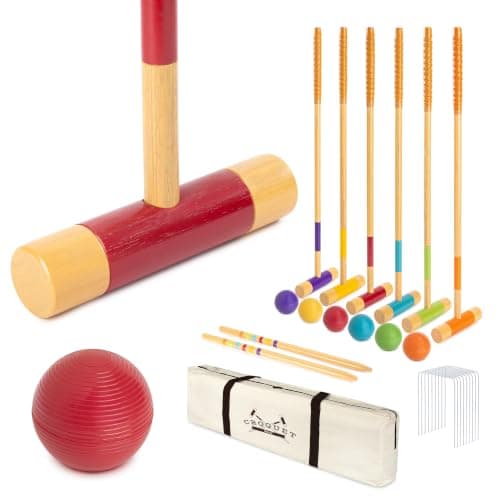
Six hardwood mallets — 35 in in the deluxe version — six 3 in and 10 oz balls, nine wickets, two end posts and a wooden stand, which is the full nine-wicket kit in one purchase.
Skip this if
Skip this if your lawn is under about 40 ft. The USCA full court is 100 x 50 ft and while you can shrink it, below about 40 ft the wickets stop being a challenge.
Price as of October 20, 2026. #ad How we make money
FAQ
Questions people actually ask
What order are croquet balls played in?
How do bonus strokes work in croquet?
What is deadness in croquet?
How big does a backyard croquet court have to be?
Why you can check our work
We have not played these. Every figure above is copied from a manufacturer's published listing or a governing body's published rules, and named so you can verify it. Where a maker publishes nothing, the field is blank rather than filled in. How we pick explains the whole method, including what would change a recommendation.
Read next
Related pages
Comparison
Best croquet set for kids
Mallet length decides it — a 24 inch set for children against 28 and 35 inch sets for adults.
Comparison
Croquet set sizes
Player count controls the mallets, balls and wickets — not the court, which the USCA fixes.
Picks
Yard game guides
Rules, regulation dimensions, materials and storage — sourced from governing bodies and makers.
Picks
Croquet sets
Nine wickets, two stakes, up to six players — and the honest answer on how small a court can get.
Comparison
Croquet vs bocce
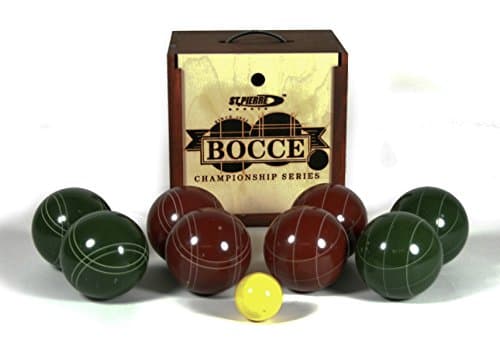
A 5,000 sq ft nine-wicket court against a game that runs happily in a 60-foot strip.
Sources
Every figure on this page is copied from one of these sources. If you find one that is wrong or out of date, tell us and we will fix it.