The published specs
Side by side
| Croquet | Bocce | |
|---|---|---|
| Full court | 100 x 50 ft (5,000 sq ft) | 86.92 x 13.12 ft (about 1,140 sq ft) |
| Backyard footprint | Adjustable — the USCA allows resizing | About 60 x 12 ft (about 720 sq ft) |
| Shape needed | A wide rectangle | A long, narrow strip |
| Players | Up to 6 | 2 to 4, commonly played in teams |
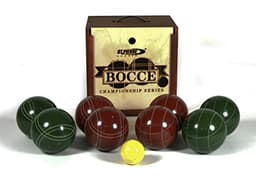
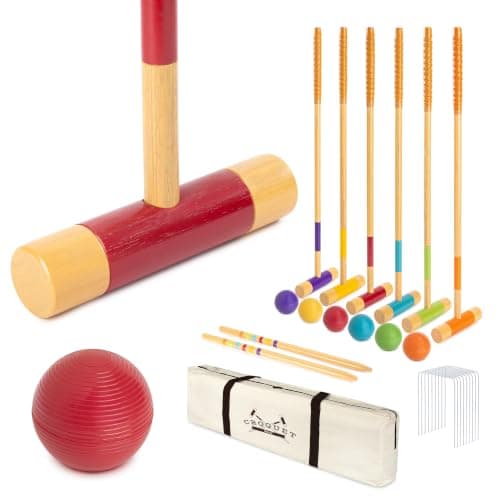
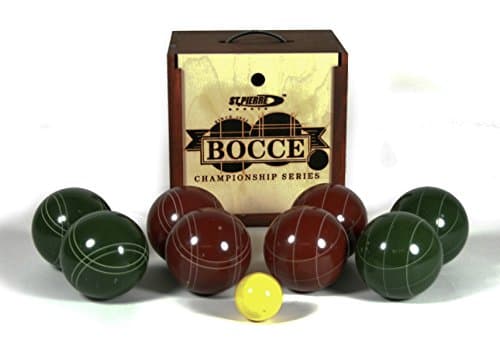
| Equipment | 6 mallets, 6 balls, 9 wickets, 2 end posts | 8 balls plus a pallino |
| Ball | 3 in diameter, 10 oz | 90 to 107 mm, solid resin |
| Playable surface | Short grass | Grass, sand, gravel, dirt |
| Setup time | Minutes — nine wickets to place | Seconds — throw the pallino |
| Ground quality | Matters a great deal | Barely matters |
| Governing body | United States Croquet Association | United States Bocce Federation |
Why croquet is not ruled out
The USCA resizing clause is the most useful rule on this site
A 5,000 square foot court rules croquet out of most yards on paper, and that is where nearly every article on the subject stops. It should not, because the USCA nine-wicket rules explicitly allow the court to be scaled to the space available.
That single clause changes the purchase. You are not buying a game that needs 100 by 50 feet; you are buying a game whose proportions are published and whose absolute size is yours to set. A half-scale court on a 50 by 25 foot lawn is still nine-wicket croquet — shots are shorter, the game is faster, and nothing about the rules breaks.
What croquet cannot compromise on is surface. The ball has to run true through a wicket, so ruts, moss and slope all show up in the game immediately. Bocce publishes grass, sand, gravel and dirt as playable, which is a fundamentally different level of tolerance.
If your lawn is uneven, that is the deciding fact, not the square footage. See yard games for sloped and uneven yards.
For a gathering
Player count is where croquet quietly wins
Bocce publishes 2 to 4 players. In practice a bocce set has 8 balls in two colours, which teams share happily, so it stretches — but the published figure is 4 and a set of 8 balls does not stretch indefinitely.
Croquet publishes up to 6, and the six-player sets sold for it carry six mallets and six balls so all six genuinely play at once. For a family gathering where the problem is people standing around, that is a meaningful two extra players, and croquet turns are short enough that nobody waits long.
Both games are unusually good for a mixed and older group: neither requires running, both are played standing, and both reward a good eye over strength. See yard games for seniors and low-mobility players and games for mixed ages.
Decision
Pick bocce if…
- Your ground is uneven, gravelly, sandy or otherwise not a lawn.
- Your usable space is a strip rather than a rectangle.
- You want to be playing thirty seconds after walking outside.
- The set has to travel — to a beach, a park or a campsite.
Full set comparison: best bocce sets. Ball size matters more than most buyers expect — bocce ball sizes compared.
Pick croquet if…
- You have a genuine lawn — flat, mown, and wider than it is long.
- Gatherings are five or six people who all want to be in the same game.
- You like a game with a layout, a sequence and some ceremony to it.
- You are happy to scale the court and mark the wicket positions once.
Full page: croquet sets. For the biggest lawns, games for big lawns.
The other side
Where to buy the other one
The card at the top of this page covers one side of the comparison. This is our current pick for the other, ranked on published specifications rather than on play we have not done.

Best overall
GoSports Six Player Croquet Set
GoSports
Six hardwood mallets — 35 in in the deluxe version — six 3 in and 10 oz balls, nine wickets, two end posts and a wooden stand, which is the full nine-wicket kit in one purchase.
Skip this if
Skip this if your lawn is under about 40 ft. The USCA full court is 100 x 50 ft and while you can shrink it, below about 40 ft the wickets stop being a challenge.
Price as of October 19, 2026. #ad How we make money
FAQ
Questions people actually ask
How much space does croquet need?
Is bocce or croquet better for a mixed-age group?
Does croquet need a perfect lawn?
Which game is quicker to set up?
Why you can check our work
We have not played these. Every figure above is copied from a manufacturer's published listing or a governing body's published rules, and named so you can verify it. Where a maker publishes nothing, the field is blank rather than filled in. How we pick explains the whole method, including what would change a recommendation.
Read next
Related pages

Picks
Compare yard games
Twenty-one head-to-heads with the verdict first and the published specs behind it.
Picks
Croquet sets
Nine wickets, two stakes, up to six players — and the honest answer on how small a court can get.
Picks
Best bocce ball sets
Six sets compared on published ball diameter, material and weight — including the size question nobody explains.
Picks
Best yard games for big lawns
The games that need 60 feet or more — and finally work when you have it.

Picks
Yard games for seniors and low-mobility players
Played standing, no running, light equipment — filtered on published weights and distances.
Sources
Every figure on this page is copied from one of these sources. If you find one that is wrong or out of date, tell us and we will fix it.