The build
Setting up
- Find hard, level ground and clear the area around it.
- Lay three blocks side by side to make a row. Lay the next three across them at 90 degrees. Repeat.
- Build until you run out — Yard Games publishes 19 rows for its 56-block Giant and Large sets, and 18 rows for the 54-block 21-inch junior set.
- Straighten the tower by running a flat hand down each face before you start.
That last step matters more than it sounds. Blocks that sit even slightly proud on one side put every subsequent pull off balance, and the game ends early for a reason nobody enjoys.
The rules
Playing
- Players take turns. Order is however you like; alternate around the tower.
- On your turn, remove one block from any complete row below the top row.
- One hand only. This is the rule that makes the game hard and the one casual games abandon first.
- Place the block on top, across the row below, to keep building.
- Your turn ends when the block is placed and you have taken your hand off it.
- Whoever makes the tower fall loses.
You may touch and test blocks to find a loose one, but once you have moved a block enough that it is clearly out of line, you have committed to it.
Settle this first
What counts as a fall
This is the dispute that ends giant Jenga games badly, and it is worth agreeing in advance. The standard convention:
- The tower has fallen when any block other than the one being placed comes off the tower. You do not wait for a full collapse.
- A block you knock and catch still counts as having come off.
- The block in your hand does not count — dropping the one you are placing is not a loss until it disturbs the tower.
Making it better
House variants worth adding
The base game is a two-player game that a crowd watches. These variants make it a crowd game, which is what you bought a giant version for:
- Write on the blocks. Instructions, questions or forfeits on each block, revealed when it is pulled. It is the single most common modification and it turns the tower into an icebreaker — genuinely why these turn up at weddings. Note that writing on blocks is permanent.
- Two-tower race. Two teams, two towers, first to collapse loses. Doubles the number of people playing at once.
- Time limit. Ten seconds per turn. Removes the deliberation and makes a long game short, which is useful at a party.
- Non-dominant hand only. The best handicap we know of for a mixed group, because it costs an experienced player far more than a beginner.
For families
Age floors and reach
| Set | Published age floor | Start height | Endgame reach |
|---|---|---|---|
| Yard Games Giant (2.5 ft) | 8+ | 2.5 ft | Up to 5 ft — adult reach |
| Yard Games Large (2 ft) | 8+ | 2 ft | Around 4 ft |
| Yard Games Large Jr. (21 in) | 8+ | 21 in | Eye level for a child |
| Jenga GIANT hardwood | 12+ | Stacks to over 5 ft | Adult reach |
The reach column is the one that decides whether a child actually plays. A tower's interesting phase is the endgame, and the endgame happens above the starting height. On the 2.5-foot set that means placing blocks at four or five feet — a game a child watches. On the 21-inch set, the same endgame is at their eye level.
Full size comparison: best giant Jenga sets. For mixed-age gatherings generally, see games for mixed ages.
What we would buy
The gear behind this guide
The sets whose published specifications this page is built on. Ranked on spec completeness and footprint clarity, not on testing we have not done.
Best overall
Yard Games Giant Tumbling Timbers
Yard Games
56 sustainably sourced New Zealand pine blocks at 1.5 x 2.5 x 7.5 in, starting at 2.5 ft over 19 rows and reaching 5 ft, in a nylon case.
Skip this if
Skip this if the only flat ground you have is a lawn. A 19-row tower needs a hard, level base — grass tips it before anybody pulls a block.
Best for younger players
Yard Games Large Jr. Tumbling Timbers (21 in)
Yard Games
54 blocks at 1.2 x 2 x 6 in over 18 rows, starting at 21 in — the smallest published size in the family and the one a shorter player can reach the top of.
Skip this if
Skip this if adults are the main players. Small blocks make an easy game, and easy stacking games end quickly.
FAQ
Questions people actually ask
How do you set up a giant Jenga tower?
What are the rules of giant Jenga?
What age is giant Jenga suitable for?
Does the tower have to fall completely to end the game?
Why you can check our work
We have not played these. Every figure above is copied from a manufacturer's published listing or a governing body's published rules, and named so you can verify it. Where a maker publishes nothing, the field is blank rather than filled in. How we pick explains the whole method, including what would change a recommendation.
Read next
Related pages
Picks
Yard game guides
Rules, regulation dimensions, materials and storage — sourced from governing bodies and makers.
Picks
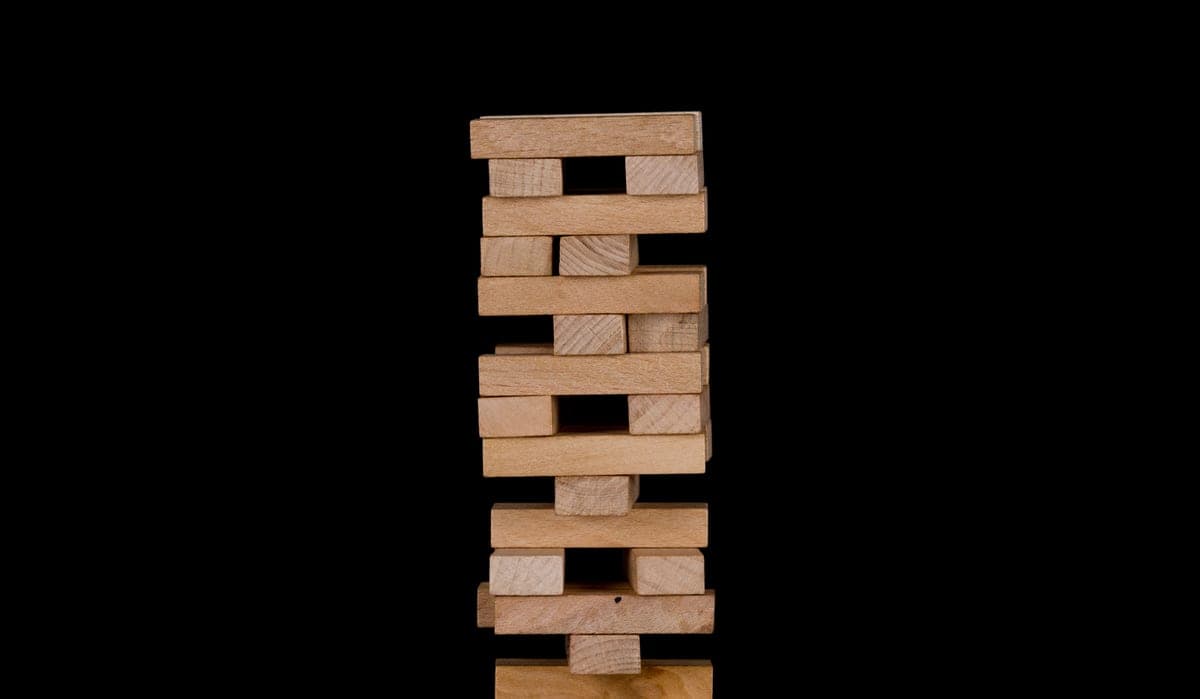
Best giant Jenga sets
Four tower sizes with published block dimensions, row counts and age floors — including one for a patio.

Guide
Giant game storage
How to store wooden giant games so they still play in year five — and what warps them.
Guide
Giant games, wind and weather
Wind, soft ground and damp — what actually ruins a giant game, and how to set up around it.

Picks
Best yard games for large groups
The games that genuinely absorb a crowd, by published player count and turn length.
Sources
Every figure on this page is copied from one of these sources. If you find one that is wrong or out of date, tell us and we will fix it.