Start here
Guests are not players
The mistake behind almost every over-purchase is treating the guest list as a player count. At a real gathering, most people are eating, talking or watching. A reasonable working assumption is that a third of your guests are playing anything at any given moment, and that number goes down when food arrives and up an hour afterwards.
So a 24-person barbecue has perhaps eight people wanting a game at its peak. Two games with published counts of 2 to 4 hold four to eight players plus a queue, and that is the party fully served.
A third game does not add capacity, it subtracts density. The same eight people spread across three games is two or three at each, and a game with two people at it is no longer visibly a thing to join.
Not two games — two jobs
The two roles you are actually buying for
The anchor
This is the game that runs unattended. It needs a short round, so the equipment frees up often; it needs to be legible from across a lawn, so nobody has to be taught; and it needs a small published player count, so a queue forms rather than a mob.
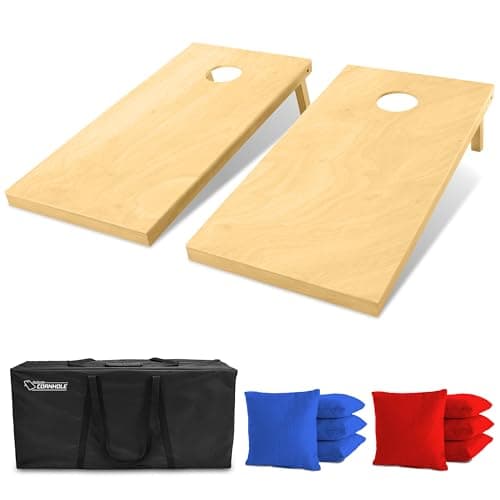
Cornhole is the standard answer. The ACL publishes 2 or 4 players, the court is 33 by 10 feet, and cancellation scoring keeps a round to a handful of throws. Ladder toss does the same job in 20 by 8 feet, with 3 / 2 / 1 scoring to exactly 21.
The loose game
This one has no fixed cast. Someone joins for one turn and leaves. Giant yard dice with a dry-erase scoreboard is the purest version — published as 2 or more players, which in practice means everyone standing nearby. A giant stacking tower publishes 2 or more with no upper limit and works the same way, with the added benefit that it is the thing in the yard people photograph.
What the loose game must not be is a game published for exactly four. Kan Jam and Spikeball are both 2 v 2 and both close the door behind them.
| Guests | Peak players | Games set up | Suggested pair |
|---|---|---|---|
| Up to 8 | 3 to 4 | 1 | One anchor — cornhole or ladder toss |
| 8 to 15 | 5 to 7 | 2 | Anchor plus a loose game |
| 15 to 30 | 8 to 12 | 2, spaced apart | Anchor plus a giant game |
| 30 to 50 | 12 to 18 | 3 | Two anchors at opposite ends plus a loose game |
| 50+ | 18+ | 3 to 4 stations | Spread out — see the block party page |
Fitting two games in one yard
Space is the second constraint, and it is a shape problem
Two games can share a yard if their footprints do not want the same axis. Most of what we cover needs a corridor, and a yard usually has one long run.
- Compatible: cornhole at 33 by 10 feet along the long axis, plus a giant game in about 10 by 10 feet near the patio. Different shapes, different corners.
- Compatible: ladder toss at 20 by 8 feet across the width, plus bocce down the length.
- Incompatible: Kan Jam at 60 feet and bocce at 60 feet. Both want the same run and only one of them gets it.
- Incompatible: anything alongside Spikeball, which needs about 30 feet in every direction and has no boundary — the players go where the ball goes.
The full footprint table for every game we cover is in how much space do yard games need, and by-space collections are filed by the shape of the ground you actually have.
The two rules that matter more than the count
Set up before guests arrive, and keep one in the bag
A game in a bag is not a game. Nobody unpacks and assembles a game at someone else's party. Whatever you own, the two you have chosen should be standing, in position, before the first guest walks in — that alone does more for a party than owning a third game.
Keep the third one packed. Every gathering has a moment where the energy drops. Producing an unopened object at that point restarts the party in thirty seconds, which the same object left standing all afternoon would not have done.
For a structured version of the same afternoon, with a bracket and a winner, see how to run a backyard tournament. For occasion-specific selections, games by occasion.
What we would buy
The gear behind this guide
The sets whose published specifications this page is built on. Ranked on spec completeness and footprint clarity, not on testing we have not done.

Best overall
GoSports 4 ft x 2 ft Solid Wood Premium Cornhole Set
GoSports
Regulation 4 x 2 ft boards on solid pine frames with a 1/2 in cabinet-grade plywood top, eight 16 oz all-weather bags and a case — the complete tournament-legal setup in one box.
Skip this if
Skip this if your yard is under 30 ft long. A regulation court is 27 ft board-front to board-front plus throwing room behind each board, and there is no shortening it without changing the game.
Price as of October 19, 2026. #ad How we make money
Best overall
Yard Games Giant Tumbling Timbers
Yard Games
56 sustainably sourced New Zealand pine blocks at 1.5 x 2.5 x 7.5 in, starting at 2.5 ft over 19 rows and reaching 5 ft, in a nylon case.
Skip this if
Skip this if the only flat ground you have is a lawn. A 19-row tower needs a hard, level base — grass tips it before anybody pulls a block.

Best overall
Yard Games Ladder Toss (Double Wooden Ladder Ball)
Yard Games
A finished wood frame with real golf-ball bolas and a nylon case — the version that does not rattle apart the way tube-and-plastic ladder sets do.
Skip this if
Skip this if you need the set to stand up in wind. A wooden ladder frame has a big sail area and no ground stakes.
Price as of October 19, 2026. #ad How we make money

Best overall
GoSports Giant 3.5 in Wooden Playing Dice Set
GoSports
Six 3.5 in hand-sanded pine dice with heat-stamped numbers that will not rub off, plus a dry-erase scoreboard and a canvas bag.
Skip this if
Skip this if your lawn slopes. Giant dice roll further than you expect and a slope turns every throw into a search.
Price as of October 19, 2026. #ad How we make money
FAQ
Questions people actually ask
How many yard games do I need for 20 people?
Is it better to have more games or fewer?
What is an anchor game?
How much space do two games need?
Why you can check our work
We have not played these. Every figure above is copied from a manufacturer's published listing or a governing body's published rules, and named so you can verify it. Where a maker publishes nothing, the field is blank rather than filled in. How we pick explains the whole method, including what would change a recommendation.
Read next
Related pages
Picks
Yard game guides
Rules, regulation dimensions, materials and storage — sourced from governing bodies and makers.
Picks
Best yard games for a backyard cookout
Five games that survive a cookout — fast setup, one-handed play, easy to abandon and rejoin.

Picks
Best yard games for large groups
The games that genuinely absorb a crowd, by published player count and turn length.
Picks
Yard games for a graduation party
One yard, four decades of guests and a schedule — the games that hold a mixed crowd together.
Guide
How much space do yard games need?
Every game's published footprint, longest run and player count in one sourced table.

Guide
How to run a backyard tournament
Bracket sizes, round lengths and the games with published rulebooks worth competing on.
Sources
- American Cornhole League — rules and regulations
- Kubb World Championship — rules (English)
- Kan Jam — how to play
Every figure on this page is copied from one of these sources. If you find one that is wrong or out of date, tell us and we will fix it.