
Step one
Pick a game with a published rulebook
This is the single highest-value decision, and it rules out most of the catalogue for tournament purposes — not because those games are worse, but because there is nothing to point at when two people disagree.
| Game | Published rules | Round length | Tournament verdict |
|---|---|---|---|
| Cornhole | American Cornhole League | Short — cancellation scoring | Best choice |
| Kubb | Kubb World Championship | Long — 20 to 40 minutes | Great game, long matches |
| Molkky | International Molkky Organisation | Medium — first to exactly 50 | Very good, self-levelling |
| Bocce | United States Bocce Federation | Medium | Good, needs a measuring rope |
| Horseshoes | NHPA | Medium | Good if you have a pit |
| Spikeball | International Roundnet Federation | Short rallies, long matches | Good for an athletic group |
| Kan Jam | Manufacturer rules | Short — first to exactly 21 | Fine, fixed at four players |
| Ladder toss | None — conventions vary | Short | Agree the rules explicitly |
| Giant stacking tower | None | Unpredictable | Not a bracket game |
Cornhole wins on all three counts: published rules, short rounds and a player count that brackets cleanly. The rules themselves are summarised in cornhole rules, and the court dimensions in regulation cornhole dimensions.
Step two
Draw a bracket that is a power of two
Four, eight or sixteen teams. Nothing else. A bracket that is not a power of two needs byes, and a bye is a free pass into the second round that somebody will resent by the third.
If you have an awkward number of players, the fix is to change the teams rather than the bracket. Six people is three teams of two, so make it four teams by putting the two strongest players in singles teams and pairing the rest — cornhole publishes 2 or 4 players and singles is a standard format, so this is not a house rule.
Single elimination, not double. An 8-team single-elimination bracket is 7 matches in 3 rounds. Double elimination roughly doubles that, and the losers' bracket is played by people who have already decided they are done. Run a second short bracket afterwards instead if there is appetite.
| Teams | Matches | Rounds | One court | Two courts |
|---|---|---|---|---|
| 4 | 3 | 2 | About 45 min | About 30 min |
| 8 | 7 | 3 | About 1 hr 45 | About 1 hr |
| 16 | 15 | 4 | About 3 hr 45 | About 2 hr |
| 32 | 31 | 5 | Too long | About 4 hr |
Step three
Say the rules out loud before the first throw
Thirty seconds, in front of everyone, covering exactly four things:
- Which rulebook. “ACL rules.” That is the whole sentence.
- What you have changed. Playing to 15 instead of 21 to keep matches short is the most common and most useful modification. Say it.
- How ties are broken. In cornhole, cancellation scoring means an exact bust is possible; decide in advance whether you play on or reset.
- Who adjudicates. One person, named. Not a committee, and not the host if the host is playing.
For bocce, add one more: use the measuring rope. Close ends are the entire dispute surface of bocce and the GoSports sets publish a rope in the box for exactly this reason.
What actually helps
Equipment worth having for a bracket
- Certified bags, if it is cornhole. ACL COMP bags are published at 6 by 6 inches and 16 ounces with a certification for competitive play. A tournament where everyone throws the same bag removes an argument you did not know you were going to have. Comparison: cornhole bags.
- A second set of boards. The single biggest improvement to running time.
- A visible bracket. Written on something. A dry-erase board is genuinely useful and a giant yard dice set ships one.
- A measuring rope, for bocce or for any game where “closest wins” decides points.
If this is for a work event rather than friends, the social constraints change the game choice considerably — yard games for a company picnic covers why an individual-skill game is the wrong pick in front of colleagues.
What we would buy
The gear behind this guide
The sets whose published specifications this page is built on. Ranked on spec completeness and footprint clarity, not on testing we have not done.

Best overall
GoSports 4 ft x 2 ft Solid Wood Premium Cornhole Set
GoSports
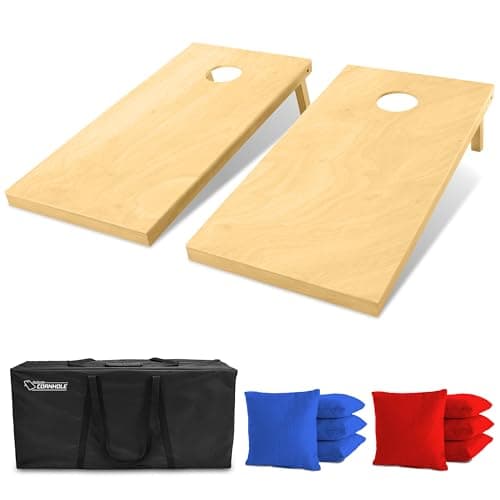
Regulation 4 x 2 ft boards on solid pine frames with a 1/2 in cabinet-grade plywood top, eight 16 oz all-weather bags and a case — the complete tournament-legal setup in one box.
Skip this if
Skip this if your yard is under 30 ft long. A regulation court is 27 ft board-front to board-front plus throwing room behind each board, and there is no shortening it without changing the game.
Price as of October 19, 2026. #ad How we make money

Best league-legal starting point
ACL COMP Officially Licensed Cornhole Bags
American Cornhole League
Dual-fabric, dual-speed bags at the ACL's own 6 x 6 in and 16 oz spec, licensed and stamped by the league that wrote the number.
Skip this if
Skip this if nobody in your group can slide a bag yet. Dual-speed fabric rewards a technique you have to build first; a rec bag is more fun for a year.
Price as of October 19, 2026. #ad How we make money
Best overall
Yard Games Kubb Premium Size Set
Yard Games
Hardwood kubb with a case, printed instructions and — the part that matters — boundary markers, so the 5 x 8 m pitch is set correctly the first time.
Skip this if
Skip this if your only space is 20 ft long. The pitch is 8 m end to end and shortening it breaks the throwing distances the game is built on.

Best overall
Tactic Mölkky Original Set
Tactic Games
The original — Tactic Games has held the Mölkky rights and trademark since 2016 and the games are still made in Pori, Finland.
Skip this if
Skip this if you want a game that survives being left on the lawn. Molkky is untreated birch and it will gray and swell.
Price as of October 19, 2026. #ad How we make money
FAQ
Questions people actually ask
What game is best for a backyard tournament?
How long does a backyard tournament take?
How many teams should a backyard bracket have?
Should you use official rules?
Why you can check our work
We have not played these. Every figure above is copied from a manufacturer's published listing or a governing body's published rules, and named so you can verify it. Where a maker publishes nothing, the field is blank rather than filled in. How we pick explains the whole method, including what would change a recommendation.
Read next
Related pages
Picks
Yard game guides
Rules, regulation dimensions, materials and storage — sourced from governing bodies and makers.
Guide
Cornhole rules
ACL scoring, cancellation explained, and what happens past 21 — with the published source.
Picks
Best cornhole boards
Five regulation sets ranked on published surface thickness, frame construction, weight and bags.

Picks
Yard games for a company picnic
Wide ability ranges, mixed enthusiasm and a trip to a park — what survives a work event.
Picks
Best kubb sets
2 to 12 players on a 5 by 8 meter pitch — three hardwood sets compared on published piece dimensions.

Guide
How many yard games do you need for a party?
Turning a guest count into an actual number of games, using published player counts.
Sources
- American Cornhole League — rules and regulations
- Kubb World Championship — rules (English)
- International Molkky Organisation — game rules
- United States Bocce Federation — open rules
Every figure on this page is copied from one of these sources. If you find one that is wrong or out of date, tell us and we will fix it.