
People assume yard games damage a lawn the way furniture does — evenly, everywhere the thing sits. They do not. Every worn backyard we have looked at shows the same pattern: the middle of the playing area is fine and there are two bald patches at the ends.
That happens because grass is far more tolerant of being walked across than of being stood on. Walking distributes load; standing compacts soil, and compacted soil has no air in the root zone.
The pattern
Games sorted by how they load a lawn
| Game | Where people stand | Lawn impact |
|---|---|---|
| Horseshoes | Two pitching platforms | Permanent — the court requires dug pits |
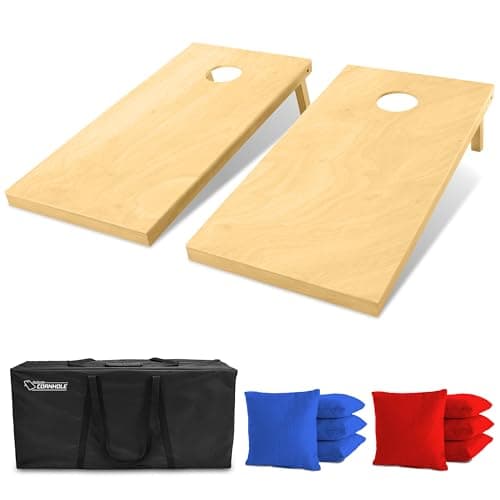
| Cornhole | Two pitcher's boxes, 27 ft apart | Two hard-wearing patches |
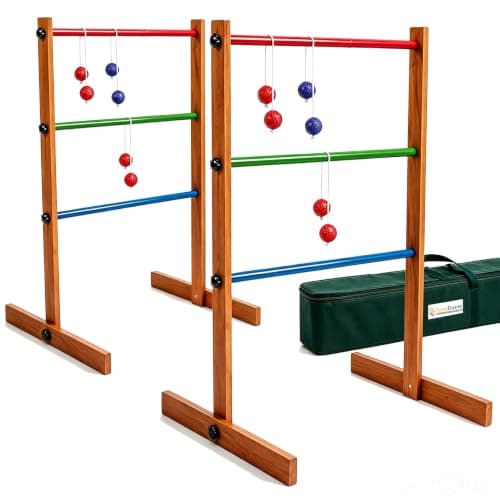
| Ladder toss | One line, 15 ft from the frames | One patch |
| Kubb | Two baselines, 8 m apart | Two patches plus centre traffic |
| Molkky | One throwing line at 3 to 4 m | One small patch |
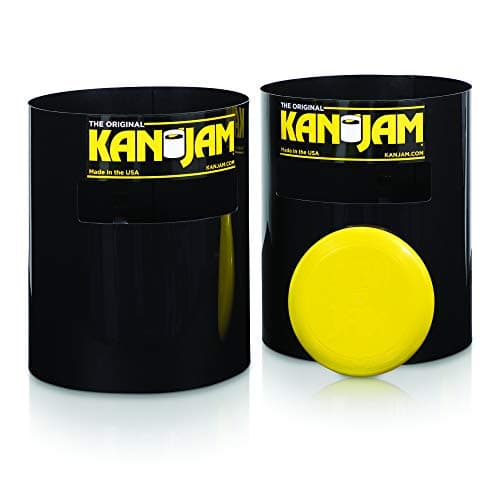
| Kan Jam | Two throwing positions, 50 ft apart | Two patches |
| Badminton | Both service areas | Two patches, plus wear at the net line |
| Bocce | Nowhere fixed — you walk the court | Minimal, spread out |
| Croquet | Nowhere fixed — you follow your ball | Minimal, but needs short grass |
| Spikeball | Everywhere and hard | Diffuse scuffing, occasional divots |
| Giant games | One spot, but they want hard ground anyway | Move them off the lawn |
Before you buy
What each game actually asks of the grass
Games with a real lawn requirement
Croquet is the only one with a genuine prerequisite. A ball must run accurately through a wicket, so the grass has to be short — the USCA notes a backyard court need not be manicured, but long grass makes wicket-running a lottery. It is worth knowing this before buying, because it commits you to mowing on a schedule.
Bocce is at the opposite extreme, and it is the reason the game travels so well: the makers publish grass, sand, gravel and dirt as playable surfaces. Long grass slows a roll, which changes the game and does not break it.
Games that damage rather than wear
Horseshoes is not a lawn game in the ordinary sense. The NHPA court specifies pit boxes 43 to 72 inches long and 31 to 36 inches wide, filled with clay or sand, with stakes 40 feet apart. That is a permanent change to the property, not wear — and pitching regulation shoes onto turf instead is worse, because a 2 pound 10 ounce steel shoe takes a divot every throw.
Games that should not be on grass at all
Giant stacking towers and giant frame games need a hard, level base, so the lawn question resolves itself: put them on the patio or the driveway. That is better for the game and better for the grass. See yard games for driveways and hard surfaces.
Practical
Keeping a played-on lawn playable
- Rotate the court. The highest-value habit on this page.
- Do not play a saturated lawn. Wet soil compacts far more readily than dry, and one afternoon of cornhole after heavy rain does more damage than a month of dry play.
- Keep the giant games off it entirely. They want hard ground anyway.
- Mow before croquet, not after. Wickets are easier to set in ground that has been watered, and easier to see in grass that has been cut.
- Lift everything before winter. A game left standing on grass for five months blocks light and kills the patch underneath it — the same reason a paddling pool leaves a yellow circle. See winterizing yard games.
If the lawn is uneven as well as worn, the levelling question is separate and covered in levelling ground for yard games, with the game-by-game tolerance table in sloped and uneven yards.
What we would buy
The gear behind this guide
The sets whose published specifications this page is built on. Ranked on spec completeness and footprint clarity, not on testing we have not done.

Best overall
St. Pierre Sports Professional Bocce Set, 107 mm
St. Pierre
107 mm thermo-set composition resin balls built to international bocce specifications and named an official ball of the United States Bocce Federation.
Skip this if
Skip this if the set is mainly for kids or a beach bag. Full-size 107 mm balls are heavy enough that a small player cannot roll one accurately.
Price as of October 19, 2026. #ad How we make money

Best overall
Yard Games Ladder Toss (Double Wooden Ladder Ball)
Yard Games
A finished wood frame with real golf-ball bolas and a nylon case — the version that does not rattle apart the way tube-and-plastic ladder sets do.
Skip this if
Skip this if you need the set to stand up in wind. A wooden ladder frame has a big sail area and no ground stakes.
Price as of October 19, 2026. #ad How we make money

Best overall
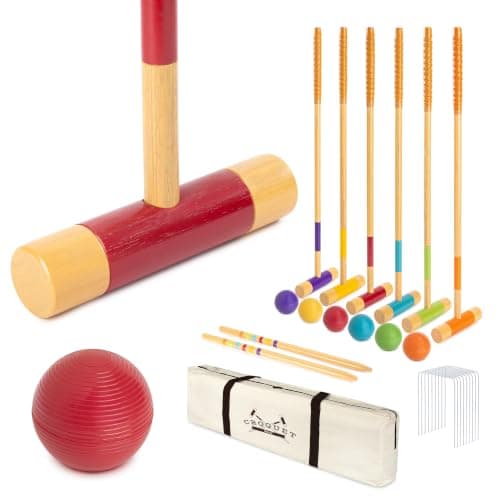
GoSports Six Player Croquet Set
GoSports
Six hardwood mallets — 35 in in the deluxe version — six 3 in and 10 oz balls, nine wickets, two end posts and a wooden stand, which is the full nine-wicket kit in one purchase.
Skip this if
Skip this if your lawn is under about 40 ft. The USCA full court is 100 x 50 ft and while you can shrink it, below about 40 ft the wickets stop being a challenge.
Price as of October 19, 2026. #ad How we make money

Best overall
Tactic Mölkky Original Set
Tactic Games
The original — Tactic Games has held the Mölkky rights and trademark since 2016 and the games are still made in Pori, Finland.
Skip this if
Skip this if you want a game that survives being left on the lawn. Molkky is untreated birch and it will gray and swell.
Price as of October 19, 2026. #ad How we make money
FAQ
Questions people actually ask
Which yard games damage a lawn most?
Do yard games kill grass?
How do you stop a cornhole court wearing out the grass?
Does croquet need a special lawn?
Why you can check our work
We have not played these. Every figure above is copied from a manufacturer's published listing or a governing body's published rules, and named so you can verify it. Where a maker publishes nothing, the field is blank rather than filled in. How we pick explains the whole method, including what would change a recommendation.
Read next
Related pages
Picks
Yard game guides
Rules, regulation dimensions, materials and storage — sourced from governing bodies and makers.
Guide
Levelling ground for yard games
Which games need level ground, which do not, and the fixes that avoid digging entirely.
Picks
Yard games for sloped and uneven yards
The games that still work on a slope or a bumpy lawn, and the three that genuinely do not.

Guide
Winterizing yard games
End-of-season storage by published material, and the two mistakes that ruin most sets.
Picks
Croquet sets
Nine wickets, two stakes, up to six players — and the honest answer on how small a court can get.
Picks
Best yard games for big lawns
The games that need 60 feet or more — and finally work when you have it.
Sources
- American Cornhole League — rules and regulations
- United States Bocce Federation — open rules
- NHPA — official rules and specifications
- Kubb World Championship — rules (English)
Every figure on this page is copied from one of these sources. If you find one that is wrong or out of date, tell us and we will fix it.