Almost nothing in this category is destroyed by cold. What destroys it is water that was already in the material when it got put away, and five months of contact with something that keeps supplying more.
So winterizing is not really a weather job. It is a drying job followed by a storage-height job, and it takes about twenty minutes for a whole garage of equipment.
The framework
Sort by published material, not by game
| Material | Found in | Winter requirement |
|---|---|---|
| Solid resin / polyresin | Bocce balls | Nothing — genuinely fine outdoors |
| Steel | Horseshoes | Dry and oil lightly; store off the floor |
| Steel rim and inflated ball | Spikeball | Deflate slightly, store the net loose |
| Resin or plastic pellet fill | Cornhole bags | Fill is fine; dry the fabric completely |
| Pine | Tumbling timbers, yard dice, board frames | Dry fully, store indoors and off concrete |
| Hardwood | Kubb, Jenga GIANT | Dry fully, store indoors and off concrete |
| Birch | Molkky | Dry fully, store indoors — the most vulnerable set here |
| Plywood | Cornhole tops (premium) | Dry, store flat or supported upright |
| MDF | Cornhole tops (budget) | Dry, indoors, flat — one soaking is terminal |
| Nylon cases and bags | Almost every set | Dry inside out before packing anything into them |
The material breakdown itself — which material fails how, and why resin does not care — is in wood vs plastic yard games. This page is what to do about it in October.
Twenty minutes, once
The end-of-season pass
- Lay everything out in the dry for an afternoon. Not in direct sun, which fades and stiffens fabric and raises grain on pine. A garage floor with the door open is ideal.
- Brush, do not wash. Dried mud comes off wood and off cornhole bags with a stiff brush. Water is the thing you are trying to remove, so adding more is counterproductive. Bag-specific detail is in how to look after cornhole bags.
- Check the hardware. Cornhole legs run on bolts and wing nuts — the GoSports set publishes 3/8 inch galvanized steel — and a wing nut that has worked loose over a season is the thing that lets a board rack out of square in storage.
- Get everything off the concrete. The single highest-value step on this page.
- Count the small parts now, not in April. Bolas, pallinos, wickets, shuttlecocks and Spikeball balls all go missing over a summer, and finding out in October gives you five months to replace them.
The specifics
Game by game
Cornhole
The boards are the concern, not the bags. A 4 by 2 foot top stored leaning at an angle takes a bow that does not come out, and a bowed surface changes how a bag slides. Flat is best; upright and properly supported at both ends is acceptable. Loosen nothing — retracted legs on their bolts are the storage position the sets are designed around.
Giant games
Fifty-six pine blocks is a lot of surface area and each one has to be dry. Stand them loosely in the case rather than packed tight, and put the case on a shelf. The category has its own page: giant game storage.
Bocce
Nothing required. Solid resin at 90 to 107 mm is indifferent to weather, and the makers publish grass, sand, gravel and dirt as playable surfaces. The only thing worth doing is checking the pallino is in the case, because it is the one piece a set cannot work without.
Molkky and kubb
The most vulnerable and the second most vulnerable sets here. Birch and hardwood both absorb water; both are thrown, so both spend the summer landing on wet grass. Dry them thoroughly and store them indoors, not in an unheated shed with a leak in it.
Horseshoes
Drop-forged steel does not care about winter and will surface-rust if left wet. Wipe dry, wipe with a lightly oiled cloth, and store off the floor. The pit itself is a groundworks question rather than a storage one — clay dries out and compacts, and it is normal to top it up in spring.
Spikeball and badminton
Both are frames plus soft goods. Let a little pressure out of the Spikeball ball so it is not stored fully tensioned for five months, and store the net loose rather than under tension. Shuttlecocks want to be flat in their tube, not crushed in the bottom of a bag.
The other half
What to do in spring
Very little, if the autumn pass was done properly. Check cornhole board hardware for loose wing nuts before the first game, re-stand a giant tower on hard level ground rather than the first patch of lawn you come to, and replace anything on the missing-parts list you wrote in October.
The one genuine spring job is the lawn, which spends a summer being played on and a winter recovering: yard games and your lawn.
What we would buy
The gear behind this guide
The sets whose published specifications this page is built on. Ranked on spec completeness and footprint clarity, not on testing we have not done.
Best overall
Yard Games Giant Tumbling Timbers
Yard Games
56 sustainably sourced New Zealand pine blocks at 1.5 x 2.5 x 7.5 in, starting at 2.5 ft over 19 rows and reaching 5 ft, in a nylon case.
Skip this if
Skip this if the only flat ground you have is a lawn. A 19-row tower needs a hard, level base — grass tips it before anybody pulls a block.

Best overall
St. Pierre Sports Professional Bocce Set, 107 mm
St. Pierre
107 mm thermo-set composition resin balls built to international bocce specifications and named an official ball of the United States Bocce Federation.
Skip this if
Skip this if the set is mainly for kids or a beach bag. Full-size 107 mm balls are heavy enough that a small player cannot roll one accurately.
Price as of October 21, 2026. #ad How we make money

Best overall
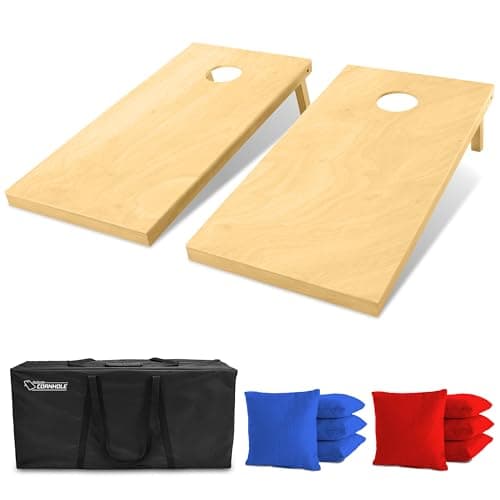
GoSports 4 ft x 2 ft Solid Wood Premium Cornhole Set
GoSports
Regulation 4 x 2 ft boards on solid pine frames with a 1/2 in cabinet-grade plywood top, eight 16 oz all-weather bags and a case — the complete tournament-legal setup in one box.
Skip this if
Skip this if your yard is under 30 ft long. A regulation court is 27 ft board-front to board-front plus throwing room behind each board, and there is no shortening it without changing the game.
Price as of October 21, 2026. #ad How we make money

Best league-legal starting point
ACL COMP Officially Licensed Cornhole Bags
American Cornhole League
Dual-fabric, dual-speed bags at the ACL's own 6 x 6 in and 16 oz spec, licensed and stamped by the league that wrote the number.
Skip this if
Skip this if nobody in your group can slide a bag yet. Dual-speed fabric rewards a technique you have to build first; a rec bag is more fun for a year.
Price as of October 21, 2026. #ad How we make money
FAQ
Questions people actually ask
Do yard games need to be brought in for winter?
What is the biggest storage mistake?
Is a garage floor a bad place to store yard games?
Should cornhole boards be stored flat or upright?
Why you can check our work
We have not played these. Every figure above is copied from a manufacturer's published listing or a governing body's published rules, and named so you can verify it. Where a maker publishes nothing, the field is blank rather than filled in. How we pick explains the whole method, including what would change a recommendation.
Read next
Related pages
Picks
Yard game guides
Rules, regulation dimensions, materials and storage — sourced from governing bodies and makers.
Guide
Giant game storage
How to store wooden giant games so they still play in year five — and what warps them.
Guide
Weatherproof yard games
Every game ranked on what actually happens when it is left outside, by published material.
Guide
Wood vs plastic yard games
Pine, hardwood, resin, MDF and plywood — what each published material does over a season.
Guide
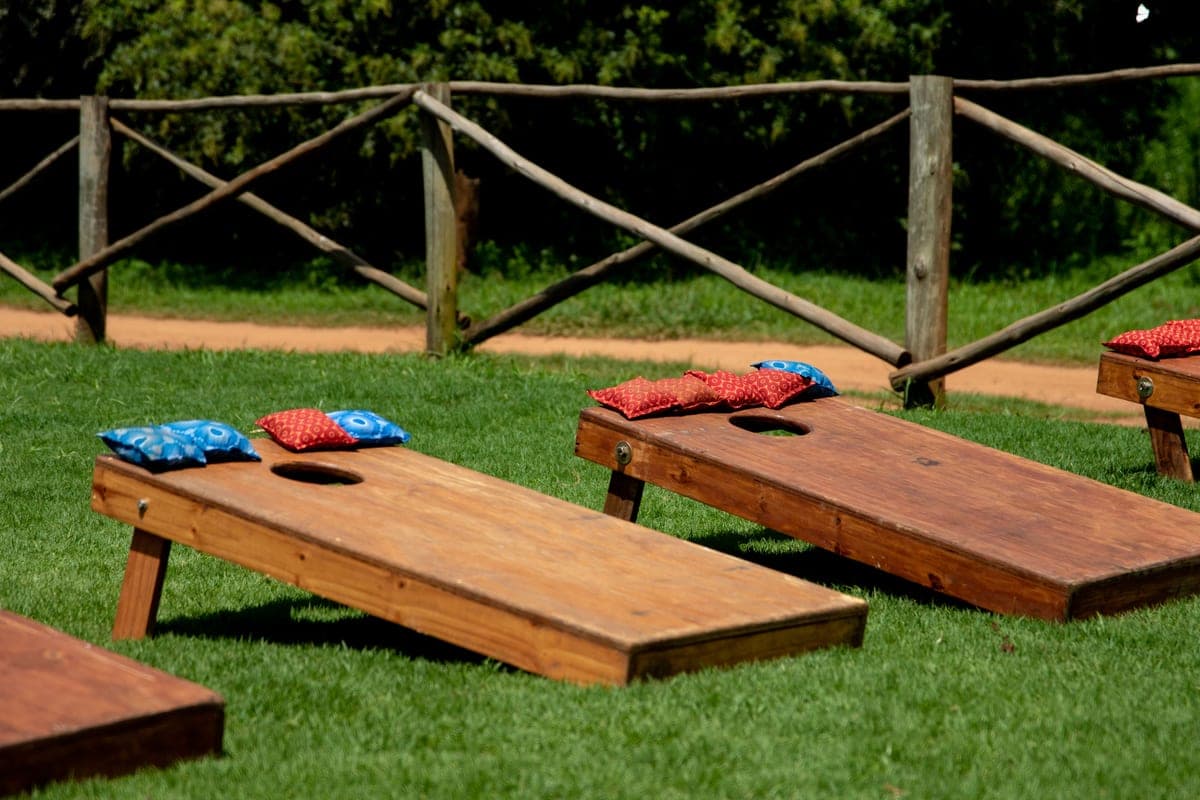
How to look after cornhole bags
Cleaning, drying and storing resin-filled bags, and the signs a set is finished.

Guide
Yard games and your lawn
Which games wear turf, where the damage always appears, and how to keep a lawn playable.
Sources
- Yard Games — Giant Tumbling Timbers
- United States Bocce Federation — open rules
- American Cornhole League — rules and regulations
- NHPA — official rules and specifications
Every figure on this page is copied from one of these sources. If you find one that is wrong or out of date, tell us and we will fix it.