Material is published on nearly every set we cover and read by almost nobody. It is also the single best predictor of whether a game will still be usable in three years, because it determines what happens the first time it is left out overnight in the rain — which, realistically, is going to happen.
Published, not inferred
The five materials, and what each one does
Solid resin and polyresin
Bocce, and nothing else here. Balls are published as thermo-set composition resin or solid polyresin at 90 to 107 mm, and the makers list grass, sand, gravel and dirt as acceptable surfaces. Water does nothing to them, UV does nothing meaningful, and a ball left in a flower bed all winter is a ball you can play with in spring.
Hardwood
Kubb sets are published as solid shock-absorbent hardwood or knot-free hardwood, and Jenga GIANT publishes premium hardwood. Hardwood is dense, takes impact well, and is what you want in a game where blocks hit each other. It still absorbs water, still greys in sun, and still splits eventually — it just takes longer than pine.
Pine
The material of the giant category. Yard Games publishes sustainably sourced New Zealand pine for its Tumbling Timbers range; GoSports publishes hand-sanded pine with heat-stamped numbers for its yard dice; cornhole frames are published as solid pine. Pine is light, which is exactly why it is used for objects you carry — and it is soft, so it dents, and it raises grain after repeated soaking.
Plywood
Cornhole playing surfaces at the good end: 1/2 inch varnished cabinet-grade plywood and 15 mm furniture-grade plywood. Plywood is layers glued together, so its failure mode is delamination — the layers separate and the surface lifts. That is a one-way process and it is why a plywood board wants a cover.
MDF
Cornhole surfaces at the budget end. MDF is a perfectly good indoor-stored playing surface — flat, smooth, cheap — and it is compressed fibre and glue, so water swells it irreversibly. One night out in the wet is genuinely enough.
| Material | Found in | Water | Sun | Can live outside |
|---|---|---|---|---|
| Solid resin / polyresin | Bocce balls | No effect | Minimal | Yes |
| Resin / plastic pellet fill | Cornhole bags | Fill unaffected; fabric mildews | Fades fabric | No — dry the fabric |
| Steel | Horseshoes | Rusts if untreated | None | In a pit, yes |
| Inflated ball and steel rim | Spikeball | No effect | Minimal | Broadly yes |
| Hardwood | Kubb, Jenga GIANT | Absorbs, then splits | Greys | No |
| Pine | Timbers, yard dice, frames | Raises grain, swells | Greys | No |
| Birch | Molkky | Absorbs, then splits | Greys | No |
| Plywood | Cornhole tops (premium) | Delaminates | Degrades finish | No |
| MDF | Cornhole tops (budget) | Swells irreversibly | Degrades finish | Definitely not |
| Water-resistant composite | All-weather cornhole | Designed for it | Designed for it | Yes, with a cover |
Practical
How to buy on material
If the game will live outdoors
Buy resin. That means bocce, and it is the reason bocce is the most owned and most played game among households that have limited storage. If it has to be cornhole, buy the all-weather set and still put a cover on it.
If you have indoor storage
Buy the wood. Kubb in hardwood, Molkky in birch, a pine stacking tower — these are better objects and better games, and with a cupboard to keep them in the material disadvantage disappears entirely. Every one of those sets ships a carrying case for precisely this reason.
If you are buying cornhole specifically
The surface material is the spec that matters most and it is always published. Cabinet- or furniture-grade plywood if the set will be stored dry; all-weather construction if it will not; MDF only if it genuinely lives indoors between games. The full breakdown is in cornhole board materials.
If you are buying bocce specifically
Composition resin against solid polyresin is a real difference in how a ball wears and sounds, and it is covered in resin vs composite bocce. Size is the other axis: bocce ball sizes.
Storage
What to do with the wooden games you already own
Almost all of it comes down to drying and covering. Wood that goes away dry keeps its shape; wood that goes away damp in a nylon case does not. Nothing wooden should be stored on a concrete floor, which wicks moisture upward into the bottom layer of whatever is sitting on it.
The giant category has its own storage page because the objects are large and awkward: giant game storage. The weather-by-weather breakdown across the whole catalogue is in weatherproof yard games, and wind specifically — which is a structural risk rather than a material one — is in giant games in wind and weather.
What we would buy
The gear behind this guide
The sets whose published specifications this page is built on. Ranked on spec completeness and footprint clarity, not on testing we have not done.

Best overall
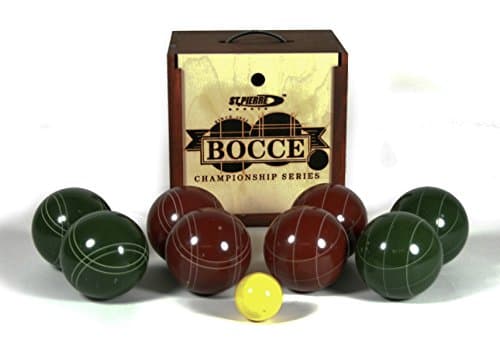
St. Pierre Sports Professional Bocce Set, 107 mm
St. Pierre
107 mm thermo-set composition resin balls built to international bocce specifications and named an official ball of the United States Bocce Federation.
Skip this if
Skip this if the set is mainly for kids or a beach bag. Full-size 107 mm balls are heavy enough that a small player cannot roll one accurately.
Price as of October 19, 2026. #ad How we make money
Best if it lives outside
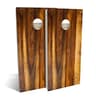
Slick Woody's Lifestyle All-Weather Cornhole Boards
Slick Woody's
Regulation 4 x 2 ft boards built on water-resistant materials with leg and back-brace supports — the set to buy when the honest answer is that it will never come indoors.
Skip this if
Skip this if you want a bare surface you can paint yourself. The graphics are the product here; you are buying a finished look, not a blank.
Price as of October 19, 2026. #ad How we make money
Best overall
Yard Games Kubb Premium Size Set
Yard Games
Hardwood kubb with a case, printed instructions and — the part that matters — boundary markers, so the 5 x 8 m pitch is set correctly the first time.
Skip this if
Skip this if your only space is 20 ft long. The pitch is 8 m end to end and shortening it breaks the throwing distances the game is built on.

Best cheap regulation set
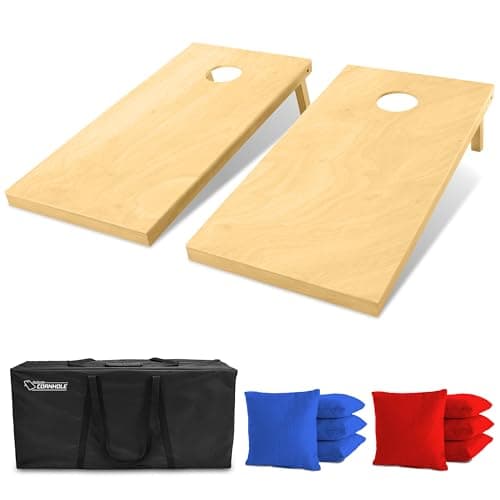
GoSports Classic 4 ft x 2 ft Cornhole Set (MDF)
GoSports
Full regulation footprint on an MDF top instead of plywood — the cheapest honest way to get 4 x 2 ft boards, eight bags and a case.
Skip this if
Skip this if the set will be stored in a shed or left under a tarp. MDF and moisture are a one-way relationship; plywood is the upgrade that matters.
Price as of October 19, 2026. #ad How we make money

Best value
Spikeball Standard 3 Ball Kit
Spikeball
The original kit with three standard balls — same 3 ft net, same rules, lighter rim and legs, and the right set for a lawn rather than a bracket.
Skip this if
Skip this if you play on packed sand or concrete every week. The lighter rim and legs are the published difference and they are what gives out first.
FAQ
Questions people actually ask
Are wooden yard games better than plastic?
Which yard games can be left outside?
Is MDF or plywood better for cornhole boards?
What is an all-weather cornhole board actually made of?
Why you can check our work
We have not played these. Every figure above is copied from a manufacturer's published listing or a governing body's published rules, and named so you can verify it. Where a maker publishes nothing, the field is blank rather than filled in. How we pick explains the whole method, including what would change a recommendation.
Read next
Related pages
Picks
Yard game guides
Rules, regulation dimensions, materials and storage — sourced from governing bodies and makers.
Guide
Weatherproof yard games
Every game ranked on what actually happens when it is left outside, by published material.
Guide
Cornhole board materials
Plywood against MDF, frame construction and bag fill — what each buys over five seasons.
Comparison
Resin vs composite bocce balls
What the two published bocce compounds actually change — and the spec that matters more than either.
Comparison
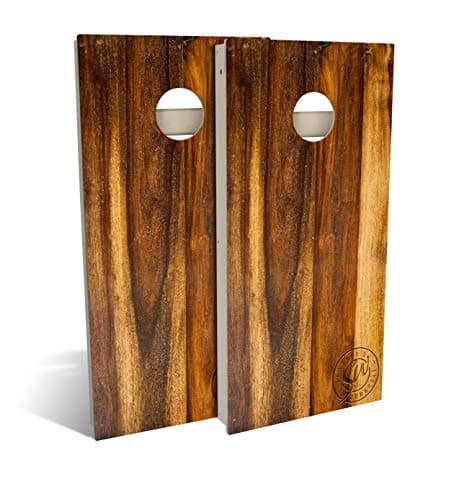
All-weather vs wood cornhole boards
What weather-resistant construction actually buys, and when a $30 cover beats the upgrade.

Guide
Giant game storage
How to store wooden giant games so they still play in year five — and what warps them.
Sources
- United States Bocce Federation — open rules
- Yard Games — Kubb premium set
- Slick Woody's — all-weather cornhole boards
- GoSports — Classic regulation cornhole set (MDF)
Every figure on this page is copied from one of these sources. If you find one that is wrong or out of date, tell us and we will fix it.