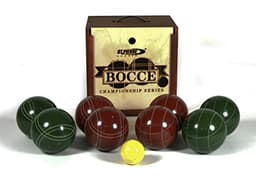
What is actually published
The two compounds
| Set | Material | Diameter | Published weight |
|---|---|---|---|
| St. Pierre Professional | Thermo-set composition resin | 107 mm | Not published |
| Baden Champions 107 | Solid polyresin | 107 mm | 2 lb each |
| Baden Champions 90 | Solid polyresin | 90 mm | Not published |
| GoSports 100 mm | High-gloss polyresin | 100 mm | Not published |
| GoSports 90 mm | Not published | 90 mm | Not published |
Note how little is actually published. One weight figure across five sets. That is typical of this category and it is why we do not rank on “premium feel” — there is nothing to rank.
The one hard credential in the group is St. Pierre's: its set is manufactured to international bocce specifications and is named an official ball of the United States Bocce Federation. That is a verifiable claim about a specific compound rather than a marketing adjective, which is why it tops our bocce ranking.
By surface
Where the difference shows up
Grass
No practical difference. Balls land on turf, roll, and stop. Both compounds will look the same after five seasons. Buy on diameter and pallino size.
Sand
No practical difference either, and bocce is the best sand game we cover — see beach and sand games. Sand is soft and forgiving; the ball buries slightly and stops, which is exactly the read you want.
Gravel and driveways
Here it matters. Stone is harder than either compound, so every roll across gravel is light abrasion and the occasional real chip. The harder thermo-set compound holds its surface longer. If your only flat run is a gravel side yard, this is the reason to spend the extra.
Hard court
Ball-on-ball contact is the wear mechanism, and it is much heavier than on grass because nothing absorbs the impact. Same conclusion as gravel.
Buy this instead
The thing to actually spend on
If you are choosing between a more expensive compound and a set with a larger pallino and a measuring rope, take the pallino and the rope. The compound affects how the balls look in year seven. The pallino affects whether you can find the target ball tonight, and the rope decides who won this frame.
And if the set is for a mixed-age household, the 90 mm diameter beats every material consideration on this page. A child who cannot roll the ball accurately is not playing the game, regardless of what the ball is made of.
The other side
Where to buy the other one
The card at the top of this page covers one side of the comparison. This is our current pick for the other, ranked on published specifications rather than on play we have not done.
Best full-size alternative
Baden Champions Bocce Ball Set, 107 mm
Baden
Full 107 mm solid polyresin at a published 2 lb per ball, with a high-visibility 60 mm pallino — the most legible set here in long grass.
Skip this if
Skip this if you play mostly at dusk or on a beach at the end of the day. Solid resin has no light of its own and 2 lb balls disappear in shadow.
FAQ
Questions people actually ask
What are bocce balls made of?
Do bocce balls crack?
How much does a bocce ball weigh?
Why you can check our work
We have not played these. Every figure above is copied from a manufacturer's published listing or a governing body's published rules, and named so you can verify it. Where a maker publishes nothing, the field is blank rather than filled in. How we pick explains the whole method, including what would change a recommendation.
Read next
Related pages
Picks
Best bocce ball sets
Six sets compared on published ball diameter, material and weight — including the size question nobody explains.
Guide
Bocce ball rules
Scoring, player-count variations and the no-court version — with the USBF as the source.
Guide
Bocce court dimensions
USBF regulation, backyard and indoor court sizes — and how small a court can honestly get.

Picks
Best games for beach and sand
The games that get better on sand, the ones that stop working, and why.
Sources
- St. Pierre — professional bocce set 107 mm
- Baden Sports — Champions bocce ball set 107 mm
- United States Bocce Federation — open rules
Every figure on this page is copied from one of these sources. If you find one that is wrong or out of date, tell us and we will fix it.