The short answer
Quick picks
Ranked on published specs, not on play we have not done. Tap any row to jump to the full write-up further down this page.
| # | Product | Best for | Score | Price |
|---|---|---|---|---|
| 1 | No photo Spikeball Pro Kit The official set of USA Spikeball sanctioned tournaments — published as 33% stronger legs and rims than the standard kit, with two grippy Pro balls, a backpack, and a pump and gauge so you can hit the pressure the rules assume. | Best overall | 8.6/10 | |
| 2 |  Spikeball Standard 3 Ball Kit The original kit with three standard balls — same 3 ft net, same rules, lighter rim and legs, and the right set for a lawn rather than a bracket. | Best value | 8.0/10 | $74.99 · View on Amazon Price as of October 23, 2026. #ad How we make money |
Spikeball is the one game on this site where the equipment tier genuinely changes how the game plays, and it is also the one where most buyers cannot tell which tier they need. Both sets are the same game: a circular net at ankle height, two teams of two, three touches a side, and a 30-foot circle of open ground.
The difference is in how predictably the ball comes off the net — and that only starts to matter once you are good.
The real differences
Where the money goes
Rim rigidity
The rim is the frame the net stretches across. A rim that flexes when a ball is spiked hard into the edge produces a bounce nobody can read — not the striker, not the defender. A stiffer rim makes the bounce repeatable, which is what turns a scramble into a rally with structure.
For casual play this is invisible. Beginners do not hit hard enough or aim close enough to the rim for flex to matter. For a good player, the rim is the equipment.
Net tension
Tension sets the pace. A tight net returns the ball fast, high and short; a slack net is slow and low. The competitive versions let you tune it; the entry version gives you whatever tension the net came with, which also means whatever tension it has aged into.
This is the single thing we would pay for if we played weekly. It is also the spec most likely to be described vaguely in a listing, so read the product page rather than the box art.
Tournament legality
If anyone in the household might enter a sanctioned event, the competitive set is the only option — and that is a binary question, not a judgement call. If the answer is no, it is worth nothing to you.
Decision
Which to buy
Three honest cases:
- A household that plays a few times a summer. Standard set. Spend the difference on a second game — two games at a party beats one good one, as how many yard games you need for a party works through.
- Teenagers who will play weekly all summer. The competitive set. They will outgrow a flexing rim by August, and the tension adjustment is what keeps the game interesting as they improve.
- Anyone planning to enter an event. The competitive set, no argument. Practising on a different bounce to the one you compete on is wasted practice.
The game itself, including the honest fitness warning, is on the Spikeball page, and the rules are in Spikeball rules.
Honest limits
The thing both versions share, which is a problem
Spikeball is the most physically demanding game we cover by a clear margin. It is played in a low crouch, it involves diving, and a point can last thirty seconds of continuous movement. No version of the set changes that.
That makes it a poor choice as a household's only game, because it excludes anyone who is not up for running. If the gathering is mixed, pair it with something underarm and stationary — the argument is in games for mixed ages, and the direct head-to-head against the easiest game to teach is Spikeball vs Kan Jam.
The picks in full
Every pick, with its published specs
Best overall
Spikeball Pro Kit
Spikeball
Our spec score
8.6/10
- Spec completeness
- 8/10
- Footprint clarity
- 7/10
- Durability
- 9/10
- Pack-down
- 8/10
Scored on published specifications only. We have not played this set.
The official set of USA Spikeball sanctioned tournaments — published as 33% stronger legs and rims than the standard kit, with two grippy Pro balls, a backpack, and a pump and gauge so you can hit the pressure the rules assume.
Skip this if
Skip this if the set is for a family lawn rather than a competitive group. The standard kit plays the same game for less.
What works
- Official tournament set, so the equipment is not the variable when you lose
- The pump and gauge matter more than they sound — ball pressure changes the whole game
- Backpack rather than a drawstring bag; this set gets carried
What does not
- Costs roughly double the standard kit for a game most people play casually
- Pro balls are grippier, which makes them harder for beginners to control
Published specifications
- Footprint
- About 30 ft x 30 ft (about 900 sq ft)
- Net diameter
- 3 ft
- Service circle
- 15 ft diameter (6 ft radius from the net)
- Ball
- 12 in circumference, about 3.8 in diameter
- Rim and legs
- 33% stronger than the standard kit
- Balls included
- 2 Pro balls
- Included
- Backpack, ball pump and pressure gauge
- Players
- 4 (2 v 2)
- Age floor
- —
- Surface
- Grass, sand, hard
Source: International Roundnet Federation / Spikeball published rules — play radiates outward from the net with no fixed boundary; the 15 ft service circle is the minimum core
Source: International Roundnet Federation / Spikeball published rules
Source: International Roundnet Federation / Spikeball published rules
Source: International Roundnet Federation / Spikeball published rules
Source: Spikeball product listing
Source: Spikeball product listing
Source: Spikeball product listing
Source: International Roundnet Federation / Spikeball published rules
Not published by the manufacturer.
Source: International Roundnet Federation / Spikeball published rules
Manufacturer listing: Spikeball Pro product listing
Best value
Spikeball Standard 3 Ball Kit
Spikeball
Our spec score
8.0/10
- Spec completeness
- 7/10
- Footprint clarity
- 7/10
- Durability
- 6/10
- Pack-down
- 8/10
Scored on published specifications only. We have not played this set.
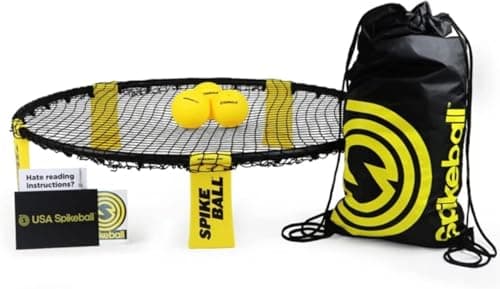
The original kit with three standard balls — same 3 ft net, same rules, lighter rim and legs, and the right set for a lawn rather than a bracket.
Skip this if
Skip this if you play on packed sand or concrete every week. The lighter rim and legs are the published difference and they are what gives out first.
What works
- Three balls, so a lost ball does not end the afternoon
- Identical net geometry to the Pro set — the game is the same game
- The cheapest way into a sport that scales from two people to eight
What does not
- Lighter rim and legs than the Pro kit
- Standard balls take less spin, which caps the ceiling
Published specifications
- Footprint
- About 30 ft x 30 ft (about 900 sq ft)
- Net diameter
- 3 ft
- Service circle
- 15 ft diameter
- Ball
- 12 in circumference, about 3.8 in diameter
- Balls included
- 3 standard balls
- Players
- 4 (2 v 2)
- Set weight
- —
- Surface
- Grass, sand, hard
Source: International Roundnet Federation / Spikeball published rules
Source: International Roundnet Federation / Spikeball published rules
Source: International Roundnet Federation / Spikeball published rules
Source: International Roundnet Federation / Spikeball published rules
Source: Spikeball product listing
Source: International Roundnet Federation / Spikeball published rules
Not published by the manufacturer.
Source: International Roundnet Federation / Spikeball published rules
Manufacturer listing: Spikeball published specifications
Price as of October 23, 2026. #ad How we make money
FAQ
Questions people actually ask
What is the difference between Spikeball Standard and Pro?
Do you need the Pro set for a backyard?
Does net tension really matter in Spikeball?
How much space does Spikeball need?
Why you can check our work
We have not played these. Every figure above is copied from a manufacturer's published listing or a governing body's published rules, and named so you can verify it. Where a maker publishes nothing, the field is blank rather than filled in. How we pick explains the whole method, including what would change a recommendation.
Read next
Related pages

Picks
Spikeball sets
Pro versus Standard on published rim strength, ball type and included pump — the same game either way.
Picks
Net & active games
Spikeball and badminton — open-space games where fitness, not placement, decides the point.
Guide
Spikeball rules
Service circle, three touches, faults and rally scoring — the published roundnet rules.
Comparison
Spikeball vs Kan Jam
Two four-player games with opposite space requirements — a square versus a corridor.
Picks
Yard games for teenagers
The games with a real skill ceiling — and the ones teenagers abandon in ten minutes.
Sources
Every figure on this page is copied from one of these sources. If you find one that is wrong or out of date, tell us and we will fix it.