
Using the set
The three discs, and which one stays home
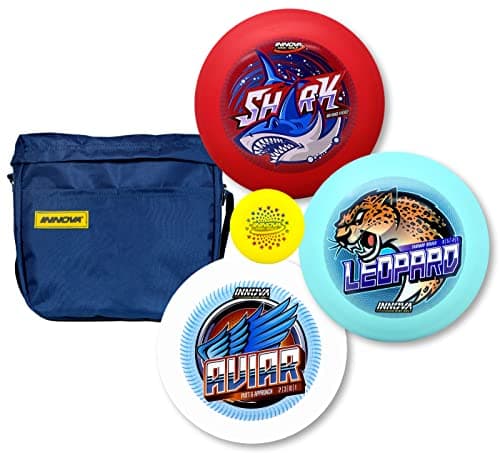
Innova publishes three named discs in the starter set — a DX Leopard driver, a DX Shark mid-range and a DX Aviar Putt & Approach putter — all in DX plastic and all stated to be approved by the Professional Disc Golf Association.
| Disc | Type | What it does | Backyard? |
|---|---|---|---|
| DX Leopard | Driver | Built to travel | No — take it to a park |
| DX Shark | Mid-range | Thrown to be placed at medium distance | Only on a large lawn |
| DX Aviar | Putt & Approach | Stops where it lands rather than skipping on | Yes — this is the backyard disc |
Naming three specific models rather than shipping an assortment is the reason to prefer a set like this: each of these discs is individually documented, so you learn what a Leopard does rather than what “the blue one” does. Full set page: backyard disc golf.
Before you buy a target
Practising without a basket
Innova publishes plainly that no basket is included. That is worth taking as an invitation rather than an omission — you can build genuinely useful practice with what is already outside.
- A tree trunk. The classic. It tells you whether you hit, not whether you would have caught, which is the limitation.
- A bucket or a laundry basket. Better than a tree, because it either catches or it does not — the same binary a real basket gives you.
- A towel on the ground. The best target for approach throws specifically, because the skill there is stopping the disc rather than hitting anything.
Set three distances and rotate: close, medium, and one you miss more often than you hit. Ten minutes of that is more useful than an hour of throwing a driver at a hedge.
The full game
When to go to a park, and how to behave there
A real hole is a tee, a fairway and a target, played by counting throws — you throw from where the last one landed until you hit the target, and the lowest count wins. Nothing about that needs a backyard; all of it needs space.
Public parks are where most backyard disc golfers actually play, and the courtesy rules are the same as any shared ground: do not throw when anyone is downrange, let a faster group play through, and pick up after yourself. Disc golf has an advantage over everything else on this site here — nothing goes into the ground and nothing is left behind. See games for parks and shared spaces.
The Professional Disc Golf Association is the governing body for the competitive game and the organisation whose approval Innova cites for these discs. If you get far enough to care about rule detail, that is where it lives rather than here.
The case
Why it is worth owning even if you never play a course
Three discs are the smallest, lightest and cheapest real sport on this site. Nothing else here fits in a coat pocket — a cornhole set publishes 38 to 46 pounds and even Molkky is twelve birch pins and a bag. See travel weight of yard games.
It is also one of the few things here with a genuine skill ceiling and a competitive scene behind it, which is exactly the filter that decides whether a teenager keeps playing something — yard games for teenagers.
And it is the answer for a yard too small for anything else. Putting practice needs about the space a patio gives you: yard games for small yards.
Go deeper
If you are buying a target
A garden supports putting, and putting is muscle memory for a catching height — so the target's published dimensions matter more than its price. The PDGA standard and the measured figures for every portable basket are in disc golf basket dimensions.
What we would buy
The gear behind this guide
The sets whose published specifications this page is built on. Ranked on spec completeness and footprint clarity, not on testing we have not done.

Best first set of discs
Innova Disc Golf Starter Set (3 Disc)
Innova
The three discs a course actually asks for — a DX Leopard driver, a DX Shark mid-range and a DX Aviar putter — all PDGA approved, in the grippy beginner plastic Innova names for the purpose.
Skip this if
Skip this if you were expecting somewhere to throw at. A disc set is not a course: Innova publishes no basket with it, and a backyard game needs a target you buy or improvise separately.
Price as of October 22, 2026. #ad How we make money
FAQ
Questions people actually ask
Can you actually play disc golf in a backyard?
Do you need a basket?
What is the difference between a driver, a mid-range and a putter?
Does disc weight matter?
Why you can check our work
We have not played these. Every figure above is copied from a manufacturer's published listing or a governing body's published rules, and named so you can verify it. Where a maker publishes nothing, the field is blank rather than filled in. How we pick explains the whole method, including what would change a recommendation.
Read next
Related pages
Picks
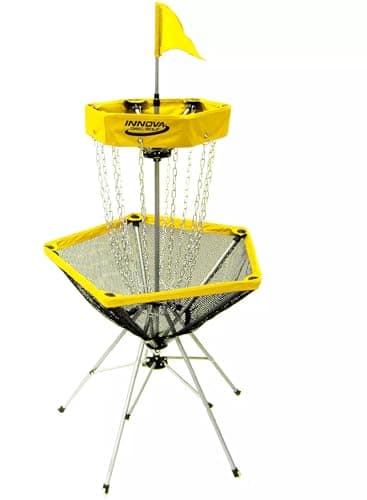
Best disc golf basket
Chain count is what decides whether a basket catches — and the target is the purchase nobody warns you about.
Picks
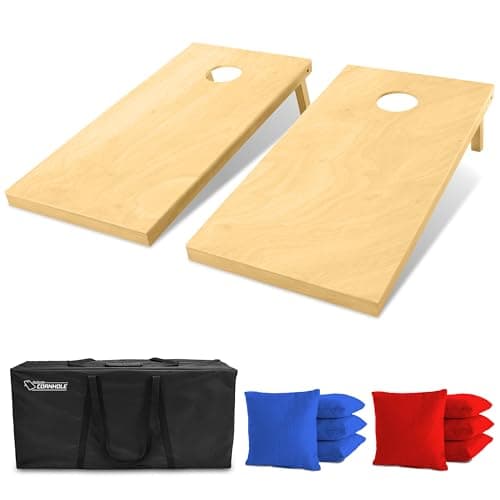
Yard game guides
Rules, regulation dimensions, materials and storage — sourced from governing bodies and makers.
Picks
Backyard disc golf
Three named PDGA-approved discs, what each one does, and the target you still have to solve.
Picks
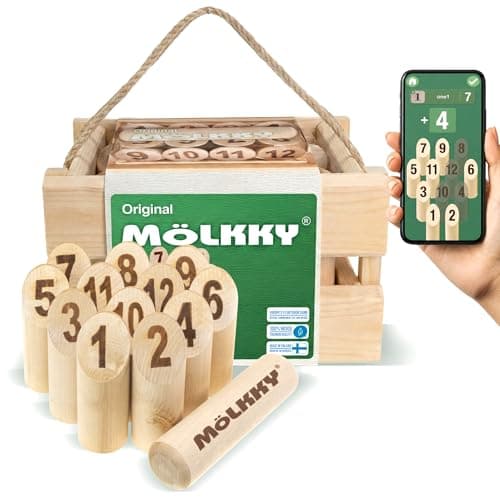
Yard games for parks and shared spaces
Nothing dug, nothing staked, nothing left behind — games for ground you do not own.
Picks
Best yard games for small yards
Five games that fit under 30 feet of clear run, with published footprints for each.

Guide
Travel weight of yard games
Published set weights and pack-down shapes, and how to judge the sets that publish nothing.
Sources
Every figure on this page is copied from one of these sources. If you find one that is wrong or out of date, tell us and we will fix it.