The usual sequence is: buy a game, discover the ground is wrong for it, level a patch that exactly fits that game, then buy a second game that needs a different patch.
The better sequence is to notice that this whole catalogue uses about three shapes, and to prepare those instead.
Plan for these
The three shapes every yard game uses
1. A hard, level pad of about 10 by 10 feet
The highest-value thing you can build, because it unlocks the games a lawn genuinely cannot support. Every giant game needs hard and level: the 2.5-foot stacking tower publishes about 10 by 10 feet of clear space, the 2-foot version about 8 by 8, the 21-inch junior set about 6 by 6, and giant 4 in a row about 6 by 6. One pad covers all of them.
Remember what that figure is: it is a fall radius, not a table footprint. A five-foot tower throws blocks further than people expect.
2. A corridor of 33 feet
Cornhole is the fixed one and therefore the one to plan around. The ACL publishes boards 27 feet apart front to front, and that distance is the skill — it cannot be shortened. Add a 4-foot board and a pitching box at each end and you need about 33 by 10 feet.
Everything shorter fits inside it: ladder toss at about 20 by 8, Molkky at about 20 by 13.
3. A longer strip, if you have it
Sixty feet takes backyard bocce and Kan Jam. Forty-eight takes a horseshoe court. Neither needs to be level in the way the pad does — bocce publishes grass, sand, gravel and dirt as playable — but a strip that is roughly true makes the game better.
| Prepared shape | Games it serves | Preparation needed |
|---|---|---|
| 10 x 10 ft hard pad | Every giant game: towers, 4 in a row, yard dice | Hard and level — paving, or a board on grass |
| 33 x 10 ft corridor | Cornhole, ladder toss, Molkky | Roughly level; boards must match each other |
| About 26 x 16 ft rectangle | Kubb (5 x 8 m pitch) | Any grass; markers rather than groundwork |
| 30 x 30 ft open area | Spikeball, badminton | Even footing; no boundary needed |
| About 60 x 12 ft strip | Bocce, Kan Jam | Optional — gravel if you want a true roll |
| 48 x 10 ft with two pits | Horseshoes | Real excavation, NHPA specification |
Where, not how big
Siting: three constraints before any measurement
- Where does a miss go? Every throwing game here has a miss condition and a miss goes past the target. Set the long axis so that what lies beyond is fence, hedge or open ground — never windows, seating, a path or a road.
- How close is the boundary? Kubb is hardwood on hardwood and a stacking tower ends every game by collapsing. Distance from a shared fence does more for neighbourly relations than any equipment choice — see yard games and noise.
- Where is the shade at four in the afternoon? Not the shade now. A games corner in full sun is used in May and abandoned in July — yard games in hot weather.
If you are committing
What to build, and in what order
- Start with the board on the grass. A season of use tells you whether the corner works before you spend anything.
- Then the 10 by 10 pad. Small, cheap, and it unlocks a whole category that a lawn cannot support.
- Then the corridor, if the ground is bad. Cornhole only needs both boards to sit at the same angle, so shimming often beats levelling.
- Only then a bocce court or a horseshoe pit. Both are real construction. Bocce does not need it — the makers publish four playable surfaces, and a compacted stone court is a luxury that buys consistency and drainage (bocce court surfaces). Horseshoes does need it, and the NHPA publishes every dimension (how to build a horseshoe pit).
One thing a permanent area does not solve: wear. A fixed court concentrates every footstep into the same few square feet, which is exactly what kills grass. If the area is turf rather than hard standing, plan to rotate within it — yard games and your lawn.
And before any of it, the footprint table for every game we cover: how much space do yard games need.
What we would buy
The gear behind this guide
The sets whose published specifications this page is built on. Ranked on spec completeness and footprint clarity, not on testing we have not done.

Best overall
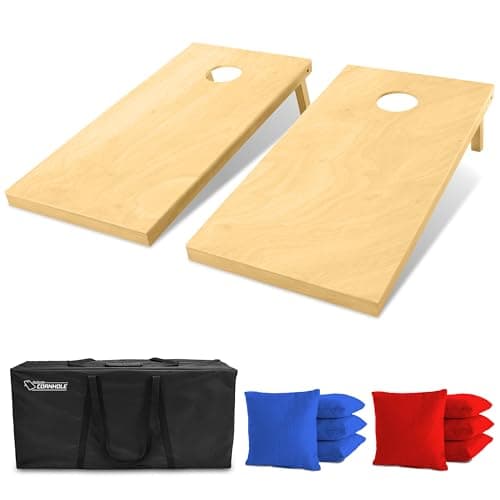
GoSports 4 ft x 2 ft Solid Wood Premium Cornhole Set
GoSports
Regulation 4 x 2 ft boards on solid pine frames with a 1/2 in cabinet-grade plywood top, eight 16 oz all-weather bags and a case — the complete tournament-legal setup in one box.
Skip this if
Skip this if your yard is under 30 ft long. A regulation court is 27 ft board-front to board-front plus throwing room behind each board, and there is no shortening it without changing the game.
Price as of October 22, 2026. #ad How we make money

Best overall
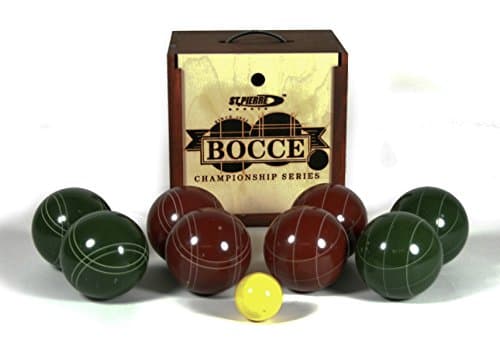
St. Pierre Sports Professional Bocce Set, 107 mm
St. Pierre
107 mm thermo-set composition resin balls built to international bocce specifications and named an official ball of the United States Bocce Federation.
Skip this if
Skip this if the set is mainly for kids or a beach bag. Full-size 107 mm balls are heavy enough that a small player cannot roll one accurately.
Price as of October 22, 2026. #ad How we make money
Best overall
Yard Games Giant Tumbling Timbers
Yard Games
56 sustainably sourced New Zealand pine blocks at 1.5 x 2.5 x 7.5 in, starting at 2.5 ft over 19 rows and reaching 5 ft, in a nylon case.
Skip this if
Skip this if the only flat ground you have is a lawn. A 19-row tower needs a hard, level base — grass tips it before anybody pulls a block.

Best overall
St. Pierre Professional Horseshoe Set
St. Pierre
Drop-forged steel shoes built to the NHPA's published weight limit, which is the one spec that decides whether a shoe behaves like a competition shoe.
Skip this if
Skip this if children will be anywhere near the pits. A 2 lb 10 oz steel shoe thrown 40 ft is the most dangerous object on this website.
FAQ
Questions people actually ask
What is the most useful shape to level in a yard?
How long a strip do you need for the corridor games?
Should you build a bocce court?
Where should a permanent games area go?
Why you can check our work
We have not played these. Every figure above is copied from a manufacturer's published listing or a governing body's published rules, and named so you can verify it. Where a maker publishes nothing, the field is blank rather than filled in. How we pick explains the whole method, including what would change a recommendation.
Read next
Related pages
Picks
Yard game guides
Rules, regulation dimensions, materials and storage — sourced from governing bodies and makers.
Guide
Levelling ground for yard games
Which games need level ground, which do not, and the fixes that avoid digging entirely.
Guide
How much space do yard games need?
Every game's published footprint, longest run and player count in one sourced table.
Guide
How to build a horseshoe pit
Every published NHPA dimension for a backyard court, in the order you need them.
Comparison
Bocce court surfaces compared
What grass, gravel, sand and dirt each do to a bocce roll, and which to build.
Guide
Yard games and your lawn
Which games wear turf, where the damage always appears, and how to keep a lawn playable.
Sources
- American Cornhole League — rules and regulations
- United States Bocce Federation — open rules
- NHPA — official rules and specifications
- Yard Games — Giant Tumbling Timbers
Every figure on this page is copied from one of these sources. If you find one that is wrong or out of date, tell us and we will fix it.