Tetherball is the only game on this site that needs no scoring system, no referee and no teaching. Two people hit a ball on a rope in opposite directions; whoever wraps it fully around the pole has won. That is the entire game, and it is why it survives in schoolyards where more elaborate games do not.
Like gaga ball, it has no governing body. The rules below are the common version, and the GoSports set is the one we verified for the tetherball page.
The rules
How a game runs
- Pick directions. One player wraps clockwise, the other counterclockwise. This is the only setup decision.
- Serve from your own half. The server strikes the ball in their direction; the opponent may not return it until it passes them once.
- Stay on your side of the line. An imagined line through the pole divides the circle in two.
- Hit, do not hold. No catching, no carrying, no touching the rope.
- Wrap it all the way. When the rope is fully wound in one player's direction and the ball stops against the pole, that player wins.
- Loser serves next. The usual convention, and it keeps games close.
Settle these first
The fouls that decide most games
| Foul | What it means | Usual penalty |
|---|---|---|
| Rope touch | Any hand on the rope | Stoppage, restart at current wrap |
| Holding or catching | Ball held, carried or caught | Stoppage, restart |
| Double hit | Two hits before it circles back | Stoppage, restart |
| Line crossing | Stepping into the opponent's half | Stoppage, restart |
| Repeated fouls | House rule | Some play loss of game |
Ownership
Keeping it playable
Tetherball is the lowest-maintenance game on this site and it still has exactly three things that go wrong, all of them cheap to fix and all of them the reason a pole stops getting used.
Ball pressure
A soft ball is slow, painful to strike and wraps sluggishly. GoSports ships a pump with the set for a reason; a ball checked at the start of the season plays like a new one.
Rope length
The rope stretches. Too long and the ball orbits at knee height and hits the pole before anyone can play it; too short and the game becomes a scrum at head height. The playable range leaves the ball hanging roughly at waist height when it is still.
The pole moving in the ground
A staked pole in soft spring ground works loose within a few weeks of real play, and a leaning pole changes the geometry of every shot. If it is going to be a permanent installation, setting the base properly is the whole difference — see setting up a permanent games area.
None of the three is expensive. All three are why a pole that went in during May is ignored by August.
Honest limits
The mismatch nobody mentions
Tetherball has one structural unfairness, and it is worth knowing before you site a pole where two children of different ages will use it.
Height wins. The ball orbits at a fixed height on a fixed rope, so a taller player can strike it at a point a shorter player physically cannot reach. In most yard games a size advantage is a tendency; here it is closer to a rule. A twelve-year-old against a seven-year-old is not a contest, and no house rule fixes it the way moving a throwing line fixes cornhole or lawn bowling.
There are two partial answers. Lengthening the rope drops the ball's orbit and brings it into a shorter player's range, at the cost of the taller player stooping. Or handicap the start: the stronger player serves from a standstill, or plays one-handed, which is the version children negotiate themselves within about ten minutes.
Where tetherball is genuinely excellent is two players of roughly the same size, and it is the best game on this site for exactly that pair — see yard games for two players. For a yard with a wide age range, a game where everyone can be given their own distance is the safer buy.
What we would buy
The gear behind this guide
The sets whose published specifications this page is built on. Ranked on spec completeness and footprint clarity, not on testing we have not done.

Best portable tetherball
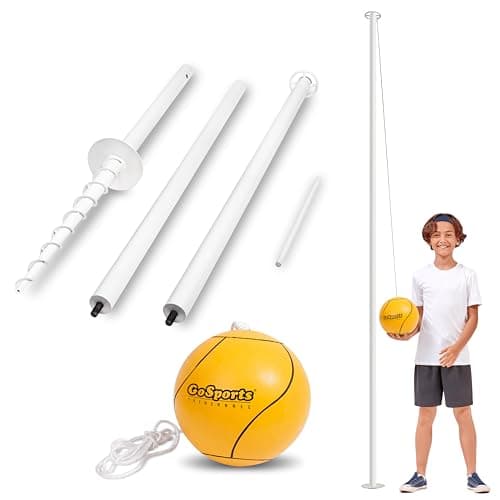
GoSports Tetherball Game Set
GoSports
A three-piece powder-coated steel pole that stakes into grass or sand, with a tetherball on its rope and a pump — GoSports publishes a minimum 15-foot circle of open space for play.
Skip this if
Skip this if you want a permanent pole. This one stakes into the ground rather than setting in concrete or an in-ground sleeve, and GoSports publishes no pole height, no diameter and no ball size.
Price as of October 19, 2026. #ad How we make money
FAQ
Questions people actually ask
How do you win at tetherball?
What are the fouls in tetherball?
How much space does tetherball need?
Why you can check our work
We have not played these. Every figure above is copied from a manufacturer's published listing or a governing body's published rules, and named so you can verify it. Where a maker publishes nothing, the field is blank rather than filled in. How we pick explains the whole method, including what would change a recommendation.
Read next
Related pages
Picks
Best tetherball set
One pole, one ball, a 15 ft circle — and why the base is the only real decision.
Picks
Yard game guides
Rules, regulation dimensions, materials and storage — sourced from governing bodies and makers.
Comparison
Tetherball vs gaga ball
Two players and a pole, or a dozen in a pit — the published play areas and who each one is for.
Picks
Yard games for two players
The games that are complete with two people — and the ones that quietly need four.
Guide
Yard game scoring systems compared
Cancellation, exact-21, exact-50 and rally scoring, and which keeps a game close.
Sources
Every figure on this page is copied from one of these sources. If you find one that is wrong or out of date, tell us and we will fix it.