Scoring is the part of a yard game people copy from whoever taught them, and it is the part that most decides whether an afternoon is fun. A system that lets a leader run away turns the second half of every game into a formality; a system that keeps the trailing player live keeps everyone at the boards.
Every game on this site uses one of four published families.
Published systems
The four families
| System | Games | How it works | Keeps a game close? |
|---|---|---|---|
| Cancellation | Cornhole, horseshoes | Only the difference between the two sides scores each round | Yes — strongly |
| Exact target | Molkky (50), ladder toss (21), Kan Jam (21) | You must land on the number, not pass it | Yes — Molkky most of all |
| Rally scoring | Spikeball, badminton | Every rally scores for somebody, win by two | Somewhat — the margin rule does the work |
| Positional / course | Bocce, kubb, croquet, stacking tower | Score comes from position or from completing a course | Varies |
Cornhole and horseshoes
Cancellation: the quiet equaliser
Under ACL rules a bag in the hole is three points and a bag on the board is one, but only the difference between the two sides goes on the scoreboard each round. Score seven to your opponent's five and you gain four, not twelve.
The effect is that a strong player has to out-throw a weaker one repeatedly to build a lead, and one good round from the weaker player wipes out several bad ones. It also makes a round very short, which is why cornhole forms a queue at parties — see how many yard games you need for a party.
Horseshoes applies the same principle to ringers: equal ringers by both players cancel and score nothing at all, so a ringer answered by a ringer is worth zero. The NHPA also publishes a count-all alternative where everything scores — faster, and much kinder to a weaker player, because their ringers are never erased. Detail: horseshoe rules.
The endgame problem
Exact targets and why 21 keeps appearing
Ladder toss scores 3 for the top rung, 2 for the middle and 1 for the bottom, first to exactly 21. Kan Jam scores 1 for a deflection, 2 for a direct hit and 3 into the goal, also to exactly 21 — with an instant win for a disc sent through the slot.
The exact requirement exists to create an endgame. Without it, a player at 19 simply throws again and wins; with it, they need one specific value and their best shot may be the wrong one. It converts the last two points of a game from a formality into the hardest part of it.
Kan Jam's instant win is the most interesting variation on this site: it means no lead is ever safe, in a game that otherwise accumulates steadily. Rules: Kan Jam rules and ladder toss rules.
Washer toss is the odd entry in this family. It also finishes at 21, and it borrows cornhole's three-for-the-hole, one-for-the-box values almost exactly — but it has no governing body, so whether overshooting 21 busts you back or simply wins is a house rule that changes from one yard to the next. Agree on it before the first throw, not at 20 points.
Spikeball and badminton
Rally scoring, and what it is really for
In rally scoring every rally produces a point for somebody, regardless of who served. Badminton publishes 21 with a two-point margin and a golden point at 30; Spikeball is commonly played to 11, 15 or 21, also win by two.
The purpose is predictability of length rather than closeness. Under serve-only scoring a game can run indefinitely while service changes hands; rally scoring puts a hard ceiling on it. The two-point margin is what stops it becoming a coin toss at the end.
For a backyard, playing to 11 rather than 21 keeps the published structure intact and halves the length — the single best adjustment to either game. See Spikeball rules and badminton rules.
Bocce, kubb, croquet
Positional scoring: no points at all
The fourth family barely counts points in the usual sense.
- Bocce scores by position: the balls closest to the pallino score, and the entire game is about where things came to rest. Nothing is worth a fixed value.
- Kubb has no score at all in the running sense. You fell your opponent's kubbs, then the king — and felling the king early loses the game immediately.
- Croquet is a course: the first side to run all nine wickets in order and stake out with all its balls wins.
- A stacking tower has no score whatsoever. Whoever makes it fall loses.
These are the games where a spectator cannot tell who is winning, which is either a feature or a problem depending on the party. For a bracket, pick from the first two families — a published, numeric, fast-resolving system is what makes a tournament runnable. That argument is in how to run a backyard tournament.
What we would buy
The gear behind this guide
The sets whose published specifications this page is built on. Ranked on spec completeness and footprint clarity, not on testing we have not done.

Best overall
Yard Games Ladder Toss (Double Wooden Ladder Ball)
Yard Games
A finished wood frame with real golf-ball bolas and a nylon case — the version that does not rattle apart the way tube-and-plastic ladder sets do.
Skip this if
Skip this if you need the set to stand up in wind. A wooden ladder frame has a big sail area and no ground stakes.
Price as of October 21, 2026. #ad How we make money

Best overall
Kan Jam Original Disc Game Set
Kan Jam
Two goals and a disc, played at a published 50 ft, with a scoring system that only works because one player deflects for the other — the most genuinely cooperative game on this site.
Skip this if
Skip this if you have an odd number of players who all want to throw. Kan Jam is built around pairs and does not adapt to three.
Price as of October 21, 2026. #ad How we make money

Best overall
Tactic Mölkky Original Set
Tactic Games
The original — Tactic Games has held the Mölkky rights and trademark since 2016 and the games are still made in Pori, Finland.
Skip this if
Skip this if you want a game that survives being left on the lawn. Molkky is untreated birch and it will gray and swell.
Price as of October 21, 2026. #ad How we make money

Best overall
GoSports 4 ft x 2 ft Solid Wood Premium Cornhole Set
GoSports
Regulation 4 x 2 ft boards on solid pine frames with a 1/2 in cabinet-grade plywood top, eight 16 oz all-weather bags and a case — the complete tournament-legal setup in one box.
Skip this if
Skip this if your yard is under 30 ft long. A regulation court is 27 ft board-front to board-front plus throwing room behind each board, and there is no shortening it without changing the game.
Price as of October 21, 2026. #ad How we make money
FAQ
Questions people actually ask
What is cancellation scoring?
Which yard game scoring system keeps a game closest?
Why do so many yard games finish on exactly 21?
What is rally scoring?
Why you can check our work
We have not played these. Every figure above is copied from a manufacturer's published listing or a governing body's published rules, and named so you can verify it. Where a maker publishes nothing, the field is blank rather than filled in. How we pick explains the whole method, including what would change a recommendation.
Read next
Related pages
Picks
Yard game guides
Rules, regulation dimensions, materials and storage — sourced from governing bodies and makers.
Guide
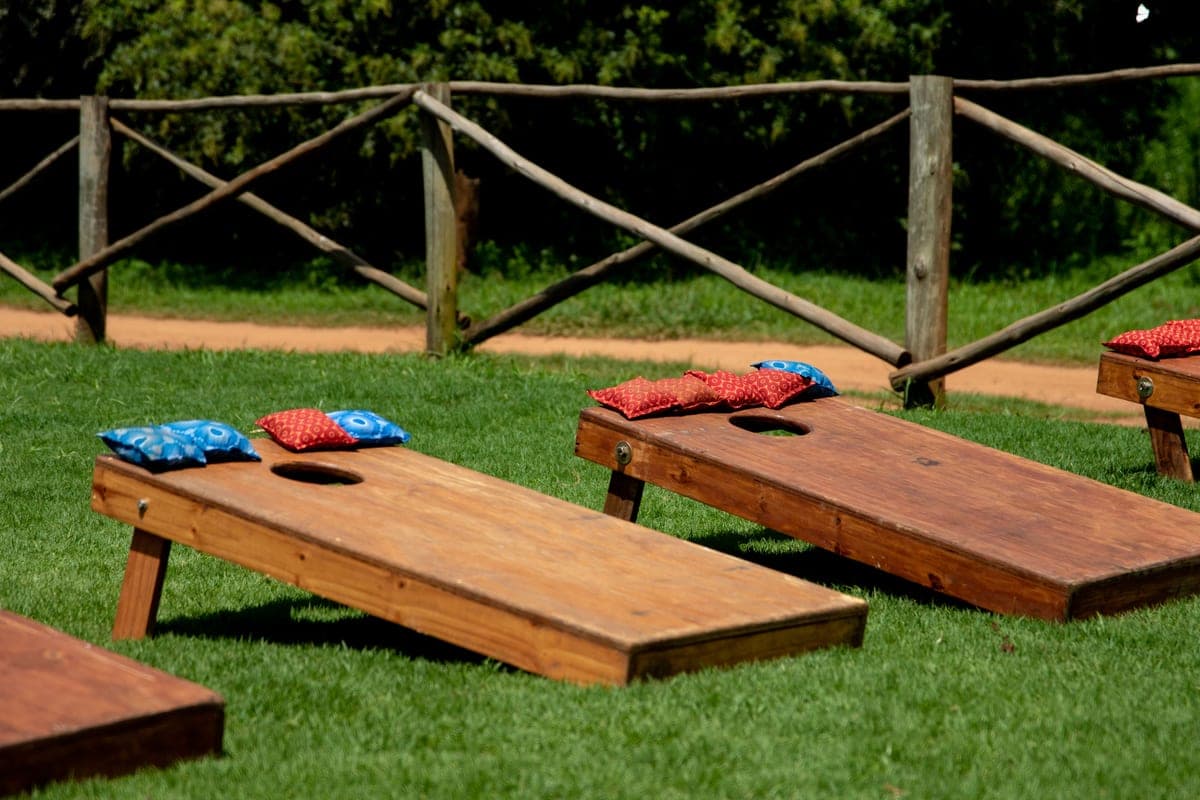
Cornhole rules
ACL scoring, cancellation explained, and what happens past 21 — with the published source.
Picks
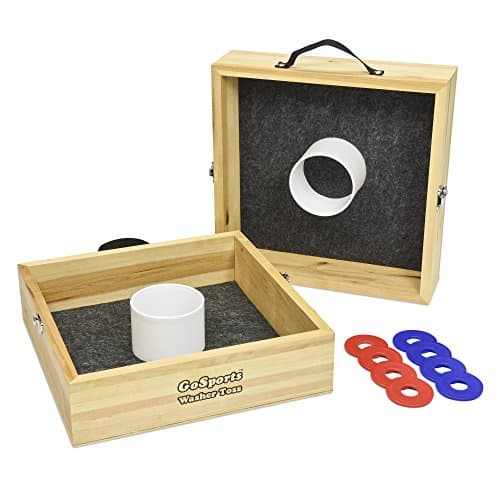
Washer toss
Cornhole's geometry in about a third of the space — and the one game here with no governing body at all.
Guide
Molkky rules
Formation, the two scoring modes, the exact-50 rule and the three-miss elimination.
Guide
Horseshoe rules
Ringers, leaners, cancellation scoring to 40, and the 27 and 37 foot foul lines.

Guide
Spikeball rules
Service circle, three touches, faults and rally scoring — the published roundnet rules.
Sources
- American Cornhole League — rules and regulations
- International Molkky Organisation — game rules
- NHPA — official rules and specifications
- United States Bocce Federation — open rules
Every figure on this page is copied from one of these sources. If you find one that is wrong or out of date, tell us and we will fix it.