Badminton is the most age-inclusive net game there is and the one most often played wrongly, because the portable sets that end up in a backyard rarely publish a net height and almost nobody measures one.
The published laws are worth knowing even if you never play a formal game, because two of them — net height and the service height limit — are the difference between rallies that last and rallies that do not.
Published dimensions
The court and the net
| Element | Metric | Imperial |
|---|---|---|
| Court length | 13.4 m | 44 ft |
| Court width, doubles | 6.1 m | 20 ft |
| Court width, singles | 5.18 m | 17 ft |
| Net height at the posts | 1.55 m | About 5 ft 1 in |
| Net height at the centre | 1.524 m | 5 ft |
| Short service line | 1.98 m from the net | 6 ft 6 in |
| Long service line (doubles) | 0.76 m from the back boundary | 2 ft 6 in |
| Service height limit | 1.15 m from the surface | About 3 ft 9 in |
The centre of the net is lower than the posts, on purpose. 1.524 metres at the centre against 1.55 at the posts is a published two-and-a-half centimetre difference. A backyard net strung drum-tight and level across the top is technically wrong, and in practice it makes the middle of the court harder than it should be, which is where a mixed-ability group plays most of its shots.
The set we cover does not publish a net height at all — we leave that field blank on the product page rather than estimate it. If you want the published game, measure the net you own to 5 feet at the centre. Full set page: backyard badminton sets.
The rule that keeps rallies alive
Serving
The serve must be struck with the shuttle below 1.15 metres from the surface — roughly waist height on most adults — and it travels diagonally into the opponent's service court.
In singles you serve from the right court at an even score and the left court at an odd score. That simple alternation is how everyone keeps track of the score without a scoreboard, which is genuinely useful outdoors.
The service height limit is the badminton equivalent of Spikeball's shoulder-height serve rule: it exists to stop the serve becoming an unreturnable weapon. Backyard games that ignore it degenerate into one person smashing serves, which is exactly the failure mode that gets a set put away for good.
A let replays the rally with no change to the score. The receiver is entitled to one if they were not ready when the serve was delivered — though attempting a return counts as having been ready.
Rally scoring to 21
Scoring
Every rally scores for somebody, regardless of who served. Games run to 21 points, win by two. At 20-20 play continues until one side leads by two — 24-22, 26-24 and so on — and at 29-29 a single golden point at 30 ends it. A match is the best of three games.
For a backyard, 21 with a two-point margin can be a long game in the heat. Playing to 11 keeps the published structure — rally scoring, win by two — while halving the length, and it is the change we would make before any other. How this compares with the exact-21 and exact-50 systems used elsewhere in this catalogue is in yard game scoring systems.
Practical
What to change outdoors
- Shorten the court, keep the width. Casual rallying works in about 30 by 15 feet. The width is what makes a rally interesting; the extra length is mostly run-back a casual game never uses.
- Measure the net to 5 feet at the centre. The single highest-value thing you can do to a backyard set.
- Play to 11. Same rally scoring, same win-by-two, half the game.
- Play in the evening. Air movement usually drops at the end of the day, and badminton is one of the few games on this site that is genuinely better after dinner — see playing yard games after dark.
For the group this game serves best, yard games for mixed ages.
What we would buy
The gear behind this guide
The sets whose published specifications this page is built on. Ranked on spec completeness and footprint clarity, not on testing we have not done.

Best overall
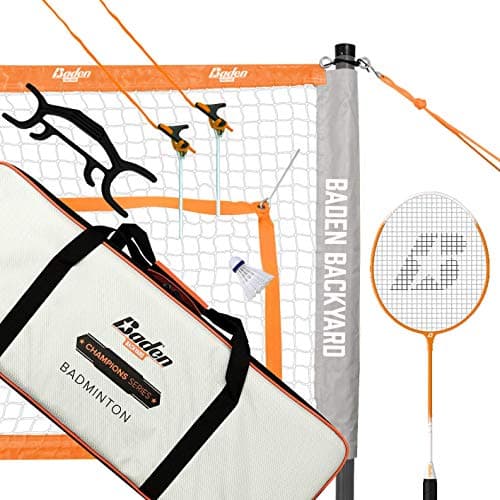
Baden Champions Badminton Set
Baden
A complete portable net-and-racket set from the same Champions line as the bocce — the fastest way to put a net on a lawn without digging anything in.
Skip this if
Skip this if the lawn is windy. A shuttlecock is the lightest projectile in yard games and a 10 mph breeze ends the game.
Price as of October 20, 2026. #ad How we make money
FAQ
Questions people actually ask
How high is a badminton net?
How big is a badminton court?
What are the badminton service rules?
How does badminton scoring work?
Why you can check our work
We have not played these. Every figure above is copied from a manufacturer's published listing or a governing body's published rules, and named so you can verify it. Where a maker publishes nothing, the field is blank rather than filled in. How we pick explains the whole method, including what would change a recommendation.
Read next
Related pages
Comparison
Portable badminton nets
21 ft by 30 in, and the pole spec that decides whether it stays taut across the span.
Picks
Yard game guides
Rules, regulation dimensions, materials and storage — sourced from governing bodies and makers.
Picks
Backyard badminton sets
Portable net, rackets and shuttlecocks — the gentlest net game, with an honest wind caveat.
Comparison
Spikeball vs badminton
The 30-foot square that ignores wind against the 44-foot court that a breeze ends.

Picks
Best yard games for mixed ages
Five games where the youngest and the oldest player are both genuinely competitive.
Guide
Yard game scoring systems compared
Cancellation, exact-21, exact-50 and rally scoring, and which keeps a game close.
Sources
Every figure on this page is copied from one of these sources. If you find one that is wrong or out of date, tell us and we will fix it.