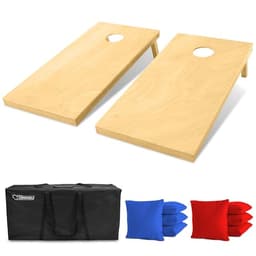
The published specs
Side by side
| Cornhole | Horseshoes | |
|---|---|---|
| Footprint | 33 x 10 ft (about 330 sq ft) | About 48 x 10 ft (about 480 sq ft) |
| Core distance | Boards 27 ft apart, front to front | Stakes 40 ft apart, front to front |
| Throwing line | Beside the board | 27 ft or 37 ft depending on class |
| Ground preparation | None — shim the legs if needed | Two pit boxes, 43 to 72 in x 31 to 36 in |
| Surface required | Grass, hard, sand | Clay or sand pit |
| Projectile | 6 x 6 in bag, 16 oz | Steel shoe, no more than 2 lb 10 oz |
| Scoring | 3 in the hole, 1 on the board, cancellation to 21 | 3 a ringer, 1 closest within 6 in, cancellation to 40 |
| Players | 2 or 4 | 2 or 4 |
| Packs away | Yes — 38 to 46 lb of boards | No — the court is permanent |
| Built-in handicap | None | Two published foul lines |
| Governing body | American Cornhole League | National Horseshoe Pitchers Association |
What you are choosing
They are the same game with different consequences
Both are pitching games: stand at one end, throw an object at a target at the other, score on where it comes to rest, walk down and do it back. Both use cancellation scoring so that a strong player has to keep out-throwing a weaker one to build a lead. Both are played standing still with a drink in hand.
The difference is what each asks of your property and your guests.
Cornhole asks for 33 feet and nothing else. The boards sit on whatever is there, both boards only need to match each other rather than the ground being level, and the whole thing goes back in a garage.
Horseshoes asks for a hole in your lawn. The NHPA publishes pit boxes 43 to 72 inches long and 31 to 36 inches wide filled with clay or sand, a stake 1 inch in diameter standing 15 inches above ground and leaning about 12 degrees toward the opposite stake, and 40 feet between them. That is a weekend of work and a permanent change — the full build is in how to build a horseshoe pit.
Handicapping
The one thing horseshoes does better than anything here
Horseshoes has the best handicap system in yard games and it is built into the published rules rather than negotiated at the start of an afternoon.
The stakes stay 40 feet apart for everybody. What changes is where you stand: adult men pitch from behind the 37-foot line; women, youth through 18 and men aged 70 and over pitch from behind the 27-foot line. Everyone plays the identical game at the identical target, and a ten-foot difference is a serious handicap that nobody has to feel awkward about accepting.
Cornhole has no equivalent — the ACL court is 27 feet for everyone. In a mixed-ability group that is a genuine point in horseshoes' favour, and it is the reason we would not dismiss it out of hand for a family that has the space. Full detail: horseshoe rules and cornhole rules.
Decision
Pick cornhole if…
- You are not digging anything, now or later.
- The yard has to be a lawn again next spring, or you rent.
- Children are anywhere near the playing area.
- You want a game that packs away and travels.
Set comparison: best cornhole sets.
Pick horseshoes if…
- You have 48 feet you are willing to commit permanently.
- You will build both pits properly with clay or sand.
- Players are adults and the run is not a thoroughfare.
- You want the deepest pitching skill curve, and a published handicap system.
Full page: horseshoes. Against the other adult precision game, bocce vs horseshoes.
The other side
Where to buy the other one
The card at the top of this page covers one side of the comparison. This is our current pick for the other, ranked on published specifications rather than on play we have not done.

Best overall
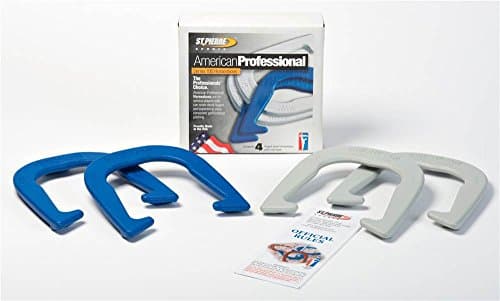
St. Pierre Professional Horseshoe Set
St. Pierre
Drop-forged steel shoes built to the NHPA's published weight limit, which is the one spec that decides whether a shoe behaves like a competition shoe.
Skip this if
Skip this if children will be anywhere near the pits. A 2 lb 10 oz steel shoe thrown 40 ft is the most dangerous object on this website.
FAQ
Questions people actually ask
Which needs more space, cornhole or horseshoes?
Which is safer?
Which is the better game?
Can you play horseshoes without digging pits?
Why you can check our work
We have not played these. Every figure above is copied from a manufacturer's published listing or a governing body's published rules, and named so you can verify it. Where a maker publishes nothing, the field is blank rather than filled in. How we pick explains the whole method, including what would change a recommendation.
Read next
Related pages

Picks
Compare yard games
Twenty-one head-to-heads with the verdict first and the published specs behind it.
Picks
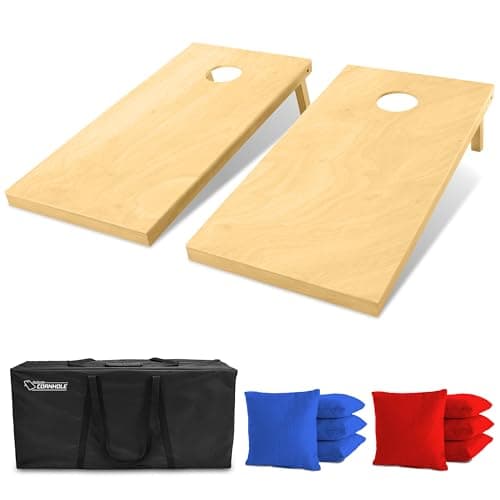
Best cornhole boards
Five regulation sets ranked on published surface thickness, frame construction, weight and bags.
Picks
Horseshoes
40 feet between stakes, a built clay or sand pit, and a 2 lb 10 oz weight limit straight from the NHPA.
Comparison
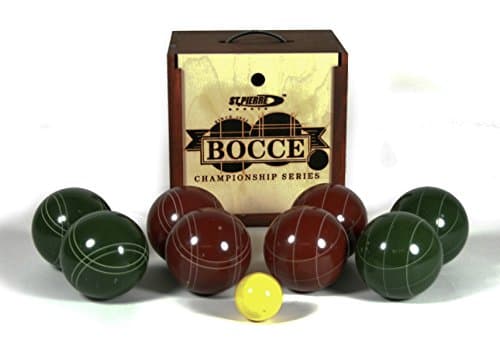
Bocce vs horseshoes
Two adult precision games — one plays anywhere, the other needs two dug pits.
Guide
How to build a horseshoe pit
Every published NHPA dimension for a backyard court, in the order you need them.
Guide
Yard game safety and age floors
What each maker actually publishes about age, and how to judge the games that publish nothing.
Sources
Every figure on this page is copied from one of these sources. If you find one that is wrong or out of date, tell us and we will fix it.