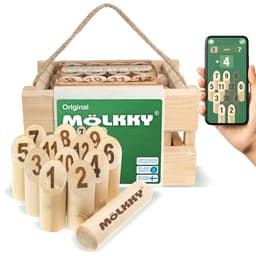
The published specs
Side by side
| Croquet | Molkky | |
|---|---|---|
| Full footprint | 100 x 50 ft (5,000 sq ft) | About 20 x 13 ft (about 260 sq ft) |
| Resizable? | Yes — the USCA allows proportional scaling | Distance is published as a 3 to 4 m range |
| Players | Up to 6 | 2 or more, individually or in teams |
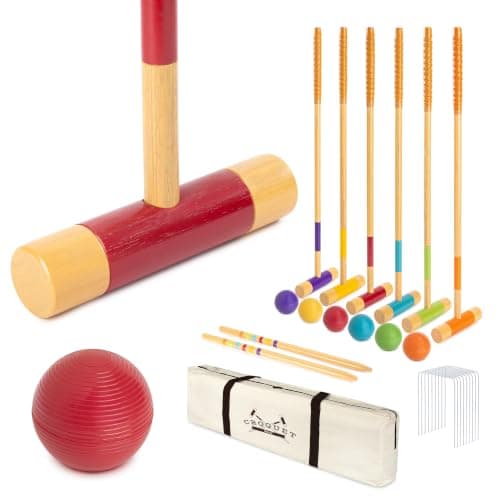
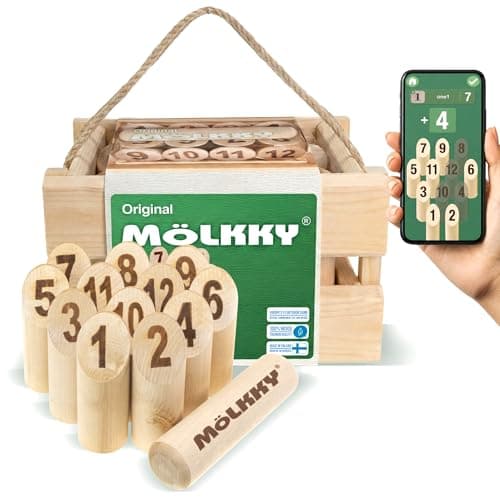
| Equipment | 6 mallets, 6 balls, 9 wickets, 2 stakes | 12 numbered pins plus a throwing pin |
| Setup time | Minutes — nine wickets to place | Seconds — stand the pins in formation |
| Surface required | Short grass — a real prerequisite | Short grass; long grass swallows pins |
| Scoring | Complete the course of nine wickets and stake out | Exactly 50; going over resets to 25 |
| Elimination | None | Three consecutive complete misses |
| Material | Wooden mallets, 3 in / 10 oz balls | Birch |
| Portability | Least portable set on the site | Smallest real game on the site |
| Governing body | United States Croquet Association | International Molkky Organisation |
Space
The widest gap in the catalogue
Nineteen times is not a difference of degree. At full size croquet is the largest published footprint on this site and Molkky is close to the smallest — the only things under it are giant 4 in a row at about 6 by 6 feet and giant yard dice at about 8 by 8.
Both do resize, and they resize differently. The USCA explicitly permits a proportionally smaller croquet court, so the real minimum is your lawn with the wicket layout scaled to match — though below about 40 feet of length every wicket is one easy tap away and the positional game disappears.
Molkky publishes its throwing distance as a range — 3 to 4 metres, with 3.5 the official competition figure — so a shorter line is inside the published game rather than a house rule. That is genuinely useful for mixed abilities.
Full footprint table for everything we cover: how much space do yard games need.
The games themselves
Depth against closeness
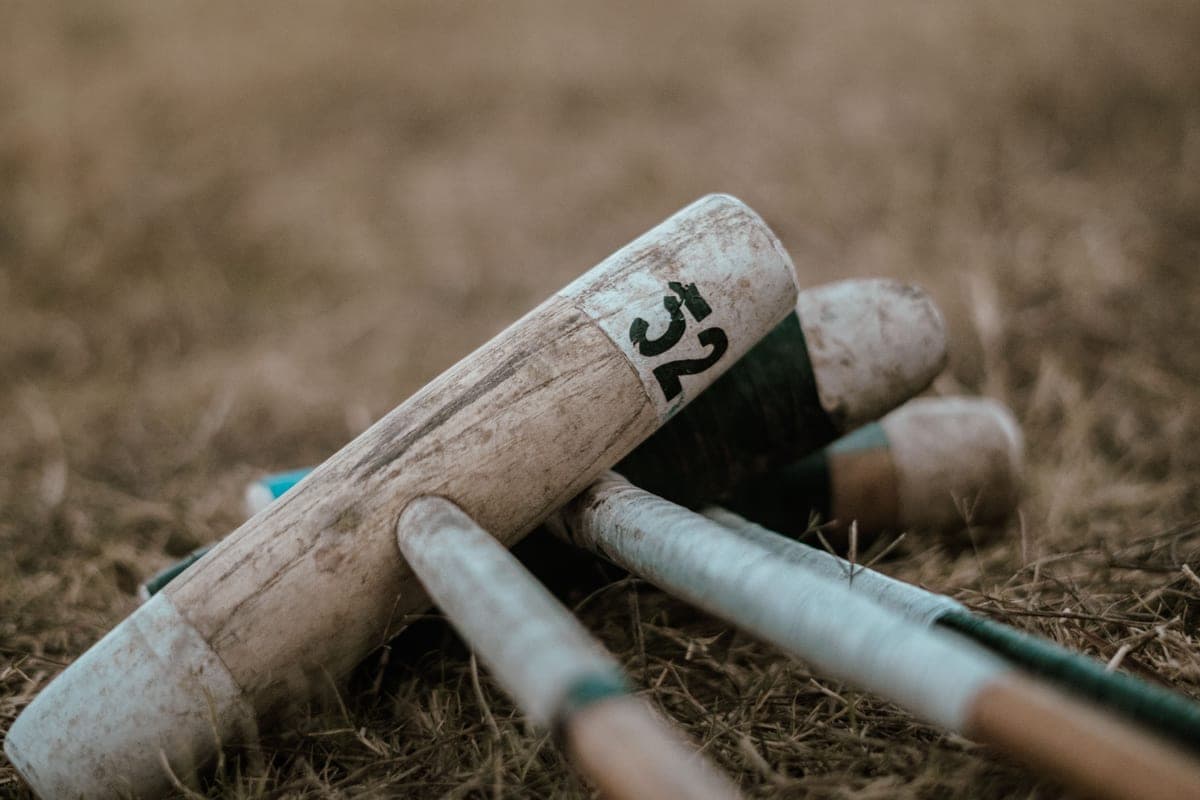
Croquet has the tactics. One bonus stroke for running a wicket, two for roqueting another ball, a maximum of two from any single stroke, and a deadness rule that stops you roqueting the same ball again until you clear your next wicket. A player who understands that chains a long single turn; one who does not takes a tap and passes the mallet. Detail: croquet rules.
Molkky has the best scoring rule in yard games. Reach exactly 50; go over and you drop to 25. At 46 points you no longer want a big score, you want a specific one — from a formation that has scattered because pins are stood back up where they land. Detail: Molkky rules.
The trade is that croquet rewards the player who learned it and Molkky keeps everyone in contention. Which of those you want depends entirely on the group.
Decision
Pick croquet if…
- You have a real mown lawn and will keep mowing it.
- Gatherings are five or six people who each want their own ball.
- You want the deepest game in the catalogue.
- The set never leaves the property.
Full page: croquet sets. Against the other crowd lawn game, croquet vs kubb.
Pick Molkky if…
- Your usable space is under about 30 feet in any direction.
- The game has to travel to a campsite, a park or a beach.
- You want every game close to the last throw.
- Setup has to take seconds, not minutes.
Full page: Molkky. Against the larger pin game, Molkky vs kubb.
The other side
Where to buy the other one
The card at the top of this page covers one side of the comparison. This is our current pick for the other, ranked on published specifications rather than on play we have not done.

Best overall
GoSports Six Player Croquet Set
GoSports
Six hardwood mallets — 35 in in the deluxe version — six 3 in and 10 oz balls, nine wickets, two end posts and a wooden stand, which is the full nine-wicket kit in one purchase.
Skip this if
Skip this if your lawn is under about 40 ft. The USCA full court is 100 x 50 ft and while you can shrink it, below about 40 ft the wickets stop being a challenge.
Price as of October 22, 2026. #ad How we make money
FAQ
Questions people actually ask
How much more space does croquet need than Molkky?
Which is quicker to set up?
Which takes more players?
Which is the better game?
Why you can check our work
We have not played these. Every figure above is copied from a manufacturer's published listing or a governing body's published rules, and named so you can verify it. Where a maker publishes nothing, the field is blank rather than filled in. How we pick explains the whole method, including what would change a recommendation.
Read next
Related pages

Picks
Compare yard games
Twenty-one head-to-heads with the verdict first and the published specs behind it.
Picks
Croquet sets
Nine wickets, two stakes, up to six players — and the honest answer on how small a court can get.
Picks
Molkky
About 260 square feet, any number of players, and the exactly-50 rule that keeps every game close.
Comparison
Molkky vs kubb
430 square feet and 12 players versus 260 square feet and the best endgame in yard games.

Guide
Molkky rules
Formation, the two scoring modes, the exact-50 rule and the three-miss elimination.
Sources
- United States Croquet Association — nine-wicket croquet
- International Molkky Organisation — game rules
Every figure on this page is copied from one of these sources. If you find one that is wrong or out of date, tell us and we will fix it.