
Thirty seconds, out loud
The six things to settle before kickoff
- What counts as down. A flag pulled, or the belt detached. The set we cover publishes that the whole belt comes away, which makes this easy to see and slow to reset — decide whether a dropped belt on the ground counts if nobody pulled it.
- Whether blocking is allowed. This is the single biggest fork. Blocking turns flag football into contact football with extra steps; no-blocking keeps it a running and throwing game. In a mixed-age backyard, no blocking.
- Whether the quarterback can run. If yes, one athletic player will simply run every play. The usual fix is that the quarterback must throw, or must wait a count before running.
- How many downs to cross the field. Four is conventional. In a short backyard, three keeps possession changing often enough that everyone gets the ball.
- What happens on an incomplete pass. Dead ball and next down is the simple version. Anything else needs a referee.
- How long the game is. Time, or a score. Both work; not agreeing is what makes games end badly.
The broader case for saying rules out loud before starting anything is in yard game etiquette and house rules.
Equipment
What the published set gives you and what it does not
| Element | Published |
|---|---|
| Players | 8, for 4 on 4 |
| Belts | 8, at 34 in |
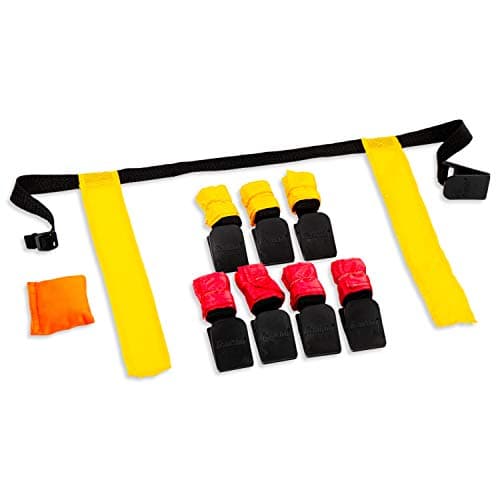
| Flags | 2 per belt; four red and four yellow |
| Flag release | The entire belt detaches when a flag is pulled |
| Field marker | One bright orange bean bag |
| Case | Carrying bag included |
| Ball | Not included |
| Field dimensions | Not published |
| Age floor | Not published |
Two published facts shape how you should play. Two flags per belt means you can run a two-flag rule — a player is only down when both are pulled — which slows a fast game down and is genuinely useful when one team is much quicker.
The whole belt detaching means the down is never in dispute and the reset takes longer. At a school field day with a queue behind you, budget for that; on a Sunday afternoon it does not matter.
Full set page: backyard flag football sets.
The real problem
Making it work with a mixed group
Flag football has the widest ability spread of any game on this site. One fast fifteen-year-old changes the whole afternoon in a way that a strong cornhole player simply does not, because cornhole is turn-based and this is not.
Three adjustments that work, in order of how much we would reach for them:
- Everyone must touch the ball before a score counts. The single best rule in backyard sport. It converts one athlete dominating into one athlete organising.
- Two-flag rule for the fastest players only. Uses a published feature of the set rather than an invented handicap, which is why it feels fair.
- Rotate quarterbacks every possession. Removes the position that otherwise becomes permanent.
This is the same handicapping logic the NHPA builds into horseshoes with its two foul lines, and which most yard games leave to the players — see horseshoe rules and yard games for mixed ages.
What we would buy
The gear behind this guide
The sets whose published specifications this page is built on. Ranked on spec completeness and footprint clarity, not on testing we have not done.

Best for a 4 on 4 game
Franklin Sports 8 Player Youth Flag Football Set
Franklin Sports
Eight 34 in belts with two flags each in two colors, a bean-bag field marker and a carry bag — everything a 4 on 4 game needs except the ball, which is not included.
Skip this if
Skip this if you were expecting a ball. Franklin publishes belts, flags, a marker and a bag, and nothing else — and the whole belt detaches when a flag is pulled, which some groups find fiddly to reset.
Price as of October 22, 2026. #ad How we make money
FAQ
Questions people actually ask
Are there official backyard flag football rules?
How many players do you need for backyard flag football?
How do you mark out a backyard field?
What counts as a tackle in flag football?
Why you can check our work
We have not played these. Every figure above is copied from a manufacturer's published listing or a governing body's published rules, and named so you can verify it. Where a maker publishes nothing, the field is blank rather than filled in. How we pick explains the whole method, including what would change a recommendation.
Read next
Related pages
Picks
Yard game guides
Rules, regulation dimensions, materials and storage — sourced from governing bodies and makers.
Picks
Backyard flag football sets
Eight published 34-inch belts for 4-on-4 — what is in the box, and the two things that are not.

Guide
Yard game etiquette and house rules
The five things to agree before you start, and which games publish an answer already.

Picks
Best yard games for large groups
The games that genuinely absorb a crowd, by published player count and turn length.
Picks
Yard games for a school field day
Fixed rotations and thirty children a station — what resets fast and survives all day.
Guide
Yard game scoring systems compared
Cancellation, exact-21, exact-50 and rally scoring, and which keeps a game close.
Sources
Every figure on this page is copied from one of these sources. If you find one that is wrong or out of date, tell us and we will fix it.