Yard game arguments are almost never about somebody cheating. They happen because two people are holding different, entirely reasonable assumptions about a rule neither of them said out loud — and by the time the disagreement surfaces, somebody is already losing, which makes it impossible to resolve neutrally.
The fix is thirty seconds at the start.
Before the first throw
The five things to say
- Which rulebook. “ACL rules.” That is the whole sentence, and for eight of the games we cover there is a real one to name.
- What you have changed. Playing to 15 instead of 21 to keep it short is fine. Not mentioning it is not.
- How close calls get decided. A rope, a phone camera, or one named person. Decide before there is a close call, because afterwards there is no neutral answer.
- Whether anyone is on a handicap, and what it is. See below — there is a right way to do this.
- When the game ends. A score, a time, or a number of rounds. Games that run out of energy rather than finishing are remembered as games that went wrong.
| Game | Rulebook to name | The usual dispute |
|---|---|---|
| Cornhole | American Cornhole League | Whether a bag knocked in by another counts |
| Bocce | United States Bocce Federation | Which ball is closest |
| Horseshoes | NHPA | Whether a leaner beats a flat shoe — it does not |
| Croquet | United States Croquet Association | Deadness, and how many bonus strokes |
| Kubb | Kubb World Championship | Whether the king was felled early |
| Molkky | International Molkky Organisation | Whether a leaning pin is down — it is not |
| Spikeball | International Roundnet Federation | Pocket, roll-up and hinders |
| Badminton | Badminton World Federation | Service height |
| Giant Jenga | Manufacturer specifications only | What counts as the tower falling |
| Ladder toss | None — conventions vary | Whether a bola that lands and falls counts |
| Flag football | None for backyard play | Blocking, and whether the QB can run |
House conventions
The four rules worth adopting everywhere
1. The person who is losing calls the close ones
Counter-intuitive and it works. It removes any suspicion of self-interest, and in practice people call against themselves more often than not when handed the responsibility.
2. Measure rather than argue
Bocce ends most frames with two balls that look identical from standing height, which is precisely why two of the sets we cover publish a measuring rope in the box. It is the least glamorous specification on this site and the one that prevents the most arguments. Horseshoes has the published equivalent: a shoe only counts as closest if it is within six inches of the stake.
3. Winner racks, loser chooses
Borrowed from pool and it transfers perfectly. Whoever won resets the equipment; whoever lost picks the next game or the next handicap. It distributes the tedious job and gives the losing player something to decide.
4. Nobody stands past a target
Not etiquette so much as the one safety convention every throwing game shares. Every game here has a miss condition and a miss goes past the target — so nothing and nobody should be there. It matters most with horseshoes, at up to 2 pounds 10 ounces of steel.
The real problem
When somebody is much better than everyone else
This is what actually ends afternoons, and no rulebook covers it. Three conventions, in the order we would reach for them:
- Split them across teams rather than handicapping them. In a doubles game, the strongest player and the weakest player are partners. Nobody has to be told they are being helped.
- Use the published distance options. As above — foul lines and throwing ranges exist for this.
- Change the game. A game with a low ceiling levels a group automatically. Molkky's exactly-50 rule with a reset to 25 makes a big lead an active disadvantage; nothing else here does that. See yard game scoring systems.
For a structured competition where the stakes are higher and the rules need to be firmer, how to run a backyard tournament. And for the one game here with no published rules at all, flag football rules for a backyard.
What we would buy
The gear behind this guide
The sets whose published specifications this page is built on. Ranked on spec completeness and footprint clarity, not on testing we have not done.

Best overall
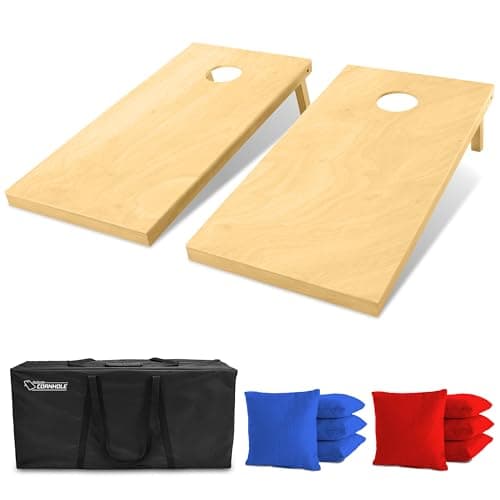
GoSports 4 ft x 2 ft Solid Wood Premium Cornhole Set
GoSports
Regulation 4 x 2 ft boards on solid pine frames with a 1/2 in cabinet-grade plywood top, eight 16 oz all-weather bags and a case — the complete tournament-legal setup in one box.
Skip this if
Skip this if your yard is under 30 ft long. A regulation court is 27 ft board-front to board-front plus throwing room behind each board, and there is no shortening it without changing the game.
Price as of October 22, 2026. #ad How we make money

Best overall
St. Pierre Sports Professional Bocce Set, 107 mm
St. Pierre
107 mm thermo-set composition resin balls built to international bocce specifications and named an official ball of the United States Bocce Federation.
Skip this if
Skip this if the set is mainly for kids or a beach bag. Full-size 107 mm balls are heavy enough that a small player cannot roll one accurately.
Price as of October 22, 2026. #ad How we make money

Best overall
Tactic Mölkky Original Set
Tactic Games
The original — Tactic Games has held the Mölkky rights and trademark since 2016 and the games are still made in Pori, Finland.
Skip this if
Skip this if you want a game that survives being left on the lawn. Molkky is untreated birch and it will gray and swell.
Price as of October 22, 2026. #ad How we make money
Best overall
Yard Games Kubb Premium Size Set
Yard Games
Hardwood kubb with a case, printed instructions and — the part that matters — boundary markers, so the 5 x 8 m pitch is set correctly the first time.
Skip this if
Skip this if your only space is 20 ft long. The pitch is 8 m end to end and shortening it breaks the throwing distances the game is built on.
FAQ
Questions people actually ask
What should you agree before starting a yard game?
Which yard games have a published rulebook to point at?
How do you handicap fairly without being patronising?
Who settles a close call?
Why you can check our work
We have not played these. Every figure above is copied from a manufacturer's published listing or a governing body's published rules, and named so you can verify it. Where a maker publishes nothing, the field is blank rather than filled in. How we pick explains the whole method, including what would change a recommendation.
Read next
Related pages
Picks
Yard game guides
Rules, regulation dimensions, materials and storage — sourced from governing bodies and makers.
Guide
Yard game scoring systems compared
Cancellation, exact-21, exact-50 and rally scoring, and which keeps a game close.

Guide
How to run a backyard tournament
Bracket sizes, round lengths and the games with published rulebooks worth competing on.

Guide
Flag football rules for a backyard
The six things to settle before kickoff, and why no published rulebook covers a backyard game.

Picks
Best yard games for mixed ages
Five games where the youngest and the oldest player are both genuinely competitive.
Guide
How many yard games do you need for a party?
Turning a guest count into an actual number of games, using published player counts.
Sources
- American Cornhole League — rules and regulations
- United States Bocce Federation — open rules
- International Molkky Organisation — game rules
- Kubb World Championship — rules (English)
Every figure on this page is copied from one of these sources. If you find one that is wrong or out of date, tell us and we will fix it.