A single-game tournament and a multi-game olympics look similar and are different events. A bracket asks “who is best at this”; an olympics asks “who is best overall”, and that only produces a good afternoon if the events are chosen so that different people win different ones.
Get that wrong and it is a bracket with extra steps, won by the same person five times.
The selection rule
Pick events that reward different things
Five events, and each one should be won by a different kind of player. The categories worth covering:
- Accuracy at distance. Cornhole. The ACL court is 27 feet board-front to board-front and cancellation scoring keeps a round short.
- Accuracy up close. Ladder toss at a published 15 feet, with 3 / 2 / 1 scoring by rung so a near-miss still scores.
- Arithmetic under pressure. Molkky. Reach exactly 50; go over and drop to 25. It is the one event where being ahead is a disadvantage, and it is the great leveller.
- Pure chance. Giant yard dice. Somebody has to be able to win an event without being good at anything, or the same three people take the whole afternoon.
- A team event. Kubb, at a published 2 to 12 players. It is the only game here that absorbs a crowd into one game, and it gives the people who lost the individual events something to win together.
Timing
Run stations in parallel
The single biggest structural decision. Five events played one after another take five times as long as five played simultaneously, and the difference is whether the afternoon finishes.
Set up all five stations at once and rotate groups between them. That needs space, and it needs the footprints to be compatible — which is a real constraint, because most of these games are corridors that want the same axis of the yard.
| Event | Footprint | Players at once | Round length |
|---|---|---|---|
| Cornhole | 33 x 10 ft | 2 or 4 | Short |
| Ladder toss | About 20 x 8 ft | 2 or 4 | Short |
| Molkky | About 20 x 13 ft | 2 or more | Medium |
| Giant yard dice | About 8 x 8 ft | 2 or more | Instant |
| Kubb | About 26 x 16 ft (5 x 8 m) | 2 to 12 | 20 to 40 minutes |
Kubb is the odd one out on time, which is why it works best as the final event with everybody in it rather than as one station in a rotation. The footprint arithmetic — which games can share a yard and which want the same run — is in how many yard games you need for a party.
The social part
Teams, and why they beat individuals
Run it in teams of three or four rather than as individuals. Three reasons, all practical:
- Nobody is exposed. A person who is bad at all five events has a bad afternoon as an individual and a fine one on a team — which is the entire argument of yard games for a company picnic.
- The maths gets simpler. Four teams and five events is twenty results to record. Sixteen individuals and five events is eighty.
- It solves odd numbers. Most of these games publish 2 or 4 players, and a team structure absorbs a fifth or seventh person without anyone sitting out — the problem described in yard games for three players.
Before anything begins
Say the rules once, at the start
Four sentences, in front of everyone, and they cover the whole afternoon:
- The events, and the order. Or the rotation, if they run in parallel.
- The scoring ladder. Same points in every event.
- Which rulebook per event, and anything you have shortened. “ACL rules, playing to 15” is a complete sentence.
- When it finishes. A time, not a feeling.
The general version of this discipline is in yard game etiquette and house rules, and the single-game bracket alternative is in how to run a backyard tournament. For a school version with fixed rotations, school field days.
What we would buy
The gear behind this guide
The sets whose published specifications this page is built on. Ranked on spec completeness and footprint clarity, not on testing we have not done.

Best overall
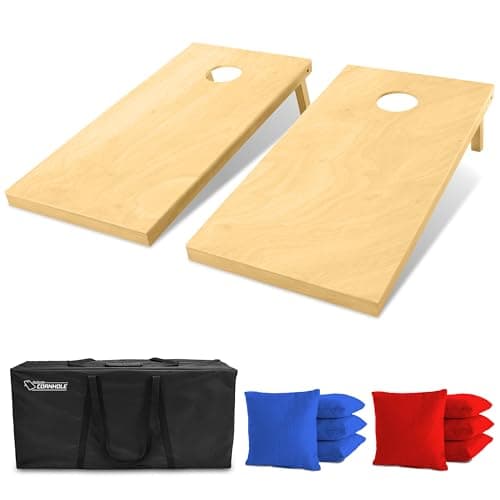
GoSports 4 ft x 2 ft Solid Wood Premium Cornhole Set
GoSports
Regulation 4 x 2 ft boards on solid pine frames with a 1/2 in cabinet-grade plywood top, eight 16 oz all-weather bags and a case — the complete tournament-legal setup in one box.
Skip this if
Skip this if your yard is under 30 ft long. A regulation court is 27 ft board-front to board-front plus throwing room behind each board, and there is no shortening it without changing the game.
Price as of October 22, 2026. #ad How we make money

Best overall
Yard Games Ladder Toss (Double Wooden Ladder Ball)
Yard Games
A finished wood frame with real golf-ball bolas and a nylon case — the version that does not rattle apart the way tube-and-plastic ladder sets do.
Skip this if
Skip this if you need the set to stand up in wind. A wooden ladder frame has a big sail area and no ground stakes.
Price as of October 22, 2026. #ad How we make money

Best overall
Tactic Mölkky Original Set
Tactic Games
The original — Tactic Games has held the Mölkky rights and trademark since 2016 and the games are still made in Pori, Finland.
Skip this if
Skip this if you want a game that survives being left on the lawn. Molkky is untreated birch and it will gray and swell.
Price as of October 22, 2026. #ad How we make money

Best overall
GoSports Giant 3.5 in Wooden Playing Dice Set
GoSports
Six 3.5 in hand-sanded pine dice with heat-stamped numbers that will not rub off, plus a dry-erase scoreboard and a canvas bag.
Skip this if
Skip this if your lawn slopes. Giant dice roll further than you expect and a slope turns every throw into a search.
Price as of October 22, 2026. #ad How we make money
Best overall
Yard Games Kubb Premium Size Set
Yard Games
Hardwood kubb with a case, printed instructions and — the part that matters — boundary markers, so the 5 x 8 m pitch is set correctly the first time.
Skip this if
Skip this if your only space is 20 ft long. The pitch is 8 m end to end and shortening it breaks the throwing distances the game is built on.
FAQ
Questions people actually ask
How many events should a backyard olympics have?
How do you score across different games?
Which games make good olympic events?
How long does it take?
Why you can check our work
We have not played these. Every figure above is copied from a manufacturer's published listing or a governing body's published rules, and named so you can verify it. Where a maker publishes nothing, the field is blank rather than filled in. How we pick explains the whole method, including what would change a recommendation.
Read next
Related pages
Picks
Yard game guides
Rules, regulation dimensions, materials and storage — sourced from governing bodies and makers.

Guide
How to run a backyard tournament
Bracket sizes, round lengths and the games with published rulebooks worth competing on.
Guide
How many yard games do you need for a party?
Turning a guest count into an actual number of games, using published player counts.
Guide
Yard game scoring systems compared
Cancellation, exact-21, exact-50 and rally scoring, and which keeps a game close.
Picks
Yard games for a company picnic
Wide ability ranges, mixed enthusiasm and a trip to a park — what survives a work event.
Picks
Yard games for a school field day
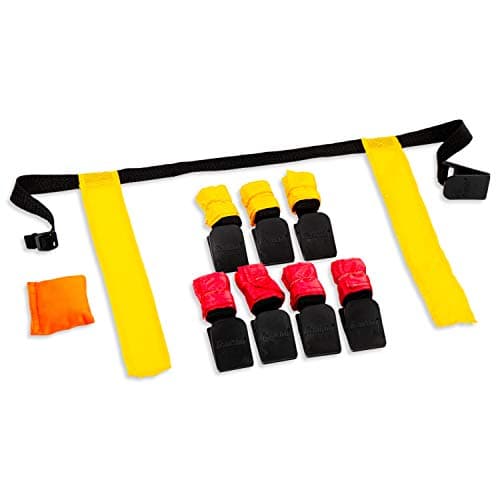
Fixed rotations and thirty children a station — what resets fast and survives all day.
Sources
- American Cornhole League — rules and regulations
- International Molkky Organisation — game rules
- Kubb World Championship — rules (English)
- United States Bocce Federation — open rules
Every figure on this page is copied from one of these sources. If you find one that is wrong or out of date, tell us and we will fix it.